
Website Maintenance Services That Protect Revenue-Critical Sites
Your site has to stay fast, secure, accurate, and ready for the next campaign after launch day. OuterBox website maintenance services keep the work moving across updates, security checks, performance, content publishing, integrations, and technical fixes.
"*" indicates required fields
"*" indicates required fields



Website Maintenance Services for the Full Site Lifecycle
A site that supports sales, leads, ecommerce orders, account access, or marketing campaigns cannot be treated as a finished project. Plugins update. Browsers change. Payment rules shift. New pages launch. Integrations age. Small issues stack up until speed, security, tracking, or conversion quality starts to slip.
OuterBox builds website maintenance services around that lifecycle. You can use a retainer, ala carte support, or a hybrid plan based on the site, platform, backlog, and risk level. Typical maintenance budgets range from $100 to $2,500 per month, and our standard development rate is $200 per hour with discounts available for volume and recurring work.
The point is scope clarity. Routine updates, content edits, technical fixes, monitoring, and reporting belong in the maintenance lane. Larger redesigns, migrations, new builds, major integrations, and full marketing campaigns should be scoped as their own projects so the maintenance plan stays focused and predictable.
What’s Included in Our Website Maintenance
Choose a retainer, ala carte support, or a hybrid plan. Every engagement is customized to your CMS and business priorities.

Site speed optimization inside your website maintenance services package
Your shoppers bail when checkout stutters, and your category pages drag on mobile the minute a new plugin or a heavy image sneaks past staging. Site speed is not a one-time launch win. A release, a plugin update, or a traffic spike can erode Core Web Vitals overnight, and ongoing web maintenance services hold the numbers steady across WordPress, Shopify, Magento, BigCommerce, WooCommerce, and nopCommerce.
- Your Core Web Vitals get tracked against Google’s thresholds (LCP 2.5 seconds, INP 200 milliseconds, CLS 0.1) on every deploy and every traffic spike
- Your product images get compressed and lazy-loaded across the catalog so category templates don’t balloon on mobile
- Your server response time gets tuned for the hosting stack you actually run (WordPress, Shopify, Magento, BigCommerce, WooCommerce, nopCommerce) instead of generic benchmarks
- Your render-blocking scripts get audited and either deferred or queued out of the critical path before they hurt first paint
- Your cache behavior (full-page, object, CDN edge) gets checked on staging so a release doesn’t silently invalidate what was already working
Your site loads fast enough that mobile shoppers see the product image before the bounce button.
Website support and maintenance services that close the security and compliance gap
Your customer data sits one unpatched plugin away from a breach report, and PCI DSS v4.0’s new requirements stopped being optional for ecommerce merchants in March 2025. The work inside website support and maintenance services is what keeps admin access, payment scope, and audit readiness from becoming Monday-morning emergencies on your site.
- Your SSL and TLS configurations get audited on every subdomain, so browser warnings stop costing sessions you already paid to earn
- Your checkout stays inside PCI DSS v4.0 scope on the platforms we support (Shopify, Magento, BigCommerce, WooCommerce, nopCommerce), with the new requirements that became mandatory after March 2025 handled as part of the retainer
- Your plugins get vetted against known vulnerability databases before anything installs on production, not after an incident
- Your backups land off-server with a tested restore process, so a recovery isn’t the first time anyone opens the backup file
- Your admin-access hygiene (2FA, least-privilege roles, audit trail) gets reviewed on a regular cadence, so an incident is never what forces the conversation
Your data stays out of a breach report, and your checkout stays inside compliance scope.
CMS and plugin discipline as part of your website maintenance and support
Your site runs on a stack that updates constantly: WordPress core, the theme, the payment extension, the shipping module, the cart plugin. An unmaintained environment turns those updates into either silent breakage or open vulnerabilities, and the retainer keeps the discipline that prevents both. Your WordPress site gets that discipline whether we originally built it through our WordPress design services or took over the maintenance later.
- Your updates (core, theme, plugins) get staged on a mirror of production before anything touches the live site
- Your compatibility gets checked across PHP version, theme, and payment or shipping extensions, so an update doesn’t silently break checkout at 9 a.m. Monday
- Your rollback plan is documented per release: the same update that added a feature can be reversed inside the maintenance window if something misbehaves
- Your plugin stack gets scanned against known vulnerability databases, with Patchstack’s 2025 report attributing 96% of 2024 WordPress vulnerabilities to plugins, so plugin hygiene carries the load
- Your change log shows what shipped, what broke, and what got rolled back, so your team reads the recap instead of asking on Slack
Plugin updates stop being a weekly scare and start being the quietest part of the release week.
Website support services for publishing, on-page copy, and structured data
Your marketing team ships content every week, and the changes that carry SEO weight (titles, H1s, canonicals, schema, redirect paths) need developer-grade review before they push to production. Website support services built around publishing keep new pages, product descriptions, and refreshed posts from accidentally undoing the ranking signals you already earned.
- Your new landing pages and PDP copy get published with the SEO structure intact (H1 hierarchy, canonicals, schema, internal links), not stripped out by a page builder or a plugin conflict
- Your image uploads get compressed, alt text verified, and filenames cleaned, so visual content adds ranking signal instead of byte weight
- Your structured data (Product, FAQ, Article, Breadcrumb) gets populated per page template, so rich-result eligibility survives every content refresh
- Your redirect map gets updated the moment pages consolidate, retire, or rename, so link equity stays with the URL it’s meant to support
- Your editorial change queue stays visible to your team, with quick turnaround on copy edits instead of a ticket backlog
- Your content production rolls up into the same program as our content marketing services, so the origination side and the publishing discipline feed one pipeline rather than two
Every content change reaches production without breaking the ranking signals you already earned.
Uptime monitoring and incident response from a website maintenance company on call
Your storefront earns revenue every minute it is up, and an unseen outage during a promotion or a Black Friday peak compounds losses by the minute. A website maintenance company that keeps monitoring on and escalation paths rehearsed is what keeps the site earning when something breaks at 2 a.m., and the retainer feeds the same program as our website development services when an incident surfaces a deeper build issue.
- Your uptime gets checked continuously from multiple regions, so a monitoring blind spot doesn’t mask a partial outage (checkout down, catalog up)
- Your alerts route to an engineer on call instead of a ticket queue that opens next business day
- Your performance degradation (slow pages, checkout errors, payment-gateway timeouts) gets flagged before it becomes a full outage
- Your root-cause documentation lands per incident, so the same issue doesn’t recur a month later on a different release
- Your escalation paths are named and rehearsed ahead of time, because downtime during peak hours costs revenue by the minute, and the worst time to write a playbook is during the incident
Minutes of downtime stop being the metric you explain on Monday.
Technical SEO inside the maintenance window
Your rankings drift whenever a deploy, a plugin, or a template change rewrites a canonical or a meta-robots tag. The technical SEO layer inside website maintenance services catches the drift every release, so one bad flag doesn’t deindex a category page on Tuesday and cost you a month of traffic by the time it surfaces in Search Console.
- Your canonicals, robots.txt, meta-robots, and hreflang get checked after every deploy, so one bad flag doesn’t deindex a category overnight
- Your 404s get monitored against Search Console and redirected before link equity bleeds away
- Your sitemap integrity gets verified: new pages enter, retired URLs leave, priorities tuned to commercial importance instead of defaults
- Your JavaScript rendering gets tested against Google’s mobile rendering path, so single-page templates don’t hide content from the crawler
- Your Core Web Vitals, structured data, and indexation get tracked on each release instead of audited once a quarter
- Your technical SEO work rolls up into the same program as our technical SEO services, so audit findings feed the retainer’s fix queue rather than a separate slide deck
Your rankings stay insulated from deploys that weren’t supposed to touch SEO.
Hosting and DevOps as part of your web maintenance services
Your hosting decides the ceiling on speed and uptime, and your DevOps choices decide how quickly the site recovers from a bad release. The retainer covers both, so your infrastructure stops being the silent bottleneck under every marketing push.
- Your DNS, domain, and SSL configurations get audited on a regular cadence, so nothing expires silently the week before a major launch
- Your staging and production environments stay in sync, so a bug caught on staging doesn’t re-emerge in production next quarter
- Your deployment pipeline gets reviewed for rollback capability, with the same discipline carried into ecommerce platform migrations when a bigger environment move is on the roadmap
- Your hosting stack gets right-sized against traffic, catalog size, and platform (WordPress, Shopify, Magento, BigCommerce, WooCommerce, nopCommerce) rather than maxed out by default
- Your database performance gets monitored, so queries slowing down the admin don’t eventually slow down the storefront
Deployments stop being Friday-afternoon gambles.
Data integrations and custom development inside website maintenance and support
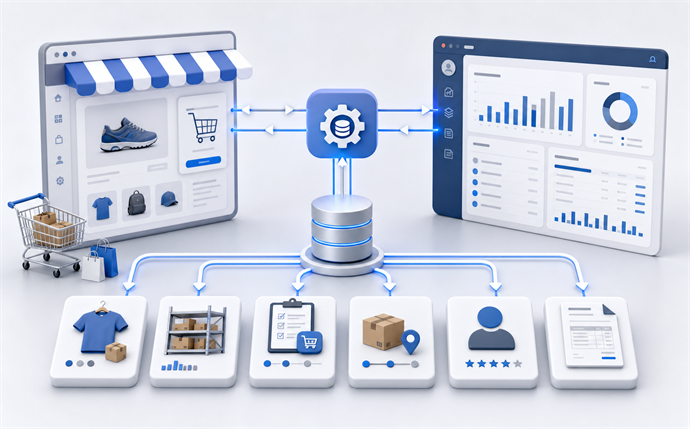
Your ERP, your CRM, your OMS, and your payment gateway all update on their own cycles, and the integrations that keep them in sync with your store break silently when one side upgrades. The retainer covers the custom layer most agencies defer: the connectors, the bespoke modules, and the payment-flow tweaks that don’t fit a packaged product.
- Your ERP, CRM, and OMS sync points get monitored for API-version drift, so a vendor upgrade doesn’t silently break inventory or customer-record flow
- Your payment-gateway integrations get tested against live-order conditions across the platforms we support (Shopify, Magento, BigCommerce, WooCommerce, nopCommerce)
- Your custom features and bespoke modules stay compatible with core platform updates, and don’t break on the first patch after launch
- Your shipping, tax, and third-party vendor APIs get version-pinned, with migration windows scheduled instead of emergency-patched after something fails
- Your custom code gets reviewed for security, performance, and maintainability, not just “does it still return 200”
- Your ecommerce build and the integrations layer run inside one program as our ecommerce website design services, so the team that built the store keeps its custom components compatible as both ends evolve
Integrations stay predictable, and your website maintenance services retainer covers the custom work other agencies defer.
Web Maintenance Built Around Long-Term Growth
Long-term site value comes from the decisions made after launch. Maintenance gives your team a way to monitor performance, evaluate competitor and platform changes, keep content accurate, and decide which improvements belong in the next sprint. That is where maintenance becomes a growth system: the site stays online, but it also keeps improving as users, campaigns, search requirements, and platform constraints change.
Watch how our team supports performance, monitoring, and improvement after launch.

“I view the OuterBox team as an extension of my own marketing team. They allow me the ability to tell them what’s strategically important to us. They push us when they see opportunities, but at the end of the day, they are 100% focused on what we want to do to make our business work and do that to the best of their ability. That has allowed us to grow over the years.” — Brent Noward, Director of Marketing, CORSA Performance
Website Maintenance Services
Get a Web Platform Maintenance Estimate
A good estimate starts with the platform, site size, backlog, risk areas, update frequency, and business goals. Send us your CMS, site URL, biggest maintenance concerns, and timing. Prefer to speak with someone? Call 1-866-647-9218, Monday through Friday, 9 a.m. to 5 p.m. ET.
Services
"*" indicates required fields
Core Platforms We Maintain







Behind Our Website Maintenance Service
Maintenance gets easier to trust when the same team understands development, marketing, performance, and measurement. OuterBox brings in-house developers, programmers, SEO specialists, paid media specialists, content teams, analytics support, and account management into the same operating model.
OuterBox supports maintenance across WordPress, Shopify, Magento, BigCommerce, WooCommerce, and nopCommerce, with platform-specific planning instead of generic CMS support.
Since 2004, OuterBox has worked across web development, SEO, paid media, CRO, content, email, and analytics. The team brings 20+ years in digital marketing, 1,000+ successful client partnerships, 2M+ page-one Google rankings, 300+ USA-based in-house experts, and a 4.8/5 average from 867 reviews on FeaturedCustomers and Clutch.
20+ Years
Digital Marketing Agency
1000+
Successful Client Partnerships
2M+
Page #1 Google Rankings
300+
USA-Based, In-House Experts
Why Choose OuterBox for Web Support Services
Maintenance partners make a difference when small changes touch revenue, SEO, analytics, security, and user experience at the same time. The difference is follow-through. Your maintenance partner should keep the site stable while helping your team decide what deserves attention next.

- In-house developers work near SEO, paid media, analytics, CRO, and content specialists.
- Custom retainers, ala carte support, and hybrid plans match the site and backlog.
- Updates are planned around staging, compatibility, QA, rollback, and reporting.
- Security and compliance readiness are handled as ongoing risk management.
- Performance, Core Web Vitals, technical SEO, and publishing stay connected.
- Account management keeps priorities, recap notes, and next steps visible.
Typical Maintenance Vendor
- Development, marketing, and analytics requests move through separate queues.
- Fixed packages leave unclear boundaries or force work into the wrong tier.
- Updates ship reactively, with limited visibility into what changed.
- Security only becomes visible when a plugin, checkout flow, or form breaks.
- Speed and SEO issues wait for a separate audit or agency handoff.
- Communication depends on ticket status and scattered email threads.

Maintenance should not sit apart from the work that creates demand. That is why the maintenance program often connects with website development services, SEO, CRO, analytics, and content support, so a site gets a practical path from upkeep to improvement instead of a wall between support tickets and growth work.
Talk Through Your Website Maintenance Plan
Send us your site, platform, and maintenance priorities. OuterBox will review the scope, flag the biggest risk areas, and explain the support model that fits your site. Prefer to talk now? Call 1-866-647-9218.
"*" indicates required fields
"*" indicates required fields
Other Web Development Services from OuterBox
Related Services That Support Website Maintenance



Web Maintenance FAQs

What are website maintenance services?
Website maintenance services keep a site secure, updated, functional, fast, and ready for ongoing business needs. The work can include CMS updates, plugin or extension checks, security patches, backups, monitoring, content publishing, technical SEO checks, bug fixes, performance improvements, and reporting.
How much do website maintenance services cost?
Costs depend on platform, site size, update frequency, risk level, and how much custom functionality needs support. Typical OuterBox maintenance budgets range from $100 to $2,500 per month, and the standard development rate is $200 per hour, with possible discounts for volume or recurring work.
Do you offer retainers, ala carte support, or fixed packages?
OuterBox builds custom plans. Some sites need a monthly retainer, some need ala carte support, and some need a hybrid plan with recurring site health work plus project-based improvements. The plan should match the site instead of forcing every request into a rigid package.
What is included in a typical website maintenance plan?
A typical plan can include prioritized CMS updates, plugin or extension checks, security reviews, page speed work, content publishing, technical SEO checks, uptime or form monitoring, backup and restore review, bug fixes, and reporting. Larger redesigns, migrations, new builds, major integrations, and full marketing campaigns should be scoped separately.
How do you handle CMS and plugin updates safely?
Updates should move through staging, compatibility checks, QA, backup awareness, and rollback planning before production release. That matters most for WordPress, WooCommerce, Magento, Shopify, BigCommerce, nopCommerce, and other sites where one extension can affect checkout, forms, analytics, or search visibility.
Can website maintenance help with security and PCI readiness?
Yes, maintenance can support security hygiene, HTTPS configuration, plugin vetting, vulnerability patching, admin access review, backup readiness, and PCI-related checkout awareness. It should not be treated as a blanket compliance guarantee unless that work is separately scoped and documented.
Which platforms does OuterBox maintain?
OuterBox supports WordPress, Shopify, Magento, BigCommerce, WooCommerce, and nopCommerce as core maintenance platforms. The exact plan depends on your CMS, theme, apps, extensions, hosting, integrations, and internal workflow.
Will we have a main point of contact?
Yes. Website maintenance clients have an account manager as the main point of contact and liaison to the development team. The account manager helps prioritize requests, communicate status, and keep the maintenance roadmap visible.
Do you offer emergency support and incident response?
Maintenance can include monitoring, escalation planning, root-cause notes, and response procedures. Exact emergency coverage, hours, and response expectations should be confirmed during scoping so the plan does not promise a service level your site does not need or has not purchased.
When should we stop maintaining and plan a redesign or migration?
Maintenance is the right lane when the site is structurally sound and needs updates, fixes, publishing, monitoring, or steady improvement. A redesign, rebuild, or migration becomes a better conversation when the platform blocks growth, the UX cannot support buyers, integrations keep failing, or maintenance is mostly compensating for an outdated architecture.
Related Articles: Website Maintenance Services

Web Development | 5 min read
In the digital age, the importance of having an eCommerce website for your business cannot be overstated. As more and more consumers are shifting their…

Web Development | 5 min read
Are you ready to grow your business with a more advanced eCommerce platform? A new platform can help you scale your products, better manage your…
Web Development | 5 min read
You need to integrate your ERP into your eCommerce website. With so many different ERP systems and website platforms, it’s difficult to understand how your…