
Web Design Services Built for Search, Speed, and Sales
Your website is usually the first serious proof a buyer sees. It has to be fast, SEO-ready, conversion-focused, clear about your offer, and manageable after launch.
We build web design services around that full job. Strategy, UX, design, development, SEO, content, analytics, integrations, launch, and post-launch support all stay connected. The site works as a growth asset instead of a one-time design project.
"*" indicates required fields
"*" indicates required fields






Website Design and Development Services That Treat Your Site Like Revenue Infrastructure
A new website should not be judged only by how it looks on launch day. It should be judged by what it lets your business do after launch. The site has to rank, convert, support every marketing channel, and give your internal team a CMS they can run without breaking the brand.
That is why design and development have to move together. Wireframes shape the path between a visitor’s question and the conversion that answers it. Visual design turns your brand into a usable system.
Development keeps the site fast, secure, accessible, and easy to maintain. SEO protects crawlability, redirects, structured data, and internal links before rankings are put at risk.
When those pieces are planned separately, the site usually pays for it later. A beautiful template can still be slow. A fast build can still be hard to edit.
A polished redesign can still damage rankings if redirects, metadata, schema, and content structure are handled after the fact.
Those decisions stay in one plan from the start.
What's Included in Our Web Design Services
A serious website project needs more than a homepage concept. Use the web design services section below as a scope checklist. It covers custom web design, UX strategy, front-end development, back-end development, CMS implementation, SEO and Core Web Vitals, CRO, content, integrations, QA, launch, and support. The goal is to show which workstreams belong in the project before your team asks for a quote.
Custom Web Design Built Around Your Brand Instead of a Template
Your website is how every prospect evaluates your brand before deciding whether you are worth a conversation. Template-based web design services flatten that differentiation into whatever the theme shipped with. Your custom web design is one thread of the broader program, and our custom web design work is where the visual system gets built to match how you actually sell.
- Your visual identity reads consistent across every page and every device, with brand rules (logo, color palette, typography, voice) enforced at the component level
- Your page templates fit the content you actually publish (service pages, product lines, resource library, case studies) instead of forcing your material into a theme’s defaults
- Your user flows get validated through clickable wireframes before pixel design starts, so friction gets caught while it is still cheap to fix
- Your internal team publishes new pages without breaking brand consistency, thanks to a design system documented for editors and developers both
- Your investment compounds because every visual decision ties to a named outcome; Forrester’s widely cited estimate puts the return on user-experience spend at $100 for every $1 invested
Your brand shows up the same way to every visitor who will ever evaluate whether you are worth hiring.
UX Strategy and Wireframing for Web Design That Converts
Your visitors decide in seconds whether your site is worth their time. Nielsen Norman Group’s research puts the average page-exit window at 10 to 20 seconds, so UX strategy maps the path from landing page to conversion and puts proof, pricing, and contact in front of buyers when they are ready to act. Your UX strategy rolls up into the same program, and our conversion rate optimization consulting is where wireframe bets get tested against real user behavior instead of best-practice hunches.
- Your wireframes map to how your actual buyers evaluate, because user research and audience segmentation shape layout before any visual design lands
- Your prospects reach the page they need with the fewest decision points possible, through information architecture organized around buyer intent
- Your clickable prototypes let you test flow, copy, and CTA placement before a single production asset gets built
- Your funnel stages (awareness, evaluation, decision) each carry the content, proof, and CTAs they need to move the visitor forward
- Your accessibility foundations get set during wireframing (structure, navigation patterns, content hierarchy) so the build reaches WCAG 2.1 AA conformance cleanly instead of through post-launch retrofit
Your visitors reach the page that converts them through a layout built around how they actually evaluate, not how the site owner wishes they would.
Front-end Web Development for Sites That Perform on Every Device
Your front-end is what visitors actually experience. Speed, responsiveness, and interactivity decide whether they stay or bounce, and front-end development translates your design into HTML, CSS, and JavaScript that load fast on a mid-range Android phone and scale cleanly up to a 4K desktop. Your front-end is part of the same program, and our eCommerce web design work is where interaction patterns get pressure-tested against real shopping traffic before they ship to your site.
- Your pages load with semantic HTML that screen readers, search crawlers, and future developers can parse without guessing
- Your CSS stays maintainable as the site grows; design tokens and component-scoped styles keep specificity from running away
- Your JavaScript runs lean, with heavy libraries loading only on pages that actually need them, so the homepage does not pay for the checkout script
- Your responsive breakpoints get tested on the device matrix your analytics show your audience actually uses; StatCounter’s March 2026 data puts mobile at 55.94% of global web traffic, so the small-screen experience is the majority case
- Your interactive components (tabs, accordions, filters, mega-menus) work for keyboard navigation and touch targets from the start
Your mobile experience holds its Core Web Vitals thresholds on the same phones and carriers your buyers actually use.
Back-end Web Development Services Built for Reliability and Scale
Your back-end runs everything the visitor never sees: database queries, business logic, the API calls that populate each page. Back-end architecture decides whether your site holds up under a Black Friday spike, a product launch email, or a link from a major publication. Your back-end sits underneath every other channel your site runs on, and our web development maintenance work keeps the stack patched and monitored so security does not degrade after launch.
- Your server architecture is sized for the traffic your business actually expects rather than whatever default preset a cheap host ships with
- Your database schema fits the content model you actually have (product catalogs, resource libraries, user accounts, subscription tiers), so queries stay fast as the data grows
- Your dynamic pages serve quickly through caching layers that stay fresh where freshness matters: inventory, pricing, personalization
- Your CRM, ERP, and marketing platforms survive future updates because API endpoints are documented and version-controlled
- Your site stays hardened against common attack patterns (SQL injection, XSS, credential stuffing) because security is part of the build, not a retrofit; Sucuri’s 2023 Hacked Website Report found 39.1% of compromised CMS installations were running outdated software at the time of infection
Your data survives traffic spikes, integrations, and security pressure that would take a cheaper build offline.
CMS Implementation That Fits Your Web Design and Your Team
Your content management system shapes what your marketing team can publish independently and what requires an engineering ticket. Web design services built on the wrong CMS turn into a two-year headache where every page update blocks on someone who does not work there anymore. Your CMS choice is one thread of the broader program, and our B2B web design work is where platform architecture gets mapped to complex content models that touch multiple audiences.
- Your WordPress build ships with custom theme development, plugin governance, and editor workflows designed for non-technical publishers; W3Techs’ April 2026 figure shows WordPress powers 42.2% of all websites
- Your Shopify, BigCommerce, or Magento implementation uses platform-native commerce features where that matters more than design flexibility
- Your Drupal deployment handles complex permissions, multi-site architectures, and regulatory compliance without bolted-on modules creating long-term fragility
- Your headless CMS stack (Contentful, Sanity, Strapi) syndicates content across web, mobile apps, and partner channels through a single source of truth
- Your editors keep publishing through staff turnover because training and documentation are built around your workflow, not a generic CMS manual
Your editors publish new pages without opening a support ticket or waiting on a developer sprint.
Core Web Vitals and On-Page SEO Engineered From the First Line of Code
Your rankings depend on signals Google measures at the code level: crawlability, page experience, internal linking, structured data. A web design company that treats SEO as a post-launch retrofit ships sites that lose ranking to competitors whose developers built SEO in from the start. Your technical SEO is how the whole program stays accountable, and our technical SEO work makes sure the code decisions a developer made three years ago are still paying rankings today.
- Your Core Web Vitals meet Google’s documented thresholds (LCP under 2.5 seconds, INP under 200 milliseconds, CLS below 0.1) on every template before launch
- Your crawlers see a clean site because semantic HTML, heading hierarchy, and internal linking are built into the templates, not patched over with schema as a crutch
- Your pages qualify for rich results through JSON-LD schema (Organization, Product, Service, FAQ, Breadcrumb) deployed at the template level
- Your existing ranking equity survives the migration because canonical tags and redirect maps get mapped before launch, well ahead of Google noticing any 404s
- Your crawl budget points at the commercial URLs that actually drive pipeline, thanks to indexation controls and an XML sitemap scoped to what matters
Your rankings compound for the commercial terms that produce pipeline rather than drifting toward vanity keywords.
Conversion Rate Optimization Engineered Into the Design From Day One
Your conversion rate is a design decision before it is a testing exercise. CTAs, form length, trust signals, and page hierarchy get set during wireframing rather than fixed later by rearranging buttons in an A/B test. Your conversion rate optimization multiplies whatever the rest of the program is doing, and our CRO work runs the tests against real shopping behavior instead of best-practice hunches.
- Your primary CTAs land at natural decision points (after proof, ahead of context) and get phrased as the outcome the visitor wants
- Your forms carry the field count that matches lead value: short forms for top-of-funnel, deeper qualification for demo and sales requests
- Your trust signals (client logos, review stars, security badges, certifications) appear where skepticism surfaces rather than stacked into a generic banner
- Your checkout flow respects the stakes; Baymard Institute’s 50-study average puts online cart abandonment at 70.22%, so every friction point either earns its place or gets removed
- Your A/B testing infrastructure turns every winning design decision into a repeatable pattern across the site rather than a one-off lift
Your revenue per visitor improves because CTAs, forms, and trust signals were placed where buyers actually make decisions.
Website Design Copy That Earns Rankings and Converts Readers
Your copy does the work that design alone cannot do. Website design services that ship with placeholder content force your marketing team to retrofit the site’s voice months later, usually with whoever has the spare hour that week. Your copy feeds the same program, and our SEO work builds the topical depth that lets a single page rank for dozens of commercial variations instead of just one.
- Your service and product pages earn rankings for the terms that convert, because copywriting ties to keyword research and buyer journey from the outline stage
- Your headline hierarchy answers the visitor’s question on the first line; a longstanding Nielsen Norman Group finding holds that users read at most 28% of the words on an average visit (20% is more likely), so the opening sentence has to earn the rest
- Your proof content (case studies, testimonials, specific client outcomes) reads from the buyer’s angle, not the service provider’s
- Your voice stays consistent through staff turnover because guidelines are documented for every future writer
- Your pages pass readability, scannability, and structural SEO (headings, bullet density, keyword placement) before going live
Your copy earns rankings for dozens of commercial variations instead of relying on the one keyword that happened to be in the title.
Integrations That Connect Your Website to the Rest of Your Business
Your website rarely operates alone. It writes to your CRM, reads from your inventory system, triggers your marketing automation, and pulls data from analytics platforms; when those integrations get stapled on after launch, the copy-paste workarounds cost your team hours every week. Your integrations are one thread of the broader program, and our AI development services ship the custom API and system-integration logic that off-the-shelf connectors cannot handle.
- Your CRM (Salesforce, HubSpot, Microsoft Dynamics) syncs form submissions, lead scoring, and engagement history in both directions without manual reconciliation
- Your marketing automation (HubSpot, Marketo, Pardot, Klaviyo) triggers the right nurture sequence because lead behavior flows in at the page level
- Your payment and subscription platforms (Stripe, Recurly, PayPal) carry documented error handling so failed transactions never silently drop revenue
- Your ERP, inventory, and order management systems keep pricing and availability current on product pages without a manual export-import every morning; per Okta’s 2025 Businesses at Work report, the average organization now runs over 100 SaaS applications, so those integration points are multiplying
- Your future integrations (and any future replatforming) build against a known contract because API endpoints are documented and version-controlled
Your systems talk to each other without the copy-paste workarounds that cost your team hours every week.
Launch-Ready QA and Compliance Before the Site Goes Public
Your launch succeeds or fails on the testing that happens before traffic hits. QA runs against the browsers, devices, screen readers, and geographies your audience actually uses, and compliance gets verified (ADA, WCAG, privacy regulations) so the site does not ship with known legal or accessibility liabilities. Your launch sits on top of every other channel the program ships, and our web development work runs the final testing pass with the rollback plan documented rather than assumed.
- Your testing matrix is built from your live analytics rather than a generic template of popular devices
- Your accessibility clears WCAG 2.1 AA (color contrast, keyboard navigation, screen-reader compatibility, alt text); WebAIM’s 2026 Million report found 95.9% of home pages have detectable WCAG failures
- Your infrastructure holds under projected traffic because performance gets load-tested before launch, long before a press mention sends ten times the usual volume
- Your security posture is verified (SSL, header hardening, authentication flows) before the site is exposed publicly
- Your go-live runs on a checklist with a tested rollback plan, so a production problem is reversible instead of an emergency
Your launch goes live with every WCAG, browser, and performance edge case caught in testing rather than surfacing as a customer complaint.
Support and Growth Work From Your Web Design Agency After Launch
Your web design services investment compounds when the site keeps improving after launch rather than drifting toward obsolescence. Ongoing support handles CMS updates, security patches, and content iteration; growth work layers on analytics review, CRO testing, and content expansion that turn an already-converting site into one that performs better every quarter. Your support and growth plan is how the whole program stays accountable, and our analytics work builds the reporting that shows which tests and content bets are actually moving revenue.
- Your CMS, plugins, and dependencies stay current so security patches ship before vulnerabilities get exploited; IBM’s 2024 Cost of a Data Breach Report puts the global average breach cost at $4.88 million
- Your analytics review surfaces the pages leaking traffic, the search terms slipping, and the conversion paths that deserve testing
- Your content calendar maps to search intent and business priorities instead of a blog quota disconnected from pipeline
- Your CRO tests concentrate on the revenue-weighted pages that can actually move the number, not spread thin across every page equally
- Your roadmap evolves with your product, audience, and commercial priorities, with OuterBox operating as an extension of your team across 20+ years of engagements
Your growth keeps compounding after launch because the site evolves with your product, your audience, and your commercial priorities.
Recent Client Results
Recent Web Design Projects
A web design portfolio is most useful when it shows what changed for the business after launch. These three OuterBox projects pair a specific site problem with the website design and development, content, and search decisions behind it. The figures are historical results from each client’s combined engagement. They are not forecasts for a future project.
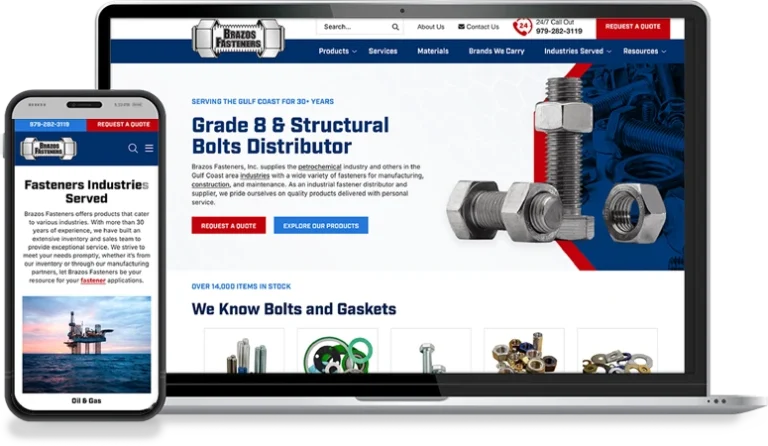
Brazos Fasteners
Industrial distribution | Website redesign, content, SEO, and analytics
Brazos Fasteners has served the Gulf Coast for more than 30 years, distributing and supplying various fasteners to petrochemical, manufacturing, construction, and maintenance buyers. The company entered the engagement with a dated website, limited content, and weak organic visibility. The redesigned site modernized its visual identity, organized technical products with clearer navigation, and expanded product and industry content.
Conversions for Brazos Fasteners increased 442% during the first 90 days after launch. Total sessions increased 93% when comparing 2023 with 2024. Those outcomes came from the combined website design, development, content, SEO, and analytics engagement.
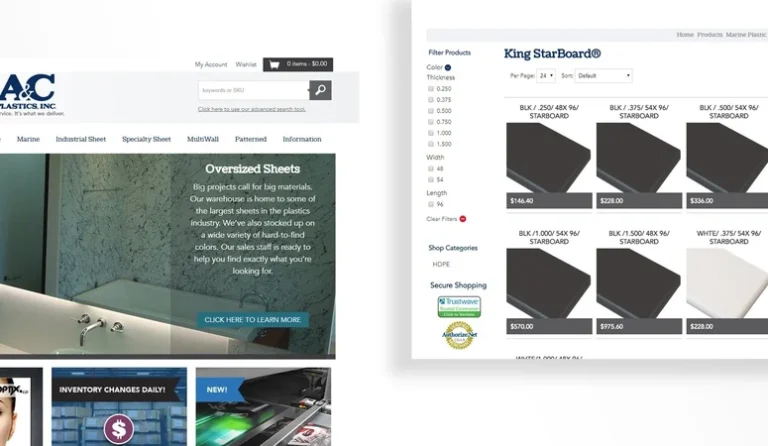
A&C Plastics
Plastic industry | Custom eCommerce website and search program
A&C Plastics, headquartered in Houston, Texas, has operated in the plastic industry for more than 40 years and entered the engagement with an outdated, unoptimized website. Its priorities included streamlining business processes and making eCommerce ordering more convenient. The custom eCommerce build included AJAX product filters for thickness, width, color, and other attributes, interactive team pages, and downloadable content, while the combined engagement included search marketing, optimized site structure, and ongoing content strategy.
Across the combined website and search engagement, organic search traffic for A&C Plastics increased 1,225% and organic online leads increased 450%.

Boat and RV Accessories
eCommerce retail | Website redesign, migration, UX, and search
Boat and RV Accessories needed to move from a legacy eCommerce platform with an extensive database of product, customer, and order records. The legacy platform also limited product browsing and checkout. The new build used a custom import process, thousands of 301 redirects, AJAX filters for products and technical specifications, Smart Search with dynamic results and suggestions, and a redesigned checkout.
Across the combined redesign and search engagement, Boat and RV Accessories recorded 196% growth in organic revenue, 244% growth in organic search traffic, and a 39% increase in conversion rate.
See how this work has played out for the businesses we've partnered with.
See Our Web Design ResultsWhat Effective Web Design Services Need to Get Right

-
A clear path to the answer. Visitors need to find the proof, product, service, form, or checkout step they came for.
-
Crawlable, fast templates. Search visibility needs clean URLs, schema, internal links, indexation rules, and page speed that meet Core Web Vitals thresholds.
-
Mobile-first experience. Google uses the mobile version of site content for indexing and ranking.
-
An editor-friendly CMS. Reusable components, structured fields, and page templates keep publishing fast without creating design drift.
-
Sales and marketing instrumentation. Forms, analytics, call tracking, CRM handoffs, and conversion events that show which pages create qualified demand.
OuterBox Web Design Process
How Web Design & Development Services Bring a Site to Life
Hard decisions happen early so the build feels organized. Discovery becomes plan. Plan becomes design. Design becomes site. Launch becomes a system you can grow on top of.
Discovery & Strategy
Business model, audience, search demand, performance, integrations, and launch risks become a shared plan.
Design
Wireframes, visual concepts, and reusable components reviewed in stages so nothing surprises the team at launch.
Build
Front-end, back-end, CMS, SEO, integrations, accessibility, and analytics implemented against the approved plan.
Launch & Growth
QA, redirects, analytics validation, and post-launch SEO, CRO, and maintenance keep the site improving.
See How We Build High-Performing Websites
OuterBox treats every website as an investment, not a one-time cost. SEO is built into every project from day one, the UX, content, and development teams ship together, and the biggest difference is what happens after launch. The site is set up to keep performing and getting found online, not just look good on launch day.
Our Personalized Approach to Building High-Performing Websites

“OuterBox has brought tremendous value to our business. The combination of the website, search marketing and eCommerce capabilities has changed who we are.” – Fanuc World
Get a Free Website Design Estimate
Get a Free Website Design Estimate
Tell us about your goals, timeline, and must-have features. We’ll follow up within 24 hours (Mon–Fri). Prefer to talk now? Call 1-866-647-9218.
Services
"*" indicates required fields
From Start-Ups to Fortune 500 Companies Our Clients Are Succeeding Online













Your Web Design and Development Partner
OuterBox is a website design company and full-service digital marketing agency founded in 2004. Our in-house team brings strategy, UX, design, development, SEO, paid media, CRO, content, analytics, and support into the same plan.
That matters because most website problems cross disciplines. A redesign can become an SEO problem. A CMS decision can become a content problem.
A form decision can become a sales-routing problem. A slow template can become a paid-media efficiency problem. OuterBox keeps those decisions connected so the site works across the whole marketing system.
Proof points include 20+ years in business, 1000+ successful client partnerships, 2M+ page-one Google rankings, and a 4.8/5 average rating from 867 reviews.
20+ Years
Digital Marketing Agency
1000+
Successful Client Partnerships
2M+
Page #1 Google Rankings
300+
USA-Based, In-House Experts
Why Choose OuterBox as Your Web Design Company
A side-by-side look at what changes when web design, SEO, CRO, and CMS work come from one accountable team.

- Strategy: Site plan built around buyer behavior, search demand, conversion paths, platform fit, and internal workflow.
- Team: Designers, developers, SEOs, CRO specialists, analysts, content strategists, and project managers working from one plan.
- SEO: Crawlability, redirects, metadata, schema, internal links, Core Web Vitals, and launch checks built into the project.
- CMS: Editor workflows, structured fields, reusable components, and documentation shaped around the way your team publishes.
- eCommerce: Product discovery, checkout, catalog structure, platform constraints, integrations, and CRO planned together.
- Launch: QA, redirect checks, analytics validation, form testing, accessibility review, and rollback planning before go-live.
- Growth: Post-launch SEO, CRO, analytics, content, paid media, and maintenance can continue with the same team.
Typical design-only provider
- Strategy: Visual direction first, with business requirements often handled after approval.
- Team: A smaller creative or freelance team may need separate vendors for SEO, content, analytics, or support.
- SEO: May be addressed after launch, when rankings can already be affected.
- CMS: Theme defaults or page-builder freedom can drift quickly after launch.
- eCommerce: Storefront visuals may ship without enough attention to merchandising, SEO, or back-office systems.
- Launch: Checklists often center on visual review and basic browser testing.
- Growth: Project handoff may leave your team to coordinate the next phase.
Get an Estimate for Website Design and Development Services
Tell us what your current site needs to solve. That may be more qualified leads, a better eCommerce experience, a cleaner CMS, stronger SEO, faster performance, a safer migration, or a full brand and UX rebuild. We will review your goals, ask the right scoping questions, and recommend the web design services path that fits your business, timeline, platform, and budget. Prefer to talk now? Call 1-866-647-9218 between 9 and 5 EST. Sound good? Let's get started by reviewing your website and what the new site needs to accomplish.
"*" indicates required fields
"*" indicates required fields
Other Web Design Paths from OuterBox
Related Services That Support Your Web Design Project


Web Design Services FAQs
What is included in web design services?
Most web design services should include discovery, sitemap planning, UX strategy, wireframes, visual design, front-end development, CMS setup, and content support. SEO foundations, analytics setup, QA, launch support, and training should also be planned before launch. More complex projects may add eCommerce work, CRM or ERP integrations, migration planning, custom features, accessibility work, and post-launch support.
How much do web design services cost?
Cost depends on scope, page count, content, CMS, integrations, eCommerce needs, migration risk, custom functionality, and timeline. Many OuterBox website projects fall between $10,000 and $50,000. Larger custom builds or complex eCommerce and integration projects can exceed $100,000.
How long does it take to design and build a website?
Many projects take 10 to 20 weeks from discovery through launch. Focused WordPress or lead-generation sites may move faster. Large eCommerce, corporate, or integration-heavy projects usually need more time for requirements, design review, data migration, QA, and launch planning.
Does web design include SEO?
It should. SEO affects sitemap structure, template design, URL rules, internal links, metadata, schema, page speed, content hierarchy, redirects, and launch validation. Our process includes SEO thinking from the beginning so rankings are protected instead of repaired after launch.
Which platforms does OuterBox work with?
Platform support includes WordPress, Shopify, BigCommerce, Magento, WooCommerce, NopCommerce, and custom development paths. The right platform depends on your content workflow, catalog complexity, integration needs, internal team, budget, and long-term ownership goals.
Can you redesign our current website without losing rankings?
Yes, but it has to be planned carefully. The process should include URL inventory, redirect mapping, metadata preservation, content decisions, structured data review, internal links, analytics validation, Search Console checks, and post-launch monitoring. Redesign risk rises when those steps are left until the end.
Will our team be able to manage the site after launch?
Yes. A good CMS setup should give your editors reusable components, structured fields, documentation, and training. The goal is to let your team publish normal updates without a developer while still protecting layout, brand consistency, speed, and SEO structure.
What makes a website design convert better?
Conversion improves when the site makes the next step obvious and credible. That means clear messaging, fast pages, useful proof, logical navigation, well-placed CTAs, appropriate form length, mobile-friendly layouts, accessible interactions, and analytics that show where visitors hesitate.
Do you support websites after launch?
Yes. Post-launch support can include maintenance, SEO, CRO, analytics, content, paid media, and future development. That support matters because rankings, conversion paths, security risks, content needs, and platform requirements continue changing after the launch date.
Related Articles: Web Design Services

Digital Marketing, Web Design, Web Development | 9 min read
Engineers are a discerning lot. They research specifications before talking to anyone, weigh all the evidence, and cringe at overt salesyness. Put differently, if the…

Digital Marketing, Web Design, Web Development | 9 min read
For a manufacturing firm, successful digital marketing hinges on the strength of your website. It’s not just whether it can attract traffic (though that’s still…

Web Design | 5 min read
Just like the latest technology advancements, website design is constantly evolving. What was cutting edge just a few years ago is quickly outdated because of…