
Healthcare Digital Marketing Agency For Patient Growth
A healthcare digital marketing agency cannot rely on one campaign, one landing page, or one dashboard to drive patient growth. Patients, caregivers, members, trial candidates, and health consumers all move through different paths before they trust a brand enough to call, book, enroll, or ask for help. OuterBox builds healthcare marketing services around that reality, connecting paid media, SEO, content, CRO, web design, analytics, and reputation work into one program.
"*" indicates required fields
"*" indicates required fields






Healthcare Marketing Has To Match Patient Choice, Policy Risk, And Revenue
Healthcare marketing carries pressure most categories never face. Search intent can shift from symptom research to urgent care in a single query. Ad platforms limit what can be targeted, claimed, or remarketed. Intake forms, schedulers, call paths, and analytics tools can create risk if nobody defines where sensitive information belongs.
A healthcare digital marketing agency has to plan for those constraints before spend moves. The work should help patients find the right next step, help internal teams understand which channels are producing qualified demand, and help the program stay inside the review process your organization already uses.
That is the difference between channel activity and a real healthcare growth program. The channel list matters, but the operating system around the channels matters more.
Healthcare Marketing Services That Work As One Program
The completed healthcare tabs module below is the source of record for channel-level detail on this page. It covers paid search, paid social and programmatic, healthcare SEO, conversion rate optimization, content marketing, web design and UX, HIPAA-aware ad and tracking governance, analytics, reporting, reputation, and reviews.
Those services work best when they are planned together. A paid search campaign can expose a weak landing page. A strong healthcare SEO plan can fail if provider pages, location profiles, and appointment paths are not connected. A reporting dashboard can look clean while still missing the difference between low-value form fills and real patient or customer demand.
OuterBox keeps those pieces connected. Your strategy should not depend on one team buying traffic, another team publishing content, and a third team discovering months later that the data never answered the business question.
What's Included in Our Healthcare Marketing Services
Full-service programs built for patient acquisition, clinical trial enrollment, brand growth, and HIPAA-compliant campaign management.

Paid search campaigns built around healthcare demand and policy risk
Healthcare search demand rarely arrives in one clean bucket. A patient comparing symptoms, a caregiver searching for a specialist, and a trial candidate checking eligibility all need different ad paths. For teams evaluating a healthcare marketing agency, paid search should explain how service-line demand, geography, and policy risk fit together before budget moves into the account.
- Your account structure should separate brand, symptom, procedure, provider, location, and urgent-intent queries so spend does not blur across very different patient needs.
- Your ad copy and landing pages should be reviewed against Google’s Healthcare and Medicines policy before restricted-category problems reach the account.
- Your scheduler, call, and form paths should match the ad promise, with insurance prompts and appointment options placed where patients expect them.
- Your PPC management reporting should show which service lines create booked appointments rather than stopping at clicks and leads.
Paid search becomes easier to manage when patient intent, policy risk, and appointment value are visible in the same plan.
Paid social reach for health consumers inside platform rules
Health consumers often meet the brand before they search. Meta, YouTube, TikTok, and programmatic placements can shape that early awareness, but healthcare creative has to work inside platform rules that limit targeting, claims, and remarketing choices.
Paid social advertising should make the message carry more of the segmentation load. A DTC wellness brand may need product education with careful claim language. A health system may need service-line awareness that points people toward locations, providers, or appointment paths. A clinical trial recruiter may need eligibility framing that earns attention without overpromising enrollment outcomes.
Useful social programs also manage fatigue. Frequency caps, consented audience lists, creative rotation, and landing-page feedback keep the channel from becoming a disconnected awareness spend.
Healthcare SEO for symptom, service-line, and provider demand
Healthcare SEO has to map how patients research before they are ready to book. Condition questions, procedure comparisons, provider searches, insurance terms, and location modifiers all belong in different parts of the site. The parent program should support that map while the dedicated healthcare SEO services page carries the deeper SEO conversation.
- Condition and procedure pages should answer different query classes, with review workflows and source dates visible enough to support trust.
- Provider profiles need consistent specialties, credentials, locations, accepted insurance context, and appointment paths.
- Local pages should avoid thin duplication while still helping patients compare offices, services, and availability.
- Technical SEO should protect crawl paths, canonicals, structured data, and service-line growth as the site changes.
Organic growth gets stronger when patient intent decides the page structure instead of forcing every search into one generic healthcare page.
CRO for schedulers, intake forms, and appointment paths
Healthcare conversion problems usually hide in the handoff between interest and action. A patient may click the call button, open the scheduler, reach the insurance question, or abandon an intake form because the next step feels too slow or uncertain. Conversion rate optimization should isolate that moment instead of treating the whole page as the problem.
- Scheduler analysis should separate date availability, provider choice, specialty filters, location selection, and mobile usability.
- Intake-form reviews should remove fields the team does not need online and add conditional logic where the path genuinely differs.
- Landing-page tests should compare trust cues, service-line proof, call placement, form length, and appointment messaging.
- Reporting should distinguish form submissions, calls, scheduler opens, appointment confirmations, and qualified inquiries.
Bookings improve when testing focuses on the exact step where patients hesitate, stall, or choose another provider.
Content systems for conditions, procedures, and patient confidence
Patients read healthcare content differently because the decision carries risk. Service-line pages, condition articles, FAQs, provider bios, and recovery resources need enough medical context to be useful and enough governance to stay accurate. Strong content marketing gives that information a structure patients and search engines can both understand.
- Clinical claims should move through the client’s review process, with reviewer names, credentials, or source ownership clear where the page needs them.
- Condition and procedure content should explain symptoms, candidacy, preparation, recovery, risks, and next steps without turning into medical advice from the agency.
- Provider bios should support E-E-A-T with credentials, specialties, locations, accepted patient paths, and useful internal links.
- Refresh ownership should be defined for guideline changes, service-line updates, and stale facts before pages quietly age out.
Content earns more trust when search intent, clinical review, and patient questions are managed as one publishing system.
Healthcare web design that supports access, speed, and trust
Healthcare websites have to serve patients, caregivers, providers, recruiters, and internal teams at the same time. Navigation has to make service lines, locations, provider directories, insurance context, and appointment paths easy to find. The design also has to leave room for the operational details that make medical digital marketing services work after launch.
Website design services for healthcare should account for HIPAA-aware forms, portal or EHR handoffs, WCAG 2.1 AA accessibility goals, Core Web Vitals, and mobile scheduler behavior before templates are locked. Those requirements affect content models, component choices, form fields, tracking, and QA.
The site becomes a stronger marketing asset when patients can reach the right next step and internal teams can update service-line information without creating new risk.
Healthcare marketing governance for restricted ads and privacy-safe tracking
Healthcare marketing programs need guardrails because ad platforms, privacy rules, and internal approvals all shape what can safely launch. This tab should not promise legal compliance. It should show how the marketing program reduces preventable risk through review workflows, vendor boundaries, and policy-aware execution.
- Google Ads campaigns should be checked against Healthcare and Medicines policy for keywords, ad copy, landing pages, and restricted claims.
- Meta and programmatic campaigns should account for health-category limits, audience restrictions, creative claims, and retargeting exclusions.
- Forms, pixels, call tracking, and analytics should define where PHI could appear and where a no-PHI handoff is required.
- Consent language, BAA boundaries, and approval steps should be documented before campaigns, landing pages, or dashboards go live.
- Google Ads consulting can support the restricted-category side of the program when ad policy questions affect growth.
Governance keeps healthcare campaigns moving because teams know which risks need review before launch.
Healthcare analytics from first click to scheduled appointment
Healthcare reporting breaks down when the funnel crosses ads, landing pages, calls, forms, schedulers, CRM records, and privacy boundaries. Analytics services should help the team see what happened without sending sensitive patient details into tools that should never receive them.
The useful view starts with events the business can act on: call clicks, form starts, form completions, scheduler opens, appointment confirmations, service-line selections, and location choices. GA4, call tracking, form data, CRM fields, and dashboard reporting need naming rules so marketers, operators, and leadership read the same story.
Reporting should also separate health-system rollups from clinic, provider, campaign, and service-line views. Better data helps leaders decide where budget, landing-page work, content, or intake operations need attention next.
Reputation management for provider choice and local trust
Reviews and directory data influence patient choice before many visitors reach the website. Google Business Profile, Healthgrades, Vitals, Zocdoc, Yelp, and provider directories need consistent information, response rules, and monitoring. Healthcare marketing services protect trust when those surfaces are managed as part of the acquisition program.
- Location profiles should keep hours, phone numbers, categories, photos, appointment links, and service details current.
- Provider listings should align names, credentials, specialties, locations, insurance context, and availability across major platforms.
- Review responses should acknowledge feedback and route conversations offline without confirming a patient relationship in public.
- Review generation should avoid gating, incentives, or pressure tactics that create FTC, platform, or trust problems.
- Local SEO should connect directory accuracy, local visibility, and patient confidence across each market.
Reputation work performs better when listings, reviews, local search, and patient trust are managed together.
Digital Marketing For Healthcare That Puts Patient Growth First
Watch how OuterBox approaches healthcare marketing with a performance-first methodology built on accountability and real results. The team walks through their collaborative process, transparent reporting, and the strategies that drive patient acquisition at scale. For healthcare organizations, this means a marketing partner aligned with your growth goals, not vanity metrics.
How OuterBox builds performance marketing partnerships focused on measurable healthcare growth
How Healthcare SEO Supports The Broader Growth Program
Healthcare SEO is one part of the larger growth system. Condition pages, service-line pages, provider bios, FAQs, location pages, and patient education content all have to support search visibility without drifting into unsupported medical advice.
OuterBox handles the search, structure, technical, and editorial side of that work while the rest of the program keeps the next step clear: paid media can test demand, CRO can improve appointment paths, and analytics can show whether the content is producing qualified action. Your clinical, legal, or compliance reviewers stay responsible for medical accuracy and approved claims.
For deeper organic search strategy, the dedicated healthcare SEO services page covers the SEO-specific path. This page keeps the broader digital marketing program in view, because SEO performs better when content, paid media, CRO, local visibility, and analytics are not planned in separate rooms.
Website Experience And Trust Signals Should Work Together
Healthcare websites have to support many audiences at once: patients, caregivers, providers, recruiters, internal teams, and leadership. The navigation has to make service lines, locations, provider directories, insurance context, forms, phone numbers, and appointment paths easier to use on the devices people actually reach for.
Website design services for healthcare should account for accessibility, mobile speed, content governance, form behavior, and the systems your internal team needs to maintain after launch. The site should feel easier for patients and more manageable for the people responsible for keeping information current.
Reputation and local trust matter before many visitors reach the site. Google Business Profile, provider directories, reviews, location details, hours, photos, and response workflows all affect patient confidence. OuterBox connects local SEO and reputation work to the broader acquisition plan so trust signals are not treated as an afterthought.
Certified Partnerships & Platforms







Proven Healthcare Search Work At Health-System Scale
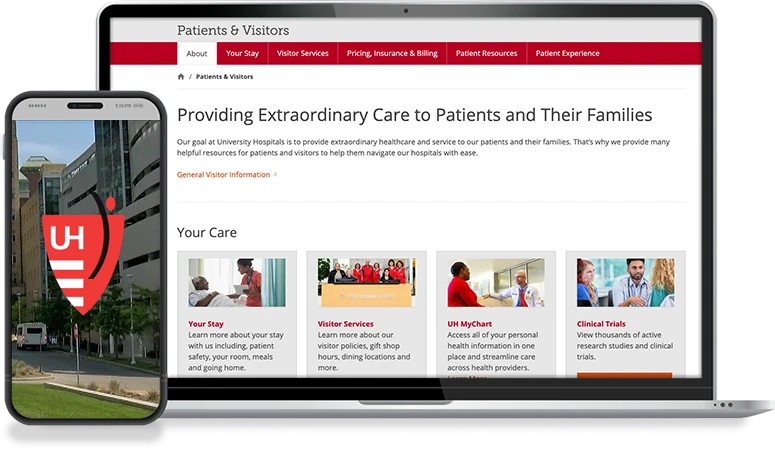
University Hospitals came to OuterBox during a major site redesign with a large internal team, service-line directors, dynamically driven content, and more than 28,000 indexed pages. OuterBox supported the SEO side of the launch and continued helping the team with technical and content optimization after the new site went live.
The engagement produced a 340% increase in organic traffic and a 321% increase in keyword rankings. Those results are healthcare SEO outcomes, not a promise that every organization will see the same result. They show that OuterBox has supported healthcare search work at a scale where governance, technical execution, content quality, and internal coordination all matter.

Healthcare brands that combine paid search with CRO testing often see 2x or more improvement in cost-per-patient-acquisition compared to running ads without conversion optimization. Learn more >

Why Healthcare Organizations Choose OuterBox
OuterBox has worked in digital marketing since 2004, with 300+ in-house experts across SEO, paid media, content, CRO, analytics, web design, and development. We have supported more than 1,000 client partnerships and earned more than 2 million page-one Google rankings across industries.
Those numbers matter because healthcare marketing rarely fails in only one place. A paid media issue may actually be a landing-page issue. An SEO issue may be a content-governance issue. A conversion issue may be a scheduler, phone, form, or analytics issue. A reporting issue may be a naming problem that started months earlier.
OuterBox's healthcare work brings those needs into one accountable program, giving buyers a clearer alternative to healthcare marketing firms that manage SEO, paid media, CRO, and analytics in separate lanes. OuterBox gives your team a partner that can diagnose across those boundaries and still execute the work. We meet you where you are, document the plan, and stay accountable for what happens after launch.
20+ Years
Digital Marketing Agency
1000+
Successful Client Partnerships
2M+
Page #1 Google Rankings
300+
USA-Based, In-House Experts
Healthcare Marketing Services
Ready To Talk With A Healthcare Digital Marketing Agency?
We’ll get back to you within 24 hours, Monday–Friday. Prefer to talk now? Call 1-866-647-9218 (9–5 EST).
Services
"*" indicates required fields
Get A Healthcare Marketing Assessment
Send us your website, priority services, locations, audiences, and current marketing concerns. OuterBox can review your search visibility, paid media structure, content, local profiles, landing pages, appointment paths, analytics setup, and reporting, then outline where a healthcare marketing program can make the biggest difference. Call (866) 647-9218 or send your site and the questions your team is trying to answer, and a real person will help route the conversation.
"*" indicates required fields
"*" indicates required fields
Related Services
Related Healthcare Marketing Services





Healthcare Digital Marketing FAQs

What does a healthcare digital marketing agency do?
A healthcare digital marketing agency helps healthcare organizations attract and convert qualified patients, members, customers, or inquiries through SEO, paid media, content, web design, CRO, analytics, local visibility, and reputation work. The work should account for patient trust, healthcare review processes, and ad platform restrictions.
What types of healthcare organizations does OuterBox support?
OuterBox can support hospitals, health systems, multi-location provider groups, specialty clinics, digital health brands, wellness brands, medical product companies, and regulated health organizations. The right program depends on your service lines, locations, audiences, compliance process, budget, and measurement goals.
How is healthcare marketing different from general digital marketing?
Healthcare marketing adds YMYL content expectations, HIPAA and PHI risk, ad platform restrictions, local profile complexity, review-response sensitivity, provider and location architecture, and measurement tied to appointment or inquiry quality. A generic channel plan usually misses at least one of those constraints.
Does OuterBox provide HIPAA compliance or legal advice?
No. OuterBox works inside your existing compliance program. We can help structure analytics, tracking, content, and campaign recommendations around PHI risk, BAA scope, and approved workflows, but your legal or compliance team makes final decisions.
How should healthcare marketing results be measured?
Rankings, impressions, clicks, and traffic are useful, but healthcare reporting should also look at calls, appointment requests, form submissions, service-line demand, location performance, online scheduling activity, paid media efficiency, and lead quality where compliant data access allows it.
How long does healthcare digital marketing take to work?
Timing depends on your channels, market, site condition, content depth, approval process, competition, and budget. Paid media can create faster visibility when approved campaigns are ready. SEO, content, local visibility, and CRO usually compound over sustained work.
Related Articles: Healthcare Marketing Services

Digital Marketing | 8 min read
Digital marketing gets more complicated for health and wellness brands every year, particularly on social media. Each platform has its own distinct policy restrictions for…

Digital Marketing | 11 min read
Senior living lead generation playbook for better senior living leads, stronger follow-up, more tours, and clearer move-in reporting.

AI, Digital Marketing | 8 min read
From OuterBox leaders, learn how AI search, earned authority, and connected marketing can educate prospects before they click and help turn search visibility into better…