By: Matt Prater

Ask a marketing director which Google Ads campaign produced last quarter’s biggest contract, and they’ll likely pause for a bit before taking an educated guess. It’s not because they are unaware of large opportunities generated from marketing, but because they can’t see the connection between marketing sources and earned revenue together in their data platforms.
The issue isn’t their skills. It’s with their data.
Google Ads tracks the click. Your CRM tracks the closed deal. But since nothing links them, bidding focuses on volume, and the campaign that actually brought in the revenue doesn’t get recognized.
Enter LOOP Analytics, the lead tracking platform OuterBox built in-house and has run for clients since 2017. LOOP now plugs into Google Ads on one side and CRMs like HubSpot and Salesforce on the other. Bidding gets smarter. Revenue gets credited to ad spend where applicable. Best of all, it sits in the same report.
Matt Prater, EVP of Innovation, and Jordan Sen, Group Director of Integrated Strategy, walk through how LOOP’s new integrations work in under three minutes.
Problem: Every Form Fill Looks the Same to Google
Google Ads was built for clicks, or “shallow conversions,” and that’s not a flaw. Understanding what attracts users and drives clicks matters for digital marketing strategy and brand awareness, but it isn’t enough to measure success alone.
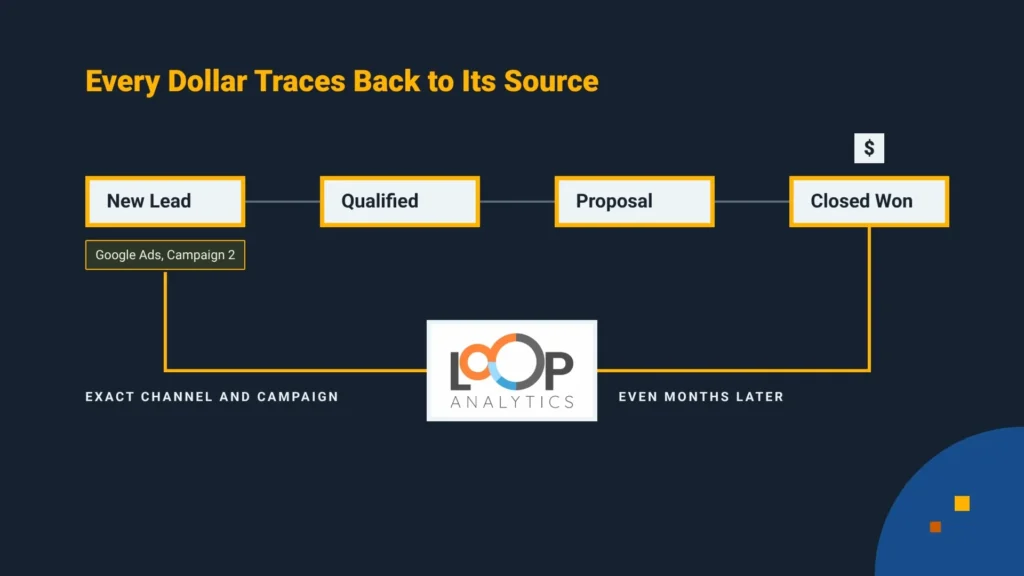
Picture a typical lead. Timing varies widely, but say a prospect clicks a paid search ad in March and fills out a contact form. A rep qualifies them in April, sends a proposal in June, and they sign the contract in September.
But Google Ads only sees the form filled in March. It also counts the bot that submitted a form ten minutes later, and even the duplicate someone sent by accident. It treats all three as conversions.
Meanwhile, the September contract lives in the CRM. Months pass with no clean line back to the March click, so the campaign that got the job done gets no credit.
Budget follows volume in Google Ads, not revenue. A high-volume campaign may keep running while the one with more real opportunities (the ones your sales team wants to pursue) gets discontinued.
The Solution: LOOP Lets Campaigns Come Full Circle
LOOP now integrates with Google Ads to tell the tool which leads are real and return closed revenue to the campaign that earned it. That last part is thanks to a second integration with CRMs like HubSpot and Salesforce. More CRM platforms are in the works.
- Learning from what works: Google Ads learns from verified leads. LOOP filters out spam and duplicate submissions, then sends Google the real leads as offline conversions. Automated bidding starts to favor the leads your sales team wants to call. Spam no longer gets a vote on where your money goes.
- Real value from real leads: Every lead carries a dollar value. LOOP attaches a value to each conversion it sends, using a figure your strategist sets, the actual order total, or an estimate based on your close rate and average deal size—no checkout required.
- Get what you need in one report: Spend and outcomes share one report. LOOP pulls in Google Ads spend every night. A Google Ads Spend report puts spend, clicks, and Google’s own conversion count next to the leads LOOP verified, with ROAS and cost per acquisition calculated on outcomes your business would recognize as real.
- Credit where credit is due: When a deal closes in a CRM like HubSpot or Salesforce, the revenue goes back to LOOP in real time and links to the campaign and keyword that brought in the lead. Even if a contract closes nine months later, the original click still gets the credit. LOOP only uses read-only access, so your CRM stays just as your team left it.
- Answers without the digging: LOOPChat, LOOP’s built-in AI assistant, answers questions like “Where should budget move this month?” in plain language, using your account’s own history. A portfolio intelligence report adds context: a performance baseline, trends over time, and sentiment from recorded sales calls.
Privacy comes first. Contact details are turned into anonymous codes (hashed) before they leave LOOP, so Google can match leads to ad clicks without seeing any personal information. There are no third-party cookies, and your team won’t need to learn a new platform.
How We Did It: Our Partnership with Google
Our relationship with Google goes past the Premier Partner badge. Google’s Additive Tech Fund supported this integration’s development.
This initiative is a Google partnership that backs technology built to plug into how advertisers already run their campaigns, and Google has a practical reason to care: its automated bidding is only as smart as the conversion data it receives.
Better signal in, better bidding out.
This means the integration works directly in your existing Google Ads accounts, using Google’s Data Manager API. We built and manage it ourselves. Our partnership with Google made it available to you more quickly.
What Changes When Ad Spend and Revenue Finally Meet
Change 1:
You’ll talk about the budget differently.
Now, instead of justifying a campaign by cost per lead, you can show the revenue it actually brought in.
If one campaign keeps closing deals and another keeps stalling, you’ll see both results in the same report—and so will Google’s bidding system.
Change 2:
Sales and marketing become more aligned.
Sales teams focus on revenue, while marketing looks at leads. When you add closed deals back into LOOP, both teams work with the same numbers. This settles the debate over whether leads are good or bad with real data.
Change 3:
Your strategy improves when you look at reporting differences.
LOOP’s conversion count and Google’s numbers won’t always match, and sometimes the gap is large. This is intentional. Google counts every click and form fill, while LOOP only counts what it tracks and verifies through lead scoring.
If the numbers don’t line up, it’s a sign to check for things like spam traffic, the wrong audience, or campaigns that get clicks but not customers. We prefer to show you both numbers side by side instead of just picking the one that looks best.
Time to Start Your Ads Strategy With the Closed Deal
For years, paid media has been judged on the numbers it could see: clicks, cost per lead, and conversion rate.
The numbers that matter most (signed deals and revenue) live in another system, so you have to connect the dots manually (should you have that kind of time). That’s why this LOOP update is a game changer for Google Ads management.
The next time someone asks which campaign produced last quarter’s biggest contract, you won’t need to pause. With LOOP connected to Google Ads and your CRM, a paid media program becomes one you can measure in real, closed revenue in a single report.
When spend and revenue sit in the same report, our agency can measure our work by what it earns, not what it collects. It’s accountability and stewardship. We treat every client dollar like our own, and LOOP holds us to that.
If you’re already a LOOP client, ask your strategist which features are live on your account and what an upgrade would include.
If you’re not, book a LOOP walkthrough, and we’ll show you what’s possible within your account.