By: Sal Commisso
Key Takeaways
- About a third of U.S. adults used an AI chatbot for health information in the past year, so the first description a patient reads may come from an AI answer, not your website.
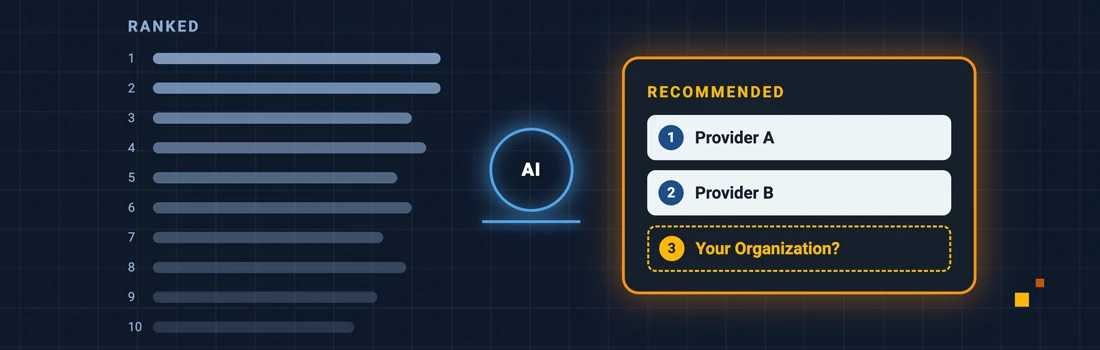
- Ranking and being recommended are different scoreboards. AI systems can cite pages well outside Google’s top ten, so a page-one ranking does not guarantee you are in the answer.
- AI systems lean on proof of expertise and consistency: credentialed authors and reviewers, specific reviews, matching listings, and clear facts on your own pages.
- If key content only loads through JavaScript, AI systems may not see it. Server-rendered HTML is the first fix to check.
- Measure AI visibility as a trend: how often you are named and cited across a fixed set of patient prompts, per platform, against the competitors patients compare you with.
Healthcare brands get recommended in AI search when AI systems can find consistent, specific, credible information about them, especially on their own site. Rankings still help, but they no longer tell you whether ChatGPT, Google AI Overviews, or Perplexity names you when a patient asks where to get care.
That was the core message of From Rankings to Recommendations, the webinar OuterBox hosted with AccuRanker on October 22. This is the written version: how patients use AI now, how AI decides who to recommend, what to fix first, and what changed for one healthcare client once AI could actually read their best answers.
Patients Now Get Their First Opinion from AI
A KFF tracking poll (2026) of 1,343 U.S. adults found that 32% had turned to AI chatbots for health information in the past year. For many patients, a generated answer is now the first thing they read about a symptom, a treatment, or a provider.
Google is moving the same way. Pew Research Center (2025) found that about one in five searches in its sample produced an AI summary, and that users were less likely to click traditional result links when one appeared. Patients can get an answer, form an opinion, and move on without ever reaching your site.
Local provider searches still behave differently. Google says local results are mainly based on relevance, distance, and prominence, so your Google Business Profile, reviews, and directory listings matter as much as ever. Our guide to local SEO covers that side.
Healthcare Content is Held to a Higher Standard
Search engines and AI systems hold health content to stricter standards than most categories, because a wrong answer can hurt someone. That means visible clinical expertise is not optional. Every page that gives medical information should show who wrote it and which licensed professional reviewed it.
Your website is also only one input. AI answers draw on review sites, provider directories, news coverage, health publishers, forums like Reddit, and your own pages. Your site is the input you control most directly, which is why most GEO work for healthcare starts there.
Being Ranked and Being Recommended Are Different Scoreboards
Traditional search earns a position: the patient sees ten blue links and compares. AI search earns a mention, a citation, or a spot on a short list of recommended providers. There is one answer, and the only question is whether your name is in it.
Each answer comes from what the model learned in training, what it retrieves with a live search, or both. Live retrieval favors timely, specific facts like services, hours, coverage, and pricing. Training data reflects the authority your brand built before the model’s cutoff through citations, PR, and expert content. That authority compounds, and it cannot be built after the fact.
You also don’t have to rank on page one to be cited. A competitor that ranks below you can still be the one AI recommends, and a strong ranking can still be left out of the answer.
One Patient Question Turns Into Many Searches
Google describes a query fan-out technique (2025) in AI Mode: it breaks a question into subtopics and runs many searches at once, then writes one answer from what it finds.
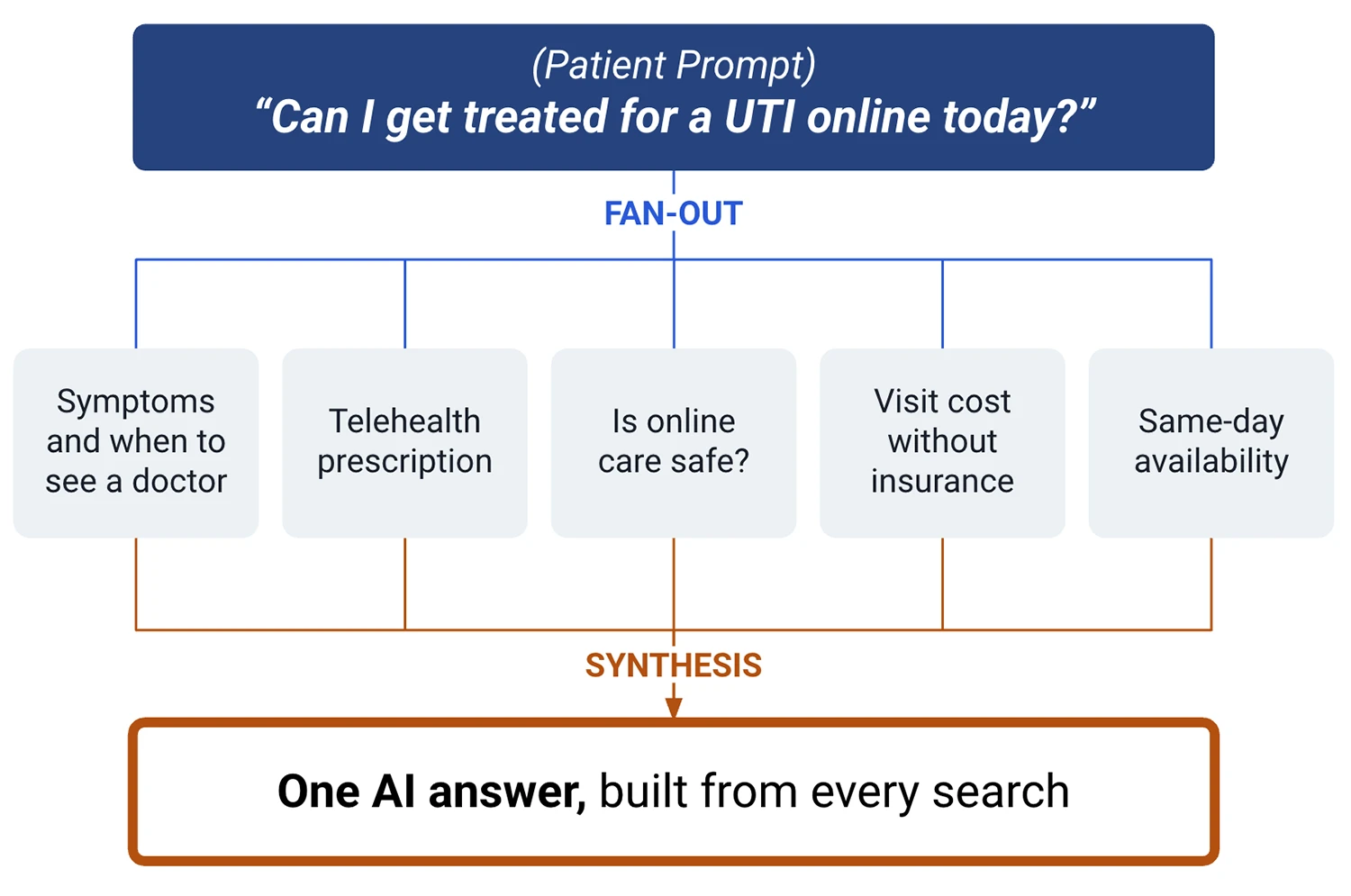
Don’t treat those sub-queries as a keyword list. They change from run to run, and most have no measurable search volume. Cover the whole topic instead: symptoms, when to seek care, safety, cost, timing, and exactly how your service works.
Five Signals AI Checks Before It Recommends a Provider
In healthcare, AI systems lean hardest on proof of expertise and consistency. These five signals carry the most weight:
- Credentials: author and medical reviewer bios with licenses and specialties, linked from every clinical page.
- Reviews: volume, recency, and responses on the major platforms. Ask patients for specific, descriptive reviews, not just a star rating, and never offer incentives for positive ones.
- Authoritative mentions: citations from .gov and .edu sites, medical associations, and trusted health publishers.
- Consistent listings: the same name, address, phone number, and provider details across your site, Google Business Profile, and every directory.
- Specific, current facts: services, conditions treated, coverage, pricing, and how care works, stated plainly on your own pages.
Structured data still helps machines understand who you are, so use Organization, physician, and MedicalWebPage schema that matches what is on the page. Just don’t treat it as a shortcut. Google states there is no special schema required to appear in AI Overviews or AI Mode, and that standard SEO best practices still apply.
Make Sure AI Can Actually Read Your Best Answers
AI systems primarily read raw HTML. If critical content only loads through JavaScript, there is a high chance they won’t see it. Here is a quick test: turn JavaScript off in your browser. If your FAQs, provider bios, or schema disappear, so does your visibility in AI answers.
Then write the way patients ask. Q&A formatting that mirrors how people phrase prompts, short direct answers under question-style headings, and FAQs placed on the service pages they belong to all make your content easier to lift into an answer. Our guide to front-end and back-end AI search optimization covers the technical checklist.
Measure AI Visibility, Not AI Rankings
The same prompt can return a different answer each time, and results vary by location, account, phrasing, and timing. There is no fixed position in an AI answer, and anyone selling one is selling something that doesn’t exist. Read AI visibility as a trend over time, not a snapshot.
These are the metrics we report for healthcare clients:
- Prompt visibility: whether your brand appears in answers for your priority patient prompts.
- Citation share: how often AI links to your pages as a source compared with competitors.
- Share of mentions: how often AI names you without a link. Mentions without citations are normal.
- Source influence: which pages and domains AI cites most for your prompts. This doubles as your content and outreach target list.
- AI sentiment: how AI describes you when it does mention you.
- AI referral traffic and leads: visits from AI platforms in GA4, tied to leads in LOOP Analytics.
We recommend building the prompt set from how patients actually ask, mapped to the journey: informational, comparison, and decision-stage questions, roughly half that name your brand and half that don’t. Your front desk and intake team are one of the best sources. Ask them which questions come up on every call. For more on building the set, see why prompt tracking matters.
Expect a measurement gap, too. AI assistants can reference your content without linking to it, so some of that influence never registers in analytics. OuterBox tracks it with AccuRanker’s AccuLLM, which reports traditional rankings and AI visibility side by side, and AI visibility tracking is part of our SEO reporting at no added cost.
What Changed for One Healthcare Client
An online healthcare provider had strong clinical content that AI systems weren’t using. We tracked 12 patient prompts across four AI platforms starting in April and worked through what was hiding their best answers:
- April: every FAQ loaded through JavaScript, so the answer text wasn’t in the page HTML. We moved it into the HTML.
- May: medical service pages carried Product schema. We swapped it for Organization and MedicalWebPage schema.
- June: the About page pointed to a parent company’s leadership. We rebuilt it around the client’s own medical team and patient testimonials.
- June: competitors owned the decision-stage questions. We published a guide to switching providers, built on real patient questions.
- October: answers were buried on one standalone FAQ page. We moved FAQs onto the core service pages and the homepage.
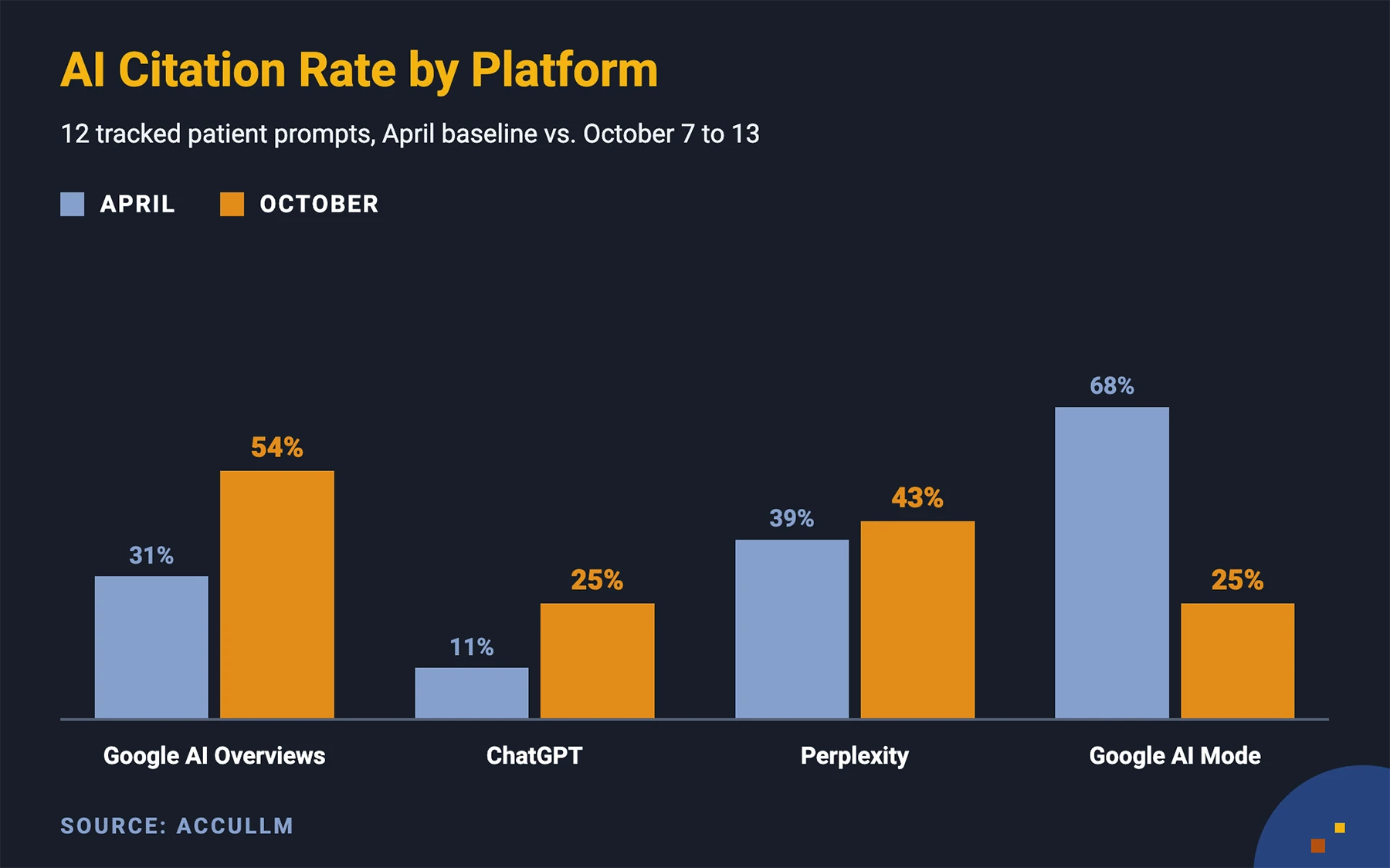
Comparing the April baseline with October 7 to 13, the client’s citation rate rose on three of four platforms: Google AI Overviews from 31% to 54%, ChatGPT from 11% to 25%, and Perplexity from 39% to 43%. On their top commercial prompt, they went from absent to cited in all seven recent AI Overview runs. On the head-to-head prompt against their main competitor, AI named them first every time.
Google AI Mode moved the other way, from 68% to 25%, and that’s the gap we’re working on now. The October FAQ change went live the same week as the latest data window, so we’re treating it as the next step, not the cause of these gains.
Where to Start in the First 30 Days
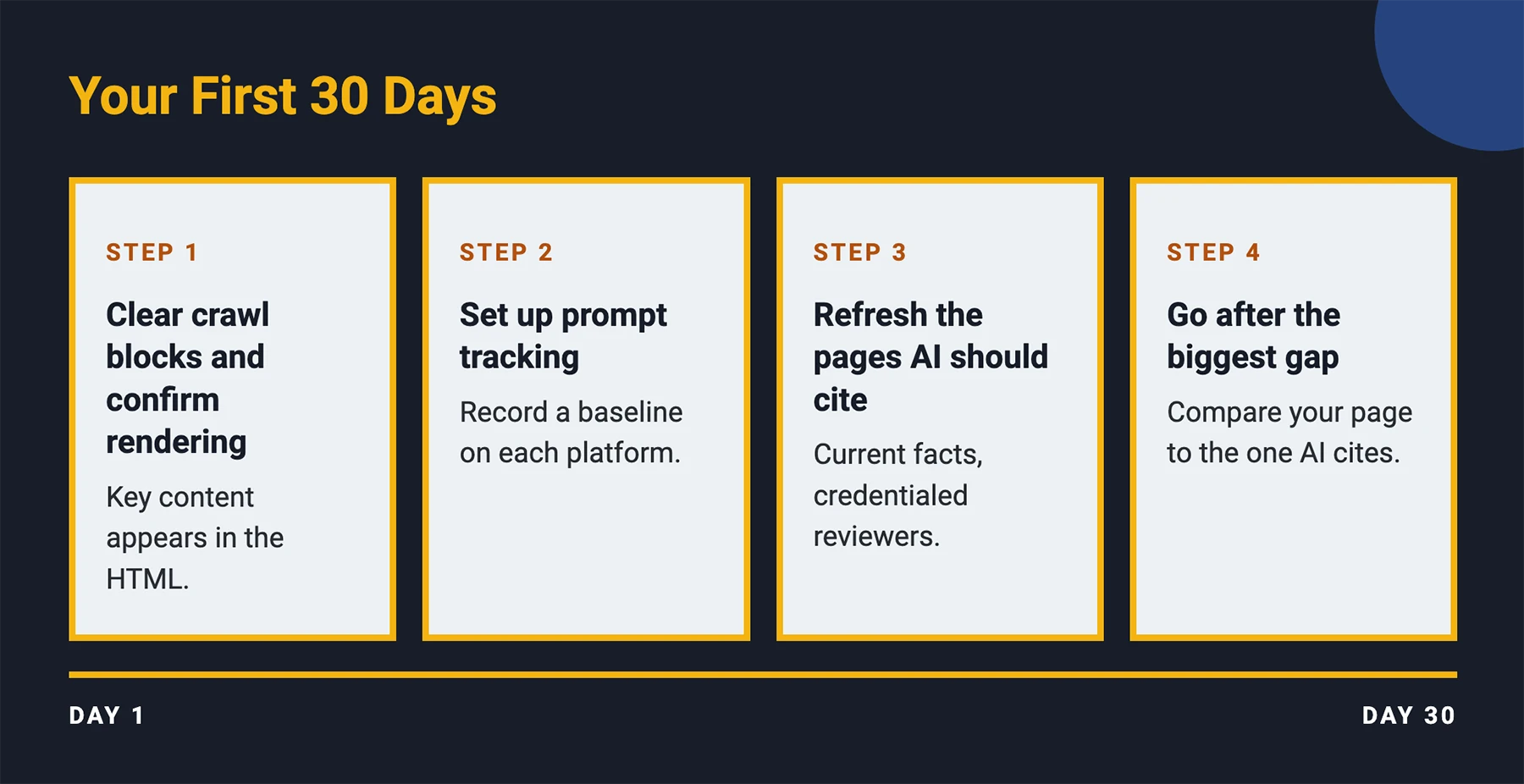
You don’t need a full program to start. This is the sequence we use with new healthcare clients:
Find Out How AI Describes Your Healthcare Brand
If you want to know which patient questions you win, which sources AI trusts in your specialty, and what to fix first, request a free AI visibility audit. Our healthcare marketing team will show you where you stand, starting with the prompts your patients actually use.
"*" indicates required fields
"*" indicates required fields
FAQs
Common questions about AI search optimization for healthcare.

What is AI search optimization for healthcare?
AI search optimization for healthcare is the work of making a provider or health brand easy for AI systems like ChatGPT, Google AI Overviews, and Perplexity to find, trust, and recommend. It builds on SEO with a stronger focus on visible clinical expertise, consistent listings, server-rendered content, and measuring whether AI names and cites you.
Do Google rankings still matter for AI search?
Yes, but they no longer predict whether AI recommends you. AI systems can cite pages well outside Google’s top ten, so track rankings and AI visibility side by side.
Does schema markup help healthcare sites appear in AI answers?
Schema helps machines understand who you are and what you offer, so it is worth having when it matches the visible page. Google states no special schema is required to appear in AI Overviews or AI Mode, so treat it as foundation work, not a shortcut.
How do you measure healthcare visibility in AI search?
Track a fixed set of patient prompts across AI platforms and report prompt visibility, citation share, share of mentions, cited sources, sentiment, and AI referral traffic. Because answers vary from run to run, read the results as trends over time rather than fixed positions.