By: obxadmin
Ask a distributor when their buyer’s process starts, and most will point to the RFQ—because that’s the moment when procurement finally reaches out. Ask Gartner, and the real answer is months earlier, by people your sales team never talked to. A typical B2B purchase runs through a team of decision makers, each gathering information on their own before the group ever compares notes. For industrial parts, where the purchase hinges on a spec sheet rather than a sales pitch, the gap between when the process actually starts and when a distributor notices it is wider than in almost any other B2B category.
That’s why it’s difficult to align some B2B buying processes to the traditional “sales funnel.” A funnel implies one lead moving through fixed stages in a linear fashion, but that’s really not how a buying group behaves. In this blog, we’ll illustrate what the process actually looks like and how your distributor digital marketing needs to align to it.
Industrial Buyers Need to Search Specs Before Choosing a Distributor
General B2B purchasing usually comes down to price, service, and reputation. Industrial procurement adds a layer most categories never deal with: the part has to be correct before it can even be considered.
A buyer searching for a replacement bearing, a specialty fastener, or a gasket isn’t shopping across a wide category of options. They’re matching a specific spec, material grade, tolerance, size, certification, and application—there’s no “close enough” or “sacrificing some aspects for price.” In aerospace, defense, or industrial safety work, it ends with the part failing in the field.
That’s the logic behind the B-SMART framework OuterBox uses for industrial keyword and content strategy, which breaks buyer intent into six categories: brand, size and SKU, material, application or industry, requirements, and type. Those six categories show up in almost every industrial search query we’ve studied, because they’re the same six things an engineer needs to confirm before a part makes the shortlist.
Certifications raise the stakes further. A buyer sourcing for a defense contract needs a supplier who can document ISO 9001:2015 quality systems or AS9100 aerospace certification. A claim of quality in ad copy doesn’t satisfy a compliance review. Lead time matters just as much: a distributor who stocks a part beats one who has to source it, and a buyer facing a production shutdown will pay a premium to know that before they submit a quote request instead of after.
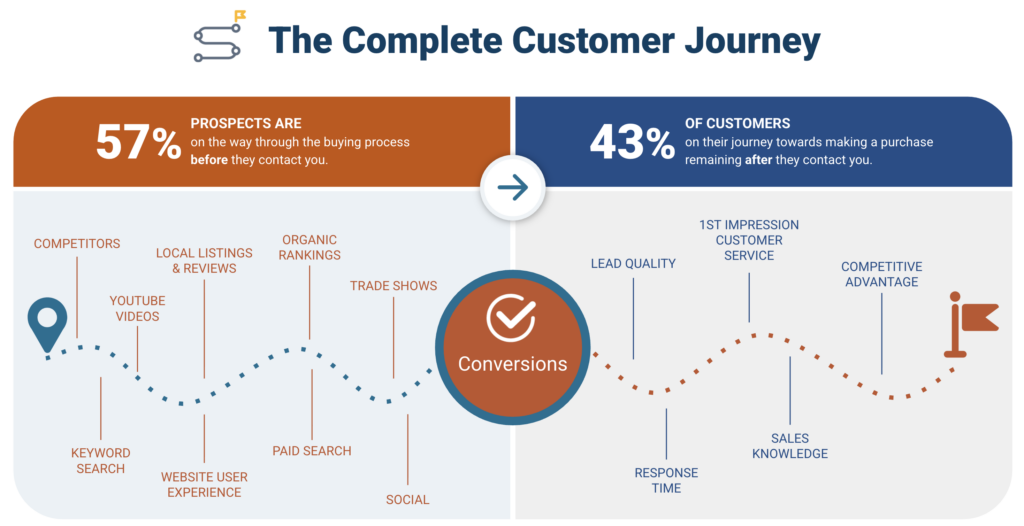
The Moments That Actually Move an Industrial Purchase Forward
None of the stages below happen in a strict line. Multiple people inside a buying group can sit at different stages at once, and a purchase can loop back to an earlier one if a spec changes or a supplier falls through. But each represents a real decision point, and each is a chance for a distributor to show up with the right information instead of waiting to be found.
Problem or Need Recognition.
The process starts with a trigger: equipment failure, a new production line or contract, a supplier that discontinued a part, or a scheduled maintenance cycle. The buyer often doesn’t have a supplier in mind yet, and may not even have the full spec worked out. They’re searching for very specific problems and solutions, not brand names.
Defining the Specs
Before anyone requests a quote, someone locks down what the part actually needs to be: material, tolerance, size, certification, application, and whatever regulatory requirement the industry carries. Engineering and procurement tend to work this in parallel rather than in sequence, with engineering defining what’s technically acceptable and procurement defining what’s commercially viable.
Researching Suppliers
Once the spec is roughly set, the buyer starts searching, and increasingly that search starts with a generic problem or product term rather than a company name. The site content that wins here tends to fall into a few buckets: what goes wrong with a given part or process, how materials or certifications compare, documented proof from similar applications, and what to look for when evaluating a supplier in the category. A distributor’s product pages have to answer those questions directly, because the buyer is comparing specification depth as much as price at this point.
RFQ Submission
Industrial buyers rarely request one quote. B2B buyers may be asking three or more suppliers before choosing one—a necessary process when the purchase carries real technical and budget risk. A quote request that arrives after a buyer has already read comparison content and spec documentation closes faster than one that starts the education process from zero.
Vendor Selection
By the time a shortlist reaches this stage, every finalist has usually already cleared the technical bar, so price alone rarely decides it. What actually decides it? On-time delivery history, company reputation, documented experience in this exact application, and how you address the specific risks and concerns a buyer asks about. With tariff and supply chain concerns, procurement teams increasingly weigh reliability and future availability into their consideration processes. A supplier who can speak to those risks before a buyer has to ask has an advantage the spec sheet alone doesn’t give them.
Purchasing
Once a vendor is chosen, the purchase often hinges on details that never came up in the spec conversation: minimum order quantities, packaging, delivery windows and timeliness, whether the part is in stock or has to be sourced. Your site should answer those questions clearly, ideally before the buyer has to ask, shortening the gap between selection and a signed order.
Post-purchase Evaluation
Successful procurement processes can turn into lasting relationships, provided everything goes right the first time. Evaluation after the sale determines whether a vendor becomes the one a buyer keeps coming back to or the one they quietly start shopping against next cycle:
- Was delivery on time?
- Was quality consistent across repeat orders?
- How fast did support respond when something went wrong?
- How easy was it to reorder without re-litigating the whole spec conversation?
Industrial buyers are also under real pressure to consolidate the number of vendors they manage, so a supplier who reliably covers more of a buyer’s catalog has a structural advantage over one who only ever fills a single line item. A rough reorder process or a slow response to a problem doesn’t just lose the next order, it puts a supplier back into the pool of vendors getting re-evaluated from scratch.
Getting In Front of the Right Buyers At the Right Time
An industrial buyer looks completely different depending on where they are in the process. Early on, they’re researching a problem or a spec, not a company, and searching in generic, unbranded terms. Later, once the spec is locked and a shortlist is forming, they’re comparing specific vendors on tolerance, certification, and lead time. A distributor showing up with the same message at both stages is showing up wrong for one of them, so the two moments need to be treated as separate problems, not one continuous pitch.
Intent-Based Content Matters
Early-stage industrial buyers search generic, unbranded terms tied to a problem or a part, not a company name. This is where intent-based content, built around the same brand, size, material, application, requirement, and type categories buyers actually search, earns visibility before a competitor’s sales rep ever makes contact.
Rapid Rivets & Fasteners, a stocking distributor of precision fasteners for military, aerospace, and commercial buyers, is a direct example. Their site had product pages but lacked the intent-based depth that matches how buyers actually search, so we built out a small set of new pages around specific product categories: aircraft blind rivets, threaded inserts, solid rivets, rivet nuts, each structured around the same spec details a buyer needs to confirm before requesting a quote.
Within six months those pages alone drove 6,441 net-new visits and a 216% increase in overall site traffic, with a 155% increase in conversion events like quote cart usage and contact form submissions. One page, built around steel threaded inserts, brought in inquiries from Boeing and Northrop Grumman. Buyers who would never have found the site through a branded search found it because the content matched the spec they were already searching for.
Paid Media Rewards Precision, Not Reach
Once a buyer has a spec in mind, paid search can target that specificity instead of competing on broad, commodity terms shared with big-box retailers who can outspend an industrial distributor without trying. Landing pages at this stage need to answer the RFQ-stage questions directly: tolerance ranges, lead times, certifications, and a quote path that doesn’t require a phone call to start.
LinkedIn earns its keep here too, particularly for reaching engineers and procurement staff before they’ve identified themselves by submitting an RFQ. Its targeting runs on job title and function rather than broad demographics, so a distributor can put content in front of people with “procurement” or “engineering” in their title at a specific company, not just a general industry audience. That precision costs more than typical paid social: average CPC for standard sponsored content runs higher than other social media platforms like Meta. Despite the premium, 58% of marketers say LinkedIn delivers the best return on ad spend of any platform they run, which for a distributor selling a five-figure order instead of a consumer impulse buy is the trade worth making.
Document ads tend to outperform other formats for this, since they let a distributor promote a technical guide or comparison document directly instead of pushing a cold click to a homepage.
Late-Stage Buyers Want Proof, Not Another Pitch
By the time a buyer is comparing final vendors, they need evidence, not another sales pitch. Case studies with specific, defensible outcomes double as ammunition for the sourcing engineer who has to justify the recommendation to their own procurement team. Email sequences at this stage should be calibrated to where a specific contact sits in evaluation rather than sent as a generic blast, since a long industrial sales cycle gives a distributor time most B2C sellers never get to nurture the relationship.
Form and call data collected throughout this whole process is worth more than a lead count. It can reveal demand for products you don’t yet carry, gaps in your spec documentation, or a regional cluster of interest that justifies a new warehouse or rep. And if your catalog isn’t your own content to begin with, because you’re distributing someone else’s spec sheets and photography, the content strategy needed to stand out is covered in more depth in OuterBox’s guide to distributor marketing strategy.
Your Site Content Needs to Speak to Different Readers and Rationales
The six-to-ten people in a typical industrial buying group aren’t opening the same page for the same reason. For instance:
- An engineer wants tolerances, materials, and technical documentation.
- A procurement lead wants lead times, pricing structure, and what happens if a shipment slips.
- A plant manager or finance approver wants total cost and how the purchase affects uptime or budget.
A single generic product page or case study trying to serve all three tends to satisfy none of them, because it answers the wrong question for at least two of the three people reading it.
That’s why industrial content strategy has to be built around roles instead of “funnel stages.” That means technical spec sheets for the engineer, risk and lead-time breakdowns for procurement, and an outcomes summary with real numbers for whoever signs off on the budget. Skip one of those roles and you’re either putting more questions on your sales team or risking a potential buyer walking away due to the hassle and uncertainty.
This is the same six buying jobs from Gartner’s framing showing up again, just closer to the ground. The committee doesn’t stop being a committee once it starts reading your website, and a page built for one role gives the other two nothing to work with.
Quick Gut Check: Can a Buyer Find Answers to These Questions Without Contacting Sales?
Before any of this becomes a bigger strategy conversation, it’s worth answering honestly:
- Do you publish the specifications buyers search for?
- Are certifications easy to find?
- Do product pages explain applications, not just products?
- Can buyers understand lead times and availability?
- Do you have proof from similar customers or industries?
A no to any of these isn’t a strategy failure, it’s a content gap, and usually the fastest one on this list to close.
OuterBox Builds Around the Buying Cycle, Not the Contact Form
Industrial buyers are doing most of their evaluation before they ever contact a supplier, researching specs, comparing certifications, and building a shortlist from search results rather than sales calls. We build our industrial digital marketing programs, SEO, paid search, and content alike, around that reality instead of around the RFQ. For distributors specifically, that means aligning content to catalog depth, territory, and fulfillment model rather than running a generic B2B template, the same thinking behind how we approach marketing for manufacturers built around the actual buying cycle instead of the contact form.
If your digital presence still assumes the RFQ is where the buying process starts, reach out to OuterBox and we’ll show you what your buyers are already doing before that.
B2B Buying Process FAQs

What is the B2B buying process?
The B2B buying process is the series of steps a business works through before making a purchase: recognizing a need, defining requirements, researching suppliers, evaluating proposals, selecting a vendor, completing the purchase, and assessing the outcome afterward. For industrial parts, this process centers on matching a technical specification and typically involves multiple stakeholders working in parallel rather than in sequence.
How many stages are in the B2B procurement process?
Most frameworks break the process into six to eight stages: need recognition, defining specifications, supplier research, RFQ submission and evaluation, vendor selection, purchase and delivery, and post-purchase review. The exact count varies by framework, but the stages tend to overlap and repeat rather than move in a strict line, especially in industrial procurement where a spec change or supplier issue can send the process back a step.
What are the biggest challenges in the industrial procurement process?
Part obsolescence, supplier consolidation, tariff and material cost volatility, long multi-stakeholder sales cycles, and increasingly risk-averse decision-making all shape how industrial buyers evaluate suppliers. Buyers are also spending more of the process in independent research before contacting anyone, which means suppliers without a strong digital presence are often eliminated from consideration before a sales conversation ever happens.
How do distributors market to industrial buyers at different stages of the buying process?
Early-stage buyers respond to intent-based SEO content built around their actual search behavior: brand, size, material, application, requirements, and type. Mid-stage buyers respond to precise paid search targeting and LinkedIn content aimed at buying committee members who aren’t actively searching yet. Late-stage buyers respond to case studies with documented outcomes and sales enablement material that supports the internal case a sourcing engineer has to make to their own procurement team.
What is a procurement process flow?
A procurement process flow maps the sequence of decisions and handoffs a business follows to source and purchase a product, from identifying a need through requisition, supplier evaluation, purchase order issuance, receipt, and payment. For industrial buyers, that flow typically includes a distinct technical specification and approval step before a request for quote is ever issued.
What is the difference between B2B and B2C buying processes?
B2C purchases are typically made by a single person, completed quickly, and driven by price or brand preference. B2B purchases, particularly industrial ones, usually involve six to ten decision-makers, take months to complete, and are driven by technical fit, risk mitigation, and total cost of ownership rather than price alone.
The B2B Buying Process for Industrial Parts: Stages, Decisions, and What Buyers Need
Are You Ready to Rank #1
We hope this guide cleared up the pricing confusion and gave you a framework for making a more informed decision about the SEO company that’s right for your business. If you have remaining questions or want to discuss your website with an SEO expert, call us at 866-647-9218 or request a quote below.
Services
"*" indicates required fields