By: Jeff Hirz

Ask a regional property manager which marketing channel produced last month’s leases and you’ll usually get one of two answers: a shrug, or a semi-confident guess.
That’s not a knock on anyone. Housing is one of the hardest industries in marketing to measure. A renter clicks a paid search ad in March, browses floor plans twice, calls the leasing office from their car in April, tours on a Saturday, and signs in May. By the time the lease is in, the trail back to that first click has gone cold. The ad platform claims the conversion. The listing site claims the call. Nobody can say for sure which one actually mattered.
Ownership doesn’t care about clicks. They care about occupancy and what it costs to get there. And rightfully so.
Enter stage right: LOOP Analytics. The lead tracking platform OuterBox built in-house, giving housing marketers a much clearer view of that path than most property management companies and owner/operators have today.
Why the Trail Goes Cold
Most housing reporting stops at the form. GA4 will count a submission as a key event, but it won’t tell you what the person typed, whether it was a real prospect or a solicitation, or whether the same person submitted twice. It also holds user-level data for 14 months at most. That sounds like plenty until you realize how long sales cycles can be with student or senior housing.
Then there’s the phone. Plenty of housing inquiries never touch a form at all. Someone sees an ad, calls the number, and talks to a leasing agent. Without call tracking tied to the rest of that visitor’s history, the call shows up as a line item with a duration and nothing else.
And there’s rarely just one decision maker. A student and a parent. An adult child researching memory care for their mom. A couple comparing three builders across a dozen browser tabs. Each of them can touch your marketing on a different device, through a different channel, over weeks or months, if not years.
Put those together and you get the reporting most operators live with: lead counts by channel, cost per lead, and a monthly occupancy number nobody can tie back to either one.
How LOOP Bridges the Gap
LOOP picks up where GA4 leaves off. Instead of just a conversion count, every inquiry becomes a lead record with the whole story attached.
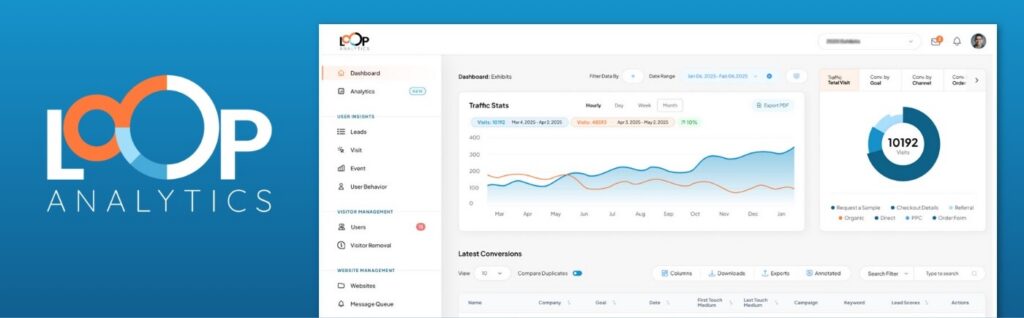
- Actual form data. Unit type, move-in date, number of roommates, care level, price range. Whatever your form asks, LOOP keeps. It also removes duplicate submissions, so one prospect doesn’t show up as three leads.
- Full channel path. First touch, every return visit, and last touch – built from UTMs and referrer data instead of last-click defaults. If a renter found you through organic search, came back from a Meta ad, and converted on a branded search, you see all three. Attribution = solved.
- Calls in the same record. LOOP integrates natively with CallRail, so a phone inquiry carries its source, a transcript, and spam flagging, sitting right next to its relevant web activity.
- Lead score. LOOP’s AI scores every lead from 0 to 100 using form inputs, call transcripts, and on-site behavior. A thumbs up or down on closed leads can teach the model what a good prospect looks like for your communities.
- Answers in plain English. LOOPChat lets you ask something like “which campaigns drove our highest-scoring leads at Riverside last month” without waiting on a custom report.
All of it runs on first-party data. No third-party cookies. The data belongs to you.
From there, the milestones your team records (tours, applications, signed leases, move-ins) come back into reporting. That’s the step that turns a lead report into something much closer to a lease report.
It’s also where we’d rather be straight with you than oversell it. The closer you get to the signature, the more the picture depends on your leasing team. What LOOP does make sure of is that when an outcome gets recorded, there’s a complete, source-tagged lead record sitting behind it. Most portfolios can’t say that today.
Same Method, Different Finish Line
Every housing segment ends in a different event, which is why a one-size reporting template never quite fits. Here’s how that lead-level visibility plays out in each.
Multifamily. Leasing never really stops, and renewals come up year-round. The useful question isn’t how many leads a community got, it’s which channels sent people who actually toured. With that broken out by community, budget can move toward the property fighting for occupancy instead of getting split evenly across the portfolio.
Student housing. You get one leasing season and no do-overs. Students and parents often both inquire, sometimes on the same unit, so deduplication and a shared view of the path matter more here than anywhere else. Watching which channels produce scored, tour-ready leads mid-season gives you time to shift spend while beds are still open, and the season’s data carries straight into next year’s plan.
Senior living. The phone does a lot of the work here: an adult child is often the one researching, and the decision can take months. Call transcripts and a long visitor history keep that thread intact across the whole comparison. It also shows how much demand your own channels are producing versus what’s coming in through paid referral services.
Active adult. The challenge here is fit. Broad 55+ campaigns pull in care-oriented searches and apartment browsers alongside the lifestyle buyers you want. Form data and lead scoring make it easy to see which campaigns bring the right people and which ones just bring volume.

How LOOP Can Help Determine Strategy
The first thing that changes is the budget conversation. Cost-per-lead is easy to improve but tells you very little, because the cheapest inquiries are usually the furthest from a tour. Once you can see lead quality and outcomes by channel and by community, the question shifts from “which channel is cheapest” to “which channel brings us people who sign.”
The second thing that changes is the leasing team’s first call. An agent who knows the prospect came in through a two-bedroom floor plan page, asked about pets, and scored an 85 is having a very different conversation than one working off just a name and phone number.
The third is the report you send to ownership. Instead of explaining a blended occupancy number, you can show which communities are converting interest into tours, which are just collecting inquiries, and where the next dollar should be invested.
Start With the Lead
You don’t need perfect attribution to make better decisions. You need to stop losing the story at the form-fill. If your current reporting ends at cost-per-lead, that’s the place to start, and it’s exactly the gap LOOP was built to close.
OuterBox’s housing team runs LOOP alongside SEO, paid media, web, and email programs for multifamily, student housing, senior living, active adult, and home builder clients. If you want to see what your own lead-to-lease path looks like, request a marketing review and we’ll walk through it together.