By: Matt Prater
A year ago, having a top-tier AI model on the team was a real head start. Today, almost every agency has one. Yours has Claude, the shop down the street uses ChatGPT, and the freelancer who pitched your client last week built a wrapper to integrate them all. That’s a good thing for the industry, and it raises an honest question for any of us who sell marketing services: once everyone has the same class of model, what makes the work better?
Our answer, after a couple of years of building, is that the model selection was always the easy part. A model on its own is a sharp new hire on day one: fast, capable, and completely new to your world. It has never met your clients, can’t open your systems, and doesn’t yet know how your best strategist runs a campaign. Everything useful it will do for you depends on what you give it to stand on.
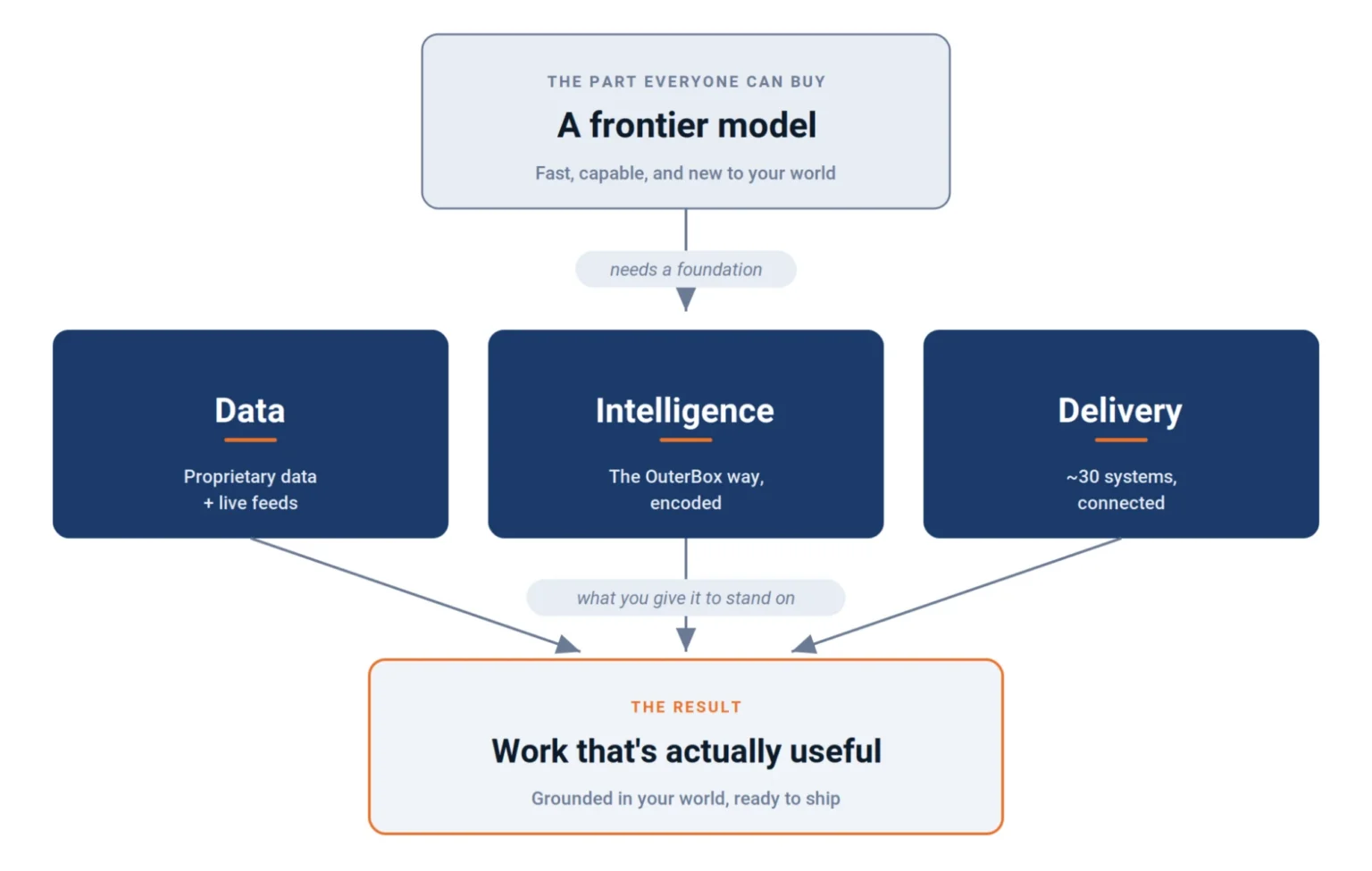
So we redesigned how the work itself gets done, then built a system to carry those new workflows so the AI had somewhere real to live. We call it OBxOS: one operating system, three connected layers, everything the agency runs on. This is a field report on it, written while it’s still being built, because that’s the only honest way to write about something like this.
Rethinking the Work Itself
The most important thing we changed isn’t visible in any tool. It’s the work itself. Before we applied AI to a single task, we rethought how that task should be done, who should do it, and what “good” looks like when a person and an AI do it together.
Take the monthly performance report, the document that tells a client what happened in their account, why it happened, and what comes next. Building one well used to take a strategist the better part of a week: pulling data from every platform, assembling the deck, and writing the story by hand. We turned it into a workflow where an agent assembles the data and drafts the narrative, which frees strategists for the part that was always the actual job: reading what the numbers mean and deciding what to do next.
We did that across the dozens of tasks that fill an agency’s week: keyword research, ad copy, competitive analysis, landing-page briefs, budget pacing, technical site audits, and the monthly report itself. The output of each one is what we call the OuterBox way of doing it, written down in a form an AI can follow. That sounds simple, but it’s the hardest thing in this entire piece.
Encoding how your best people think is slow, deliberate work, and it’s the part a competitor can’t buy. Anyone can buy the model. What we own is the judgment about how to use it on a manufacturing, telehealth or home services client’s paid search account, and that took years to write down.
Here’s the turn, though. A workflow written down is just a document, liable to languish unread in a folder somewhere. Wired into a system that already holds the client’s data, the account history, and the brand rules, it becomes something else entirely. The insight compounds instead of dying in a folder nobody reopens.
The Three Layers OBxOS Connects
Quality of output tracks quality of context, and context is the one thing a bare chat window can’t give you. OBxOS surrounds the AI with that context, and it runs on three connected layers.
The Data: An Integrated Foundation
The data layer comes first, because everything downstream depends on it. A campaign’s real story is spread across ad platforms, web analytics, call logs, and a CRM, and none of those sources says much on its own. The point of the data layer is to hold them in one place so a shift in one shows up against everything else, which is where the useful patterns actually come from.
Loop Analytics, the leads-and-calls platform we built for ourselves before it ever went to a client, closes the gap between a click and an actual customer: clients don’t lie awake over click-through rate, they care whether the phone rang and whether the lead was any good. Loop reads exactly that, pulling form and call content through our keyword framework to show what buyers actually asked for.
Alongside it, our system called Heartbeat scores the health of every client relationship from real interaction signals and flags an account drifting toward trouble before the client says a word.
Underneath both runs a single data warehouse, so the context an AI needs is structured and waiting before anyone types a prompt. We built a single view for our own sales team, every task, skill, and data connection the system touches in one picture, so we can say plainly that we pull thirty live sources into one connected system. Thirty disconnected tools bolted together can’t make that claim, and it’s the kind of number a procurement conversation responds to.
The Intelligence: Human Insights Power AI Execution
The intelligence layer is where we made our most deliberate bet. OBxIntelligence is the connected backend that sits behind every agent: a structured knowledge base for each client, live connections into Heartbeat, Loop, Google Ads, Analytics, Slack, and roughly thirty other sources, and the shared library of agents, prompts, and skills that carry the workflows our best people wrote down. This is the layer that turns a generic model into one that already knows the account.
What sits in front of all this is just an interface, a window onto the architecture. Today, for many of our people, that window is Claude Desktop, where dozens of OuterBox team members across departments hold Enterprise seats. The point is that the window is swappable. Change it tomorrow and the architecture, the workflows, and the data underneath stay exactly where they are, which is a large part of why the system outlasts any single tool. Being a member of the Claude Partner Network keeps us close to the people building the models we rely on, so we tend to see what’s coming before it ships.
Every prompt, completion, and agent request flows through a trace-monitoring layer for quality and compliance, with no client PII ever stored, and the platform itself enforces that. A policy memo doesn’t.
The Delivery: Consistency Is King
The delivery layer is where the work actually lands. Every account and deliverable for our 332 people sits inside one governed structure, with templates that keep quality from depending on who happens to be staffed, and dependencies that move the work along on their own. This is where a lot of an agency’s hidden time quietly disappears: a task sitting in someone’s queue waiting to be noticed, a handoff nobody flagged, a step blocked on an input that arrived days ago. In OBxOS, a finished step releases the next one automatically, so the account keeps moving without anyone playing traffic cop. Nobody chases anybody.
We built all of this to be model-agnostic, so the model itself can change without any of the workflows or client knowledge underneath it having to be rebuilt. That single decision is why none of what follows is fragile.
What the System Builds
The clearest way to show what a connected system makes possible is to show you something we built inside it, that we now depend on.
We ran a dev-acceleration workshop and came out with three production applications. The sharpest, OBxPacing, was live in a matter of days. Here’s what that actually took, because the shorthand hides it. About twenty instructions from a person set off 796 discrete work steps by the AI, each one a small task the system carried out and checked before moving to the next. Those steps fanned out across twelve specialized agents working in parallel and produced 44 files of working code. All of it ran inside guardrails: one source of truth, changes that only add and never quietly overwrite, and a deployment gate that stops any failing test from reaching production. For a client, that translates to twelve months of media spend planned in one place, with budgets synced and actuals updating live, in place of a spreadsheet someone rebuilds by hand every month.
Speed like that is only safe because of the structure around it, which is the whole principle OBxOS is built on.
The Agents That Scale Great Work
Building a platform in days is the dramatic version of the story. The quieter version, the one that touches every account every week, is the agents. We rolled them out in layers on purpose, so that general capability and client-specific knowledge each live where they can improve on their own.
At the base are general research and analysis agents any team can point at any account: competitor scans, SERP and keyword pulls, first-pass data analysis. They’re the reusable horsepower, useful everywhere and owned by no single account.
OBxIntelligence sits between that base layer and the next, feeding structured client context into client-specific agents that open on a client’s history and market instead of a blank page. Those agents run on the workflows we wrote down, the OuterBox way of doing the work, so the agent starts from the method our best strategist already encoded instead of a generic prompt. A generic competitor analysis is useful. The same analysis run through an agent that already knows this client’s real competitors comes back as a finished thought instead of a starting point, and that thought flows up to the strategist, who applies the judgment a system can’t.
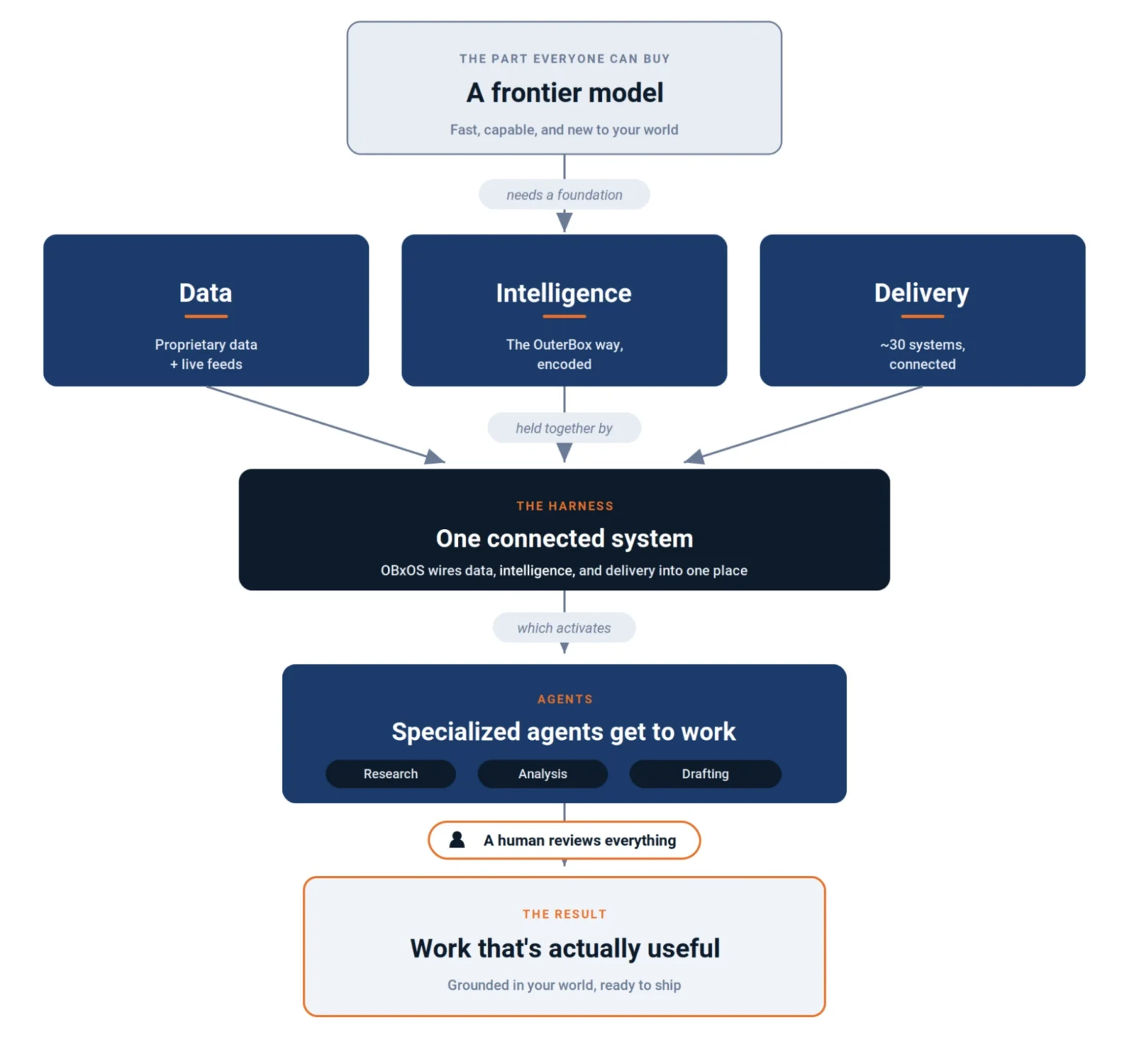
The payoff shows up account by account, and it compounds. Onboarding a new client is a good example. The stretch between kickoff and a first real strategy used to be a strategist spending days reading into the account before they could say anything useful. Now the client-specific agent already holds the history and the market, so most of that reading is done on day one and the strategist starts on the thinking. And because every agent lives in the shared OBxIntelligence library, an improvement one person makes doesn’t stay local. When a strategist sharpens an agent, the better version is what everyone else opens the next morning. The gains stack across the whole agency instead of sitting with the person who found them.
Built for Us, Then Built for Clients
None of this surprised us, and that is the point. We set out to be the smart, intentional agency, and one of our oldest principles is that whatever we build to run our own shop is built with clients in mind too. The same tools that make our people’s days easier turn out to be the ones clients ask us to build for them.
Notice the verb: build. We make custom software of our own, Loop and Heartbeat and the pacing platform among it, which is a very different offer from handing a client a login to an off-the-shelf AI tool. We run the agency on what we build long before it reaches a client, so by the time we put it in front of anyone, we’ve already hit the rough edges and smoothed them. We eat our own cooking, and then we put it on the menu.
Why a Buyer Can Tell the Difference
Generic AI demos all sound the same. “We run an AI-powered audit” lands flat with a procurement manager who’s heard it from four agencies this month. What proves you’ve built something real is whether the system speaks the specific language of a specific buyer, and that comes straight from the workflows.
In industrial manufacturing, that language is B-SMART, a framework we built and trademarked for reading buyer intent across six dimensions: brand, size, material, application, requirement, type. It’s why a search for “DFARS compliant titanium” reads as a qualified buyer signal, and why “pumps” doesn’t get chased just because the search volume looks enormous.
The same intent-first discipline, if not the acronym itself, carries into the other three markets. In housing, client-specific agents hold structure across dozens of properties so a campaign never treats the portfolio as a single blur. In digital health, patient data stays inside an approved, HIPAA-supportive workflow because the governance has to be part of the blueprint from the start. In lead gen, Loop ties SKU-level search intent to what became a lead, so the workflow optimizes toward lead value instead of traffic.
The thread through all four is the same. The model is the one our competitors can also access, but the judgment about what a buyer in food processing or student housing or a health network actually means when they search, written into a workflow and wired into a system that acts on it, is ours.
Human Judgment Stays in the Loop
Anything that can act on your behalf changes your security and quality exposure, and our architecture rests on one principle: a person stays responsible for the work.
Every material deliverable gets reviewed by a human before it leaves the building, and we put that in writing for clients alongside two companion commitments: we use AI where it improves the work, and we disclose when it did. The agents handle assembly and first drafts. People own the judgment, the relationship, and the final call.
Underneath that sits a governance policy that classifies every data source into one of three tiers: open data like brand guidelines connects freely, permitted data like client analytics connects only through integrations the AI team administers, and restricted data like client PII or anything HIPAA-adjacent can’t connect without explicit sign-off. That governance is what lets clients in regulated, high-stakes categories say yes.
Where This Goes Next
Everything above is running today. What’s ahead has more to do with connecting insight to action than with any new model.
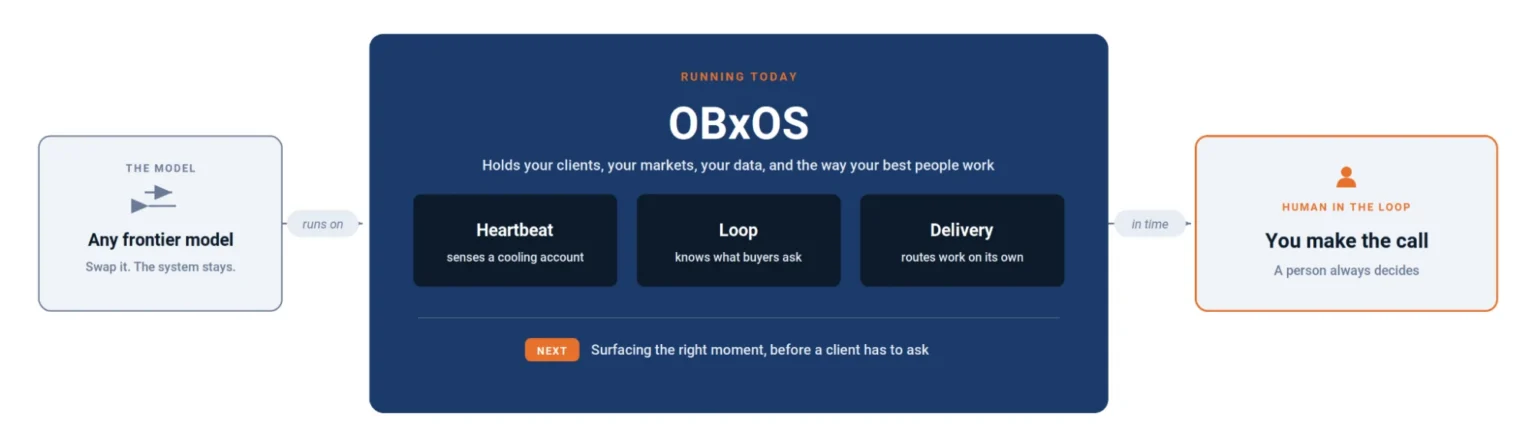
The data layer already senses when a relationship is cooling. Loop already knows what buyers are asking for. Delivery already routes work on its own. The work in front of us is connecting those so the system surfaces the right moment to the right person before a client has to raise it themselves. A person still makes the call. The system just makes sure they see it in time.
You can buy a model this afternoon. An operating system that holds your clients, your markets, your data, and the way your best people work is something you build, and then keep building. Ours is built to outlast any single model, so it gets stronger every month no matter what’s running under the hood.
A System Built to Outlast Any AI Model
Are You Ready to Rank #1
We hope this guide cleared up the pricing confusion and gave you a framework for making a more informed decision about the SEO company that’s right for your business. If you have remaining questions or want to discuss your website with an SEO expert, call us at 866-647-9218 or request a quote below.
Services
"*" indicates required fields