By: Ryan Black
Let’s face it, most of the conventional wisdom about conversion rate optimization (CRO) and digital marketing is geared towards typical eCommerce brands. That means even brands in very different industries end up utilizing those same techniques: one-step checkout flows, personalized product recommendations, and side-by-side comparisons are all borrowed directly from online retail.
While direct-to-consumer (DTC) healthcare and digital health share some commonalities with eCommerce, seeking treatment and care is very different from buying shoes. That means some techniques can work exactly as intended. But if deployed incorrectly, it can quietly destroy the trust patients need to establish before making important decisions. Successful DTC health CRO relies on understanding which tools and techniques can be carried over from eCommerce and what elements of the user experience need to be approached differently.
Healthcare Patients Now Carry Retail Expectations
Years of increasingly seamless digital commerce have shifted what people expect from every online transaction. Speed, price transparency, and personalization are now the norm, and patients don’t compartmentalize those expectations when they shift from shopping online to seeking mental health support.
DTC brands across apparel, nutrition, and personal care spent years competing for faster delivery, cleaner interfaces, and more relevant recommendations, turning user experiences and conversion rate optimization (CRO) into a science while conditioning their customers to view friction as failure. And in DTC health, the brands that we see succeeding are those that meet those customer expectations by focusing on things like subscription refills, upfront cash pricing, and side-by-side provider comparisons.
So there’s plenty that these health brands can continue to learn from eCommerce. That doesn’t mean, however, that every tool that succeeds in eCommerce can or should be embraced by DTC healthcare brands.
Where eCommerce and Digital Health Playbooks Overlap
Some eCommerce mechanics translate directly into digital health. Others work because the underlying logic is the same, even when the execution needs to be different to stay compliant.
Outcome-led copy. Retail learned long ago that customers buy the result, not the specs. That same instinct applies in digital health, but with some important stipulations. Healthcare copy that defaults to clinical language might feel more authoritative, but it doesn’t always land with patients the way practitioners assume. Your execution, though, has to account for what health brands can actually claim. For prescription products, specific outcome guarantees run into FTC and FDA scrutiny, and claims need to stay consistent with approved labeling. OTC and wellness brands have more flexibility, but “clinically-proven” claims still require real backing. The practical answer is to write copy in the patient’s language, about the patient’s life: language like “designed to help you feel like yourself again” is both compliant and affirming.
Making it easier to compare treatment options. Retail product pages let shoppers configure options based on their needs and see results updated in real time. This can also work in DTC health. One of our clients applied this directly to their prescription selection user interface: choose a medication on one side, see the relevant clinical specs update on the other. This mechanic reduces cognitive load on a decision that can feel overwhelming to a patient who isn’t sure what they’re choosing.
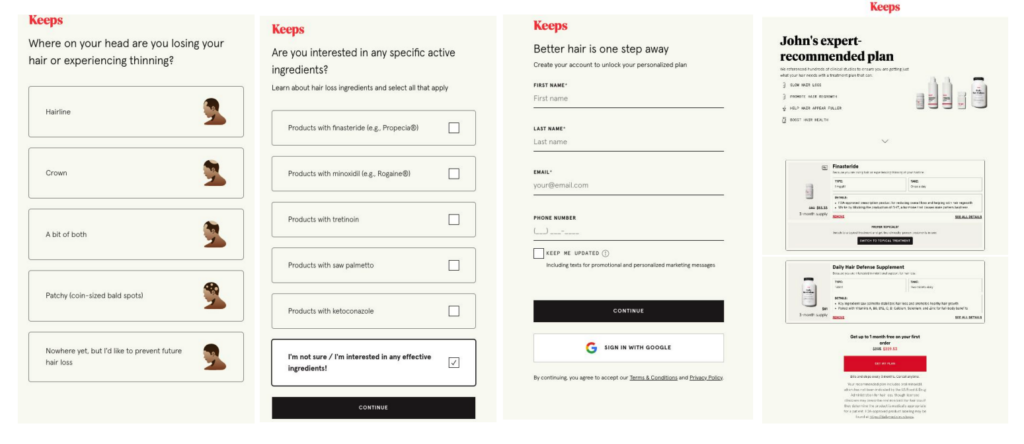
Replacing guesswork with a guided intake. Retail generates recommendations by tracking what customers browse and buy. In healthcare, that kind of inference creates HIPAA exposure and, in some cases, runs into outright legal prohibition. Onsite quizzes can be a compliant alternative: patients volunteer their symptoms and goals, the quiz responds with a clinically appropriate recommendation, and because the data is offered rather than inferred, it sidesteps the compliance issues entirely (provided you are not collecting the data improperly through onsite tags). Brands like Keeps have built successful funnels around this model.
The refund policy as a conversion tool. In eCommerce, a strong money-back guarantee is a front-page asset. Zappos revolutionized eCommerce and built a brand identity around free returns. Most DTC health brands treat the equivalent almost as a legal obligation, buried in the footers where patients rarely see them. What the better-performing brands have figured out is that a refund policy, prominently placed and specifically worded, directly addresses the patient fear of: “What if I pay and it doesn’t work?” A guarantee like “If you’re unsatisfied, we’ll provide a full refund” is a fundamentally different conversion asset than a vague satisfaction policy three scrolls down a page.
What eCommerce Tactics Can Be Adapted for DTC Health
While some tactics are a direct lift from eCommerce to DTC health, others need to be adapted a bit to match the unique nature of patients and health products.
Providing social proof. Star ratings and general patient reviews translate well to DTC health and should be used. Testimonials tied to specific clinical outcomes, however, are where DTC health brands run into trouble. The FTC requires testimonials to reflect typical results—when they don’t, required disclosures tend to undercut the testimonial’s effect. For prescription products, the FDA treats efficacy-implying testimonials as promotional material subject to Rx labeling rules. That means that a patient’s “I lost 30 pounds” story might be inspiring, but it carries legal weight the brand has to account for. To be safe, it’s best to lean on aggregate ratings and patient experience language that speaks to the process of dealing with your brand rather than a specific outcome from a treatment.
Urgency mechanics. eCommerce brands often try to create urgency to push purchases across the finish line. Countdown timers and “only 3 left” prompts are standard conversion tools in retail. While effective in retail, these are antithetical to the spirit of healthcare. A patient who feels pressured into a clinical decision does not convert at a higher rate; they abandon the funnel and do not come back. Progress indicators showing where the patient is in the intake process and how much is left can create a sense of momentum towards a care option without creating uncomfortable pressure.
Checkout friction reduction. Retail CRO is largely an exercise in removing steps, but healthcare CRO is more selective. Friction is necessary and even trust-affirming: things like safety disclaimers, allergy checks, provider review confirmation, and medical history screens are not obstacles to optimize away. A patient who sees a provider review step built into the flow trusts the result more than one who got a prescription with two clicks. The goal is to remove friction that feels bureaucratic or confusing while preserving friction that feels clinical.
What’s Different for DTC Health Brands
Now we get to the big distinctions, which stem from the sensitive and specific nature of healthcare and the extensive legislation designed to protect patient privacy. Many of the tools that have allowed eCommerce to flourish are strictly off-limits to DTC health brands and need to be avoided. Meanwhile, much of the mass-appeal positioning that eCommerce brands strive for is counterproductive in healthcare.
Retargeting and audience personalization are off-limits. And non-negotiably so. Pixel-based retargeting infrastructure allows Adidas to show you a range of shoes on Instagram days after you browsed past them on their site—or even if you indexed into a list of sportswear enjoyers. That type of tracking and personalization creates HIPAA exposure the moment it touches on health conditions and treatments. The legal and reputational risk is not theoretical, and DTC health brands should ensure that their marketing partners are not deploying these tactics on behalf of their brands.
Generic positioning. “For everyone” reads as “for no one” in healthcare. A patient managing a specific condition is looking for a brand that understands their exact condition and unique needs. Specificity builds confidence. The telehealth brand that allows patients to see themselves reflected in the imagery and language on the website will convert better than the one positioning too widely or vaguely.
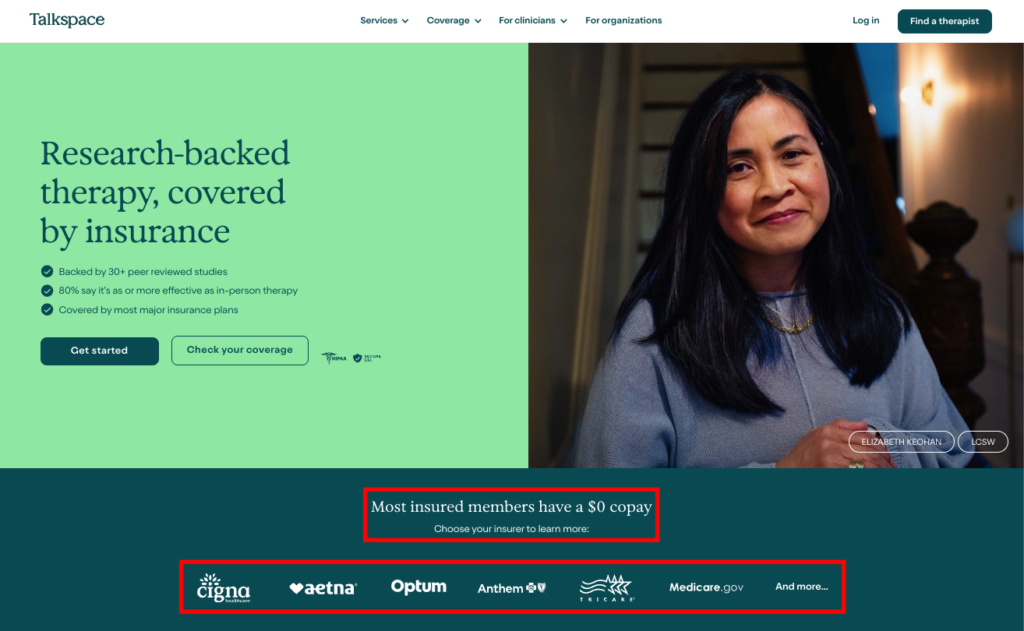
Burying trust signals in the footer. eCommerce brands don’t need to make privacy and certification assurances the same way that DTC health brands do. While eCommerce brands are focused on product benefits and lifestyle up top, DTC brands need to also make room for things like HIPAA compliance badges, provider credentials, insurance acceptance logos, and security certifications. Talkspace, for instance, places HIPAA and SSL badges directly adjacent to the primary call to action. PlushCare stacks its money-back guarantee, social proof, and insurance flexibility all above the fold.
Understanding the Underlying Principles
The DTC health brands that get this right know which parts of the eCommerce playbook to use, which to adapt, and which to avoid entirely. It’s a nuanced space where the wrong decisions can mean regulatory exposure, lost patient trust, or both—and the line between them isn’t always obvious.
If you’re looking to dive deeper into this topic, check out the recent conversation we hosted between Craig Smith, OuterBox’s Chief Strategy Officer, and Tellef Lundevall, EVP of our Healthcare department, which includes real visual examples from brands navigating these decisions well.
If your brand is trying to grow like an eCommerce company while navigating the compliance and trust requirements that set DTC healthcare apart, you need specific experience and expertise in this space. OuterBox’s team has it—and we’re ready whenever you want to start the conversation.
Where Healthcare Meets eCommerce: Matching Retail Expectations With DTC Digital Health Marketing Realities
Are You Ready to Rank #1
We hope this guide cleared up the pricing confusion and gave you a framework for making a more informed decision about the SEO company that’s right for your business. If you have remaining questions or want to discuss your website with an SEO expert, call us at 866-647-9218 or request a quote below.
Services
"*" indicates required fields