By: Jeff Hirz
Conversion rate optimization is the process of improving a website so more visitors complete a valuable action. That action might be a purchase, quote request, lead form, booked consultation, account sign-up, phone call, completed application, or movement from cart to checkout.
The simple version is easy to remember: CRO helps a site turn more of the traffic it already has into revenue or pipeline.
The practical version is more important. CRO is not a list of button-color tests or random page tweaks. It is revenue protection. If your company already pays for SEO, PPC, email, social, referrals, direct traffic, or brand demand, every weak form, unclear offer, slow page, confusing checkout step, and broken tracking event makes that traffic more expensive than it needs to be.
Most CRO wins start by finding the moment where a qualified visitor loses confidence.
A strong conversion rate optimization program finds that moment, ranks it by business value, fixes the highest-value leak first, and measures whether the fix changed the outcome that matters.
What Counts As A Conversion?
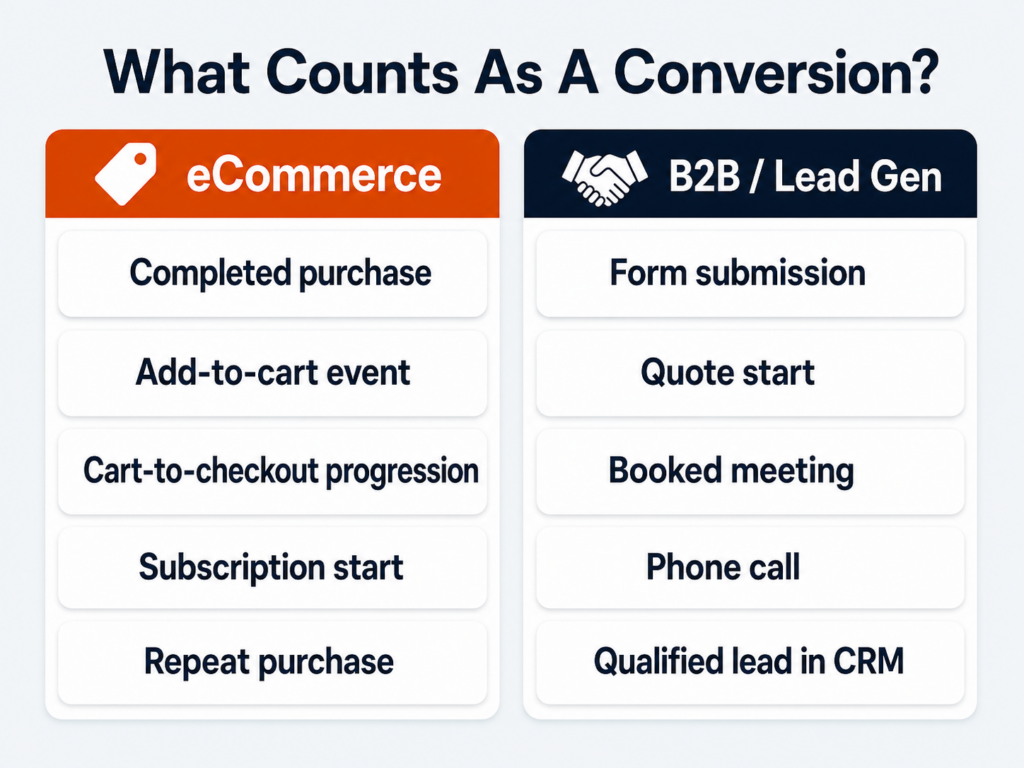
A conversion is the action your website exists to earn. The right conversion depends on the business model and the page.
For an eCommerce site, conversions can include completed purchases, add-to-cart events, product detail page engagement, cart-to-checkout progression, subscription starts, or repeat purchases. For a B2B or lead-generation site, conversions can include form submissions, quote starts, booked meetings, phone calls, demo requests, file downloads, or qualified leads passed into a CRM.
Some conversions are final business outcomes. Others are micro-conversions that show the visitor is moving in the right direction. A checkout completion matters more than a product-view event, but the product-view event may still help diagnose where the funnel is weakening.
That distinction matters because conversion rate optimization should not chase every click with equal intensity. The first job is deciding which action is valuable enough to optimize. Google Analytics uses the term key event for actions that are especially important to business success. CRO starts with that same discipline: define the business event before changing the page.
How Do You Calculate Conversion Rate?
The standard conversion rate formula is:
Conversion rate = conversions divided by visitors, multiplied by 100.
If 10,000 people visit a landing page and 300 submit the form, the conversion rate is 3%. If 2,000 shoppers reach a cart and 900 continue to checkout, the cart-to-checkout progression rate is 45%.
That formula is useful, but it is not the whole story. The quality of the conversion matters. A site can lift form submissions while lowering lead quality if the form becomes too loose. A store can lift checkout starts while lowering order value if the page pushes discounts too aggressively. A paid landing page can lift demo requests while attracting prospects the sales team cannot close.
CRO should measure the event that represents real value. In many programs, that means pairing the conversion rate with revenue per visitor, average order value, qualified lead rate, close rate, cost per acquisition, or CRM-sourced revenue. The conversion rate tells you whether more visitors acted. The business metric tells you whether the action was worth earning.
Why CRO Matters Before You Buy More Traffic
Traffic growth is expensive. SEO takes time. Paid media costs rise when more competitors bid for the same buyer. Email and social only work when people reach pages that carry the promise made in the message.
If the site leaks qualified visitors, more traffic sends more people into the same weak experience.
That is why CRO often belongs before a larger acquisition push. A better landing page can make PPC spend more efficient. A clearer product page can help SEO traffic produce more revenue. A cleaner lead form can turn more organic visits into sales conversations. A checkout fix can recover value from shoppers who were already close to buying.
Good CRO also prevents teams from blaming the wrong channel. A campaign may look weak because the landing page does not match the ad. An SEO page may look low-value because the form is buried below sections visitors never reach. A product category may look underperforming because filters, sorting, or shipping expectations create friction before the shopper reaches a product.
CRO protects the traffic you already earned, then gives acquisition channels a stronger place to send the next visitor.
The Conversion Rate Optimization Decision Map
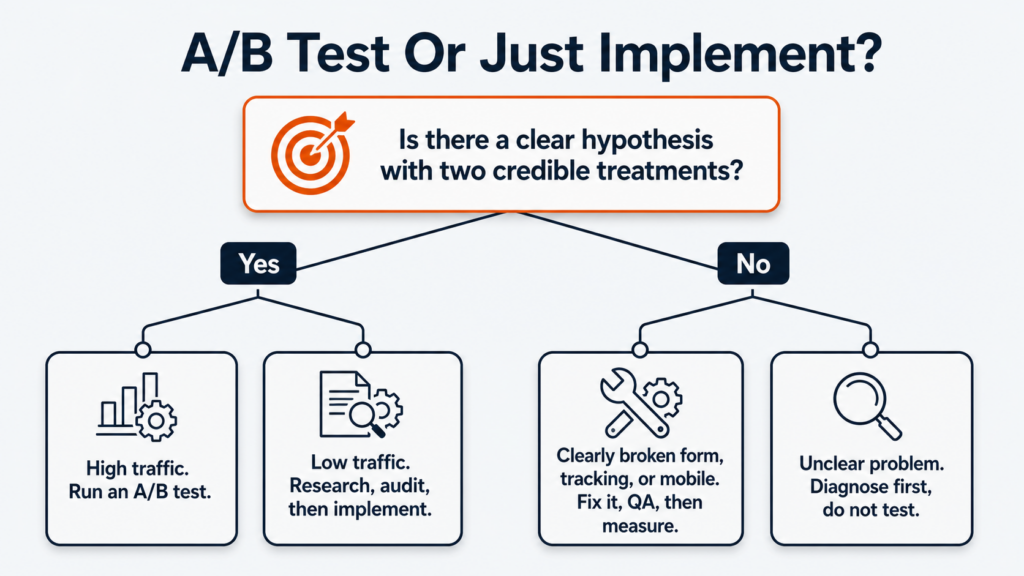
A useful CRO program needs a sequence. Without one, teams jump from opinions to tests without knowing whether they are solving the right problem.
Measurement: Which Action Matters?
Start by choosing the conversion event. Is the business trying to increase purchases, quote starts, application completions, add-to-cart rate, qualified form submissions, call volume, or demo requests?
Then confirm the tracking is reliable. GA4 events, phone tracking, form tracking, ecommerce events, CRM fields, and campaign attribution need to agree well enough for the team to trust the result. If the measurement is wrong, the testing roadmap will rank the wrong problems.
Diagnosis: Where Do Qualified Visitors Lose Confidence?
The next step is diagnosis. Funnel reports show where people leave. Behavior data helps explain why.
Useful inputs include scroll depth, heatmaps, session recordings, form-field abandonment, page-speed data, device-level conversion differences, search terms, onsite search behavior, customer service questions, user surveys, and sales-team feedback. A dashboard may show that mobile visitors abandon a form. A recording may show that validation copy appears late, the keyboard covers a field, or the next step is unclear.
The point is to identify friction that is visible enough to act on instead of gathering data for its own sake.
Prioritization: Which Leak Is Worth Fixing First?
Not every conversion issue deserves the same urgency. A typo on a low-traffic blog post and a confusing field on a high-value quote form do not have the same revenue impact.
Rank opportunities by traffic, conversion value, confidence, implementation effort, risk, and the likelihood that the fix teaches the team something reusable. A high-traffic checkout step with clear user confusion should usually outrank a low-traffic page with a vague design preference.
Prioritization keeps CRO from becoming a debate about personal taste.
Test Or Implement: Does The Decision Need An Experiment?
Some changes need formal testing. Others need repair.
If a form is broken, a tracking event is missing, or a checkout error blocks payment, the fix should ship after QA. If the team is choosing between two credible page treatments and traffic is high enough to support a valid result, an A/B test may be the right path.
Testing platforms still need enough data. Optimizely notes that binary metrics require minimum visitors or sessions and conversions in both baseline and variation before a winner can be declared with confidence. Low-traffic sites can still improve conversions, but they may need audits, user research, analytics cleanup, and careful implementation before formal testing makes sense.
Learn: What Should The Next Page Or Campaign Do Differently?
A CRO result should change the next decision. A winning form test can teach how much information visitors will provide before a sales conversation. A losing personalization test can show that a segment did not need a different message. A checkout fix can reveal that savings clarity matters more than another promo banner.
The best CRO programs document what changed, what happened, why it likely happened, and where the lesson should be applied next.
What Should You Optimize First in a CRO Program?
The first website conversion rate optimization priority is where traffic, friction, and business value overlap.
For eCommerce sites, that often means product listing pages, product detail pages, cart, checkout, shipping messages, payment options, promotion logic, site search, category filters, and mobile buying paths. A shopper who is already comparing products or reviewing the cart is close enough to revenue that small clarity issues can matter.
For lead-generation sites, the first priority is usually message match, form visibility, form length, CTA clarity, trust proof, mobile usability, and the handoff from form submission into the CRM or sales team. More form fills are useful only if the leads are qualified and routed cleanly.
For paid landing pages, CRO starts with the promise made by the ad. If the ad offers one thing and the page leads with another, visitors hesitate before they even reach the form. For SEO pages, CRO often means aligning search intent with the next step. The page should answer the searcher’s question and give a natural route into a deeper service, product, or buying action.
Baymard’s checkout research is a useful reminder that not every exit is fixable. Many shoppers abandon carts because they were browsing or were not ready to buy. But Baymard also estimates that average large eCommerce sites can gain a 35.26% increase in conversion rate through better checkout design. That is the CRO opportunity: separate natural non-buying behavior from friction your site can actually remove.
CRO Examples From Real Optimization Work
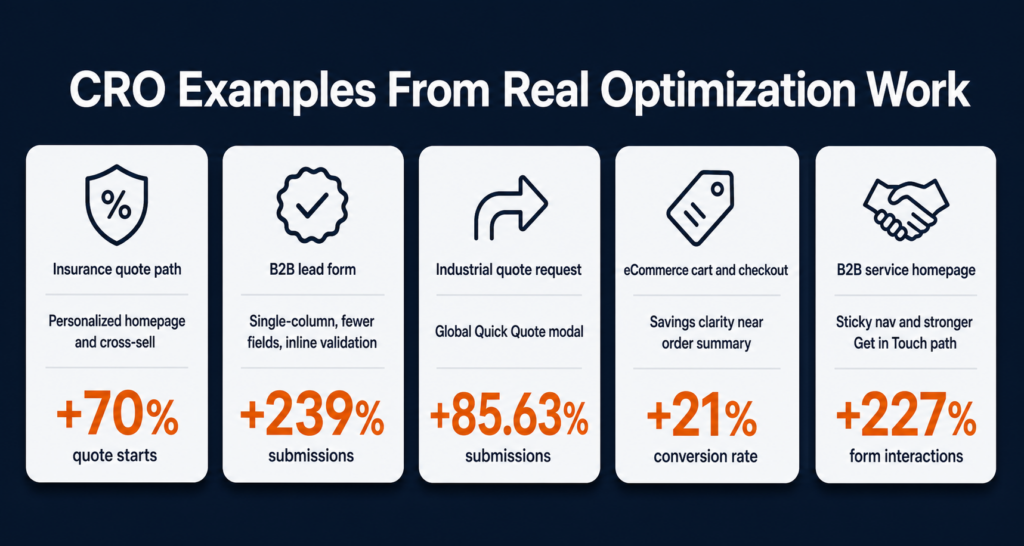
The best CRO examples are specific. The change, the friction, and the outcome should be clear enough that another team can understand the lesson without copying the exact design.
| CRO situation | What changed | Result |
|---|---|---|
| Insurance quote path | AICPA Trust used Salesforce Marketing Cloud Personalization to show more relevant homepage, cross-sell, and abandoned-quote messages based on visitor behavior. | Approximately 70% lift in quote starts and approximately 40% lift in completed applications. |
| B2B lead form | Mood Media tested a redesigned lead form with a single-column layout, taller fields, fewer non-essential fields, and inline validation. | 239% increase in lead generation submissions. |
| Industrial quote request | TIE Industrial replaced a page redirect with a global Quick Quote modal that opened in the visitor’s current funnel position. | 85.63% increase in form submissions. |
| eCommerce cart and checkout | Road Ready Wheels moved original price, discounted price, and total savings closer to the order summary in cart and checkout. | 14% lift in cart-to-checkout progression and 21% lift in conversion rate. |
| B2B service homepage | Eriksen Translations removed an outdated banner, added a stronger Get in Touch path, and made navigation stickier. | 227.27% lift in form interactions and 22.35% progression rate increase. |
The shared pattern is not that every site needs personalization, a modal, or a shorter form. The pattern is that the highest-value friction was identified first. Each change targeted a specific confidence gap: relevance, form effort, page redirect friction, savings clarity, or access to the conversion path.
A/B Testing Is Useful, But It Is Not Always Step One
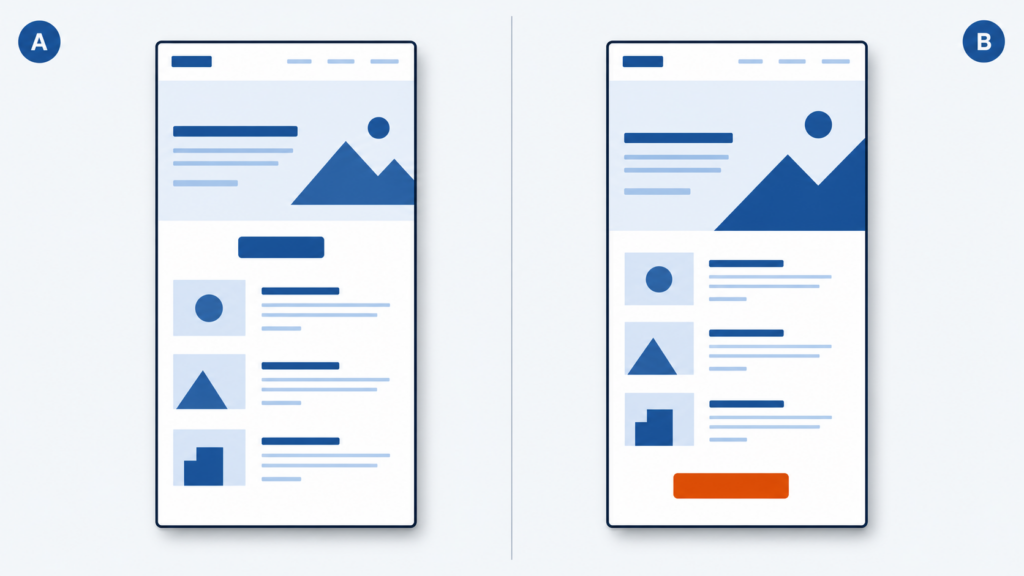
A/B testing compares a control against a variation to see which version performs better. It is valuable when the hypothesis is clear, the success metric is defined, the page has enough traffic, and the test can run without breaking the user experience or tracking.
Testing is weaker when teams use it to avoid making obvious repairs. You do not need an experiment to fix a broken form label, restore a missing event, improve a page that fails on mobile, or remove a checkout error that blocks payment. You need QA, implementation, and measurement after the fix.
Testing is also weaker when teams try to learn too much at once. If the variation changes the headline, layout, CTA, form, proof, and offer together, a win may improve performance but still leave the team unsure which part mattered. That may be fine for a major redesign decision, but it is less useful for building repeatable CRO knowledge.
Good CRO uses the right method for the decision. Research when you do not understand the problem. Implement when the issue is clearly broken. Test when there are competing credible treatments and enough data to trust the result.
How CRO Works With SEO, PPC, Analytics, And Web Design
Conversion rate optimization marketing work is usually strongest when CRO sits close to the rest of the digital marketing program.
SEO brings qualified visitors from search. CRO helps those visitors find the next useful step after the article, category page, service page, or product page answers their query. A page can rank well and still waste demand if the offer, proof, form, or product path is weak.
PPC buys attention. CRO determines whether that attention turns into a quote, order, call, or qualified lead. If conversion rate improves, the same media budget can produce more outcomes before bids or budgets change.
Analytics makes CRO trustworthy. Google Analytics consulting can help define events, funnels, audiences, and reporting views so the team knows which actions matter. Website behavior tools, including LOOP Analytics and web intelligence, can add the behavioral layer behind the numbers.
Web design and development turn CRO recommendations into durable site improvements. If a winning test never ships into the permanent page, the program loses momentum. If design decisions ignore conversion paths, the site may look better without performing better.
For eCommerce teams, CRO often overlaps with eCommerce optimization because product discovery, category paths, PDP content, cart, checkout, offers, and merchandising all affect revenue. For paid programs, CRO connects directly to PPC management because the landing page decides whether paid traffic becomes profitable demand.
When To Bring In Conversion Rate Optimization Services
You do not need a CRO consultant for every small page edit. But outside help becomes useful when the site has meaningful traffic, valuable conversion paths, and uncertainty about what is suppressing results.
Consider conversion rate optimization services when:
- Traffic is steady but leads, sales, quote starts, or checkout completions are weaker than expected.
- Paid media spend is increasing faster than qualified conversions.
- Analytics reports show drop-offs but do not explain the cause.
- Forms, carts, product pages, or landing pages are important enough that small gains have real revenue value.
- Your team has competing opinions about what to change first.
- You need research, testing, design, development, analytics, and reporting to work from the same roadmap.
For a deeper advisory program, CRO consulting can help diagnose the first revenue leak, prioritize the roadmap, and decide which changes should be tested, implemented, or saved for later.
OuterBox CRO retainers commonly range from $3K to $15K per month depending on traffic, funnel complexity, test volume, implementation support, and reporting needs. Many clients start to see noticeable movement within 60 to 90 days, though timing depends on traffic volume, measurement quality, development access, and the size of the conversion issue being addressed.
The right CRO engagement should not start with a fixed list of tactics. It should start with the question that protects revenue: where are qualified visitors losing confidence, and what is the highest-value leak to fix first?
FAQs About Conversion Rate Optimization
What is conversion rate optimization in simple terms?
Conversion rate optimization is the process of improving a website so more visitors complete a valuable action, such as buying, submitting a form, booking a call, starting a quote, or continuing to checkout.
What is a good conversion rate?
A good conversion rate depends on the business model, traffic source, offer, price point, buyer intent, device, and conversion quality. A high form-fill rate is not useful if the leads are weak. A lower conversion rate can still be profitable if the average order value or lead quality is high.
What is the difference between CRO and A/B testing?
A/B testing is one method used inside CRO. CRO is the broader process of measurement, diagnosis, prioritization, testing or implementation, and learning. Some CRO fixes should be tested. Others are clear usability, tracking, or technical repairs that should be implemented and measured.
Can low-traffic websites do CRO?
Yes, but low-traffic websites may not be ready for formal A/B testing. They can still improve conversion paths through analytics cleanup, user research, heuristic review, page-speed fixes, form improvements, clearer offers, and better CTA placement.
How does CRO help SEO?
SEO brings qualified visitors to the site. CRO helps those visitors take the next useful step after they arrive. Better conversion paths can turn the same organic traffic into more leads, sales, quote requests, or revenue without requiring rankings to improve first.
What should a CRO audit include?
A CRO audit should review measurement accuracy, conversion goals, funnel drop-offs, high-value pages, mobile usability, page speed, forms, checkout, trust signals, offer clarity, internal search or navigation behavior, and the revenue value of each likely fix.