By: Adam Littell
Domain age can help SEO, but only when the old domain behaves like a clean migration asset. It is not a shortcut.
The asset is continuity: relevant history, clean links, prior crawl and index signals, brand fit, and a rebuild plan that still serves the same audience. If those pieces are missing, age is just a registration date. If the history is messy, an aged domain can be riskier than starting fresh.
That is the practical answer to domain age SEO. Do not ask only how old the domain is. Ask what the domain earned, what baggage it carries, and whether that history still matches the site you want to build.
Domain Age Can Help your SEO, But Not By Itself
Domain age can affect SEO indirectly. It does not make a weak site rank because the domain has been registered for a long time.
Older domains and older pages often have advantages because they have had more time to earn backlinks, publish useful content, get crawled, attract brand searches, and build topical relevance. Ahrefs found that 72.9% of pages in Google’s top 10 are more than 3 years old, and that the average number one ranking page is 5 years old.
That data shows correlation rather than a simple ranking rule. Pages that last, improve, and earn links tend to collect signals that help them rank.
Use this rule when evaluating an aged domain:
- A clean aged domain with relevant history can give a new site a head start.
- A new domain can rank when the site is technically sound, useful, and promoted well.
- A spammy aged domain can create risk that a new domain would not have.
So, does domain age matter in SEO? Sometimes. But domain history and continuity matter more.
What Domain Age Means In SEO
People use “domain age” to mean several different things. They should not be treated the same.
Registration age is when the domain was first registered. This is the number most domain-age lookup tools show.
Crawl or discovery age is when Google first found the domain or a specific URL. Google explains that there is no central registry of all web pages, so it has to discover URLs through crawling, links, and other signals.
Index history is whether Google crawled, understood, and indexed pages on that domain before.
Domain history is what the domain was actually used for: the old site topic, prior content, ownership changes, backlink profile, redirects, spam, malware, and brand associations.
For SEO, domain history matters more than the registration date. A 15-year-old domain that was parked, spammed, dropped, and rebuilt across unrelated niches is not the same asset as a 15-year-old domain that consistently served the same market and earned legitimate links.
Is Domain Age A Google Ranking Factor?
Domain age is not something to optimize like a title tag, internal link, or technical fix.
Google’s SEO Starter Guide points site owners away from shortcut thinking. It says there are “no secrets” that automatically rank a site first. It also says keywords in a domain name or URL path have “hardly any effect” beyond breadcrumbs. Google’s own documentation focuses on crawlability, indexing, useful content, links, and relevance instead of WHOIS age.
Search Engine Journal’s ranking-factor review reaches the same practical verdict: how long a domain is registered does not matter to Google’s algorithm in the simplistic way SEOs often claim.
The more useful interpretation is that Google can observe signals around a domain and its pages over time. When pages are discovered, how links appear, how content changes, and whether users are served useful results all matter more than the registration date.
That is why “is domain age a ranking factor?” is less useful than it sounds. Age is easy to measure. Earned history is what you need to evaluate.
Why Older Domains Often Perform Better Anyway
Older domains can have real advantages, but those advantages usually come from assets accumulated over time.
Backlinks are the clearest example. Google’s SEO Starter Guide says the vast majority of new pages Google finds every day are discovered through links. A domain with relevant links from real websites may be discovered faster, crawled more consistently, and supported by stronger authority signals than a domain with no link footprint.
Content history can help too. A domain with years of useful pages, internal links, topical depth, and updates has more evidence behind it than a site launched yesterday. Brand familiarity can also matter indirectly when people search for, mention, or link to the business.
Take a 2015 OuterBox build. The client was launching an online wheels-and-rims store, and the domain we picked was 12 years old, had been used before, and still had a few inbound links. Within 12 months of launch, the site was driving 15,000 unique organic visits per month.
That is not a story about a 12-year-old domain ranking on its own. A relevant aged domain with existing links and a clean enough history can cut the cold-start problem when the rest of the site is strong. The domain was one useful input in a broader launch.
Domain Age Isn’t the Only SEO Factor: Use This 5 Continuity Check
If you remember one point from this article, make it this: an aged domain is only valuable when its history supports your future site.
Google’s spam policies make that especially important. Google defines expired domain abuse as buying an expired domain and repurposing it mainly to manipulate rankings with content that provides little or no value to users. Google also says sites that violate spam policies may rank lower or not appear in results at all.
That does not mean every aged-domain purchase is risky. It means the intent, history, and execution matter.
Use this five-continuity check before trusting an aged domain:
| Continuity Check | What You Want To See | Red Flag |
|---|---|---|
| Topic continuity | Prior site topic matches the new business | Old site was in an unrelated niche |
| Link continuity | Backlinks came from relevant, legitimate sites | Links are spammy, paid, hacked, or irrelevant |
| Index continuity | Important pages were crawled and indexed naturally | History of deindexing, malware, or doorway pages |
| Brand and legal continuity | Name, trademarks, and reputation are clean | Brand confusion, trademark conflict, or reputation baggage |
| Rebuild continuity | New site can satisfy the same audience better | New content exists only to exploit old links |
If the domain fails most of those checks, age is not an asset.
Should You Buy An Aged Domain For SEO?
Sometimes. But buy the domain for usable history rather than age.
An aged domain may be worth considering when the old site topic matches your new site closely, the backlink profile is clean and relevant, the prior brand does not create legal or reputation risk, and important old URLs can be mapped to useful new equivalents.
That is why we treat an aged-domain purchase like a small website migration SEO project plus a backlink-risk audit. You are not only buying a name. You are inheriting whatever search engines, users, and other websites already associate with that name.
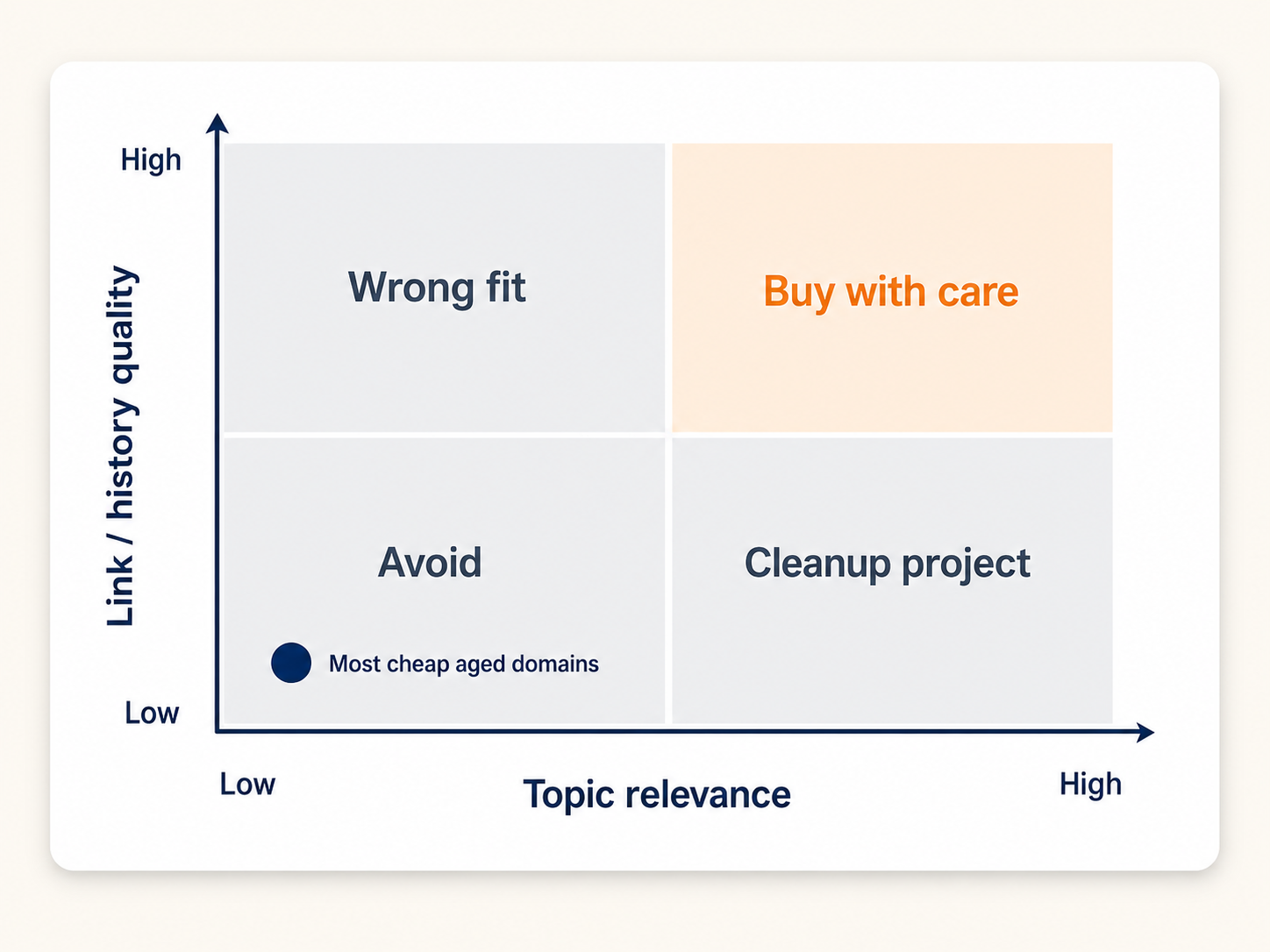
The good version is rare but valuable. If you are starting a new blog or eCommerce store and can get a relevant domain that used to earn traffic on the same topic, that can be a fantastic head start. But most available aged domains are not that clean. Plenty create the opposite problem: customers wondering whether they should buy makeup from a site with a URL like www.4wheelerzrfun.com.
The risky version is more common. Someone buys old, irrelevant domains because they have links, then points them at a domain they want to boost. That can work for a while. It is also fragile. If the site being boosted is a throwaway experiment, the risk may be acceptable. If it is your main business domain, we would not bet the brand on it. Google can take time to catch spammy tactics, but it often does get around to them.
How to Check an Aged Domain Before You Use It for SEO Value
Before buying or rebuilding on an aged domain, check more than the registration date.

Start with the backlink profile. Use a tool like Ahrefs to review referring domains, anchor text, best-linked pages, link velocity, and obvious spam patterns. A handful of relevant links from real industry sites can be useful. Thousands of low-quality links with exact-match anchors are a warning sign. Our link building work starts with the same principle: relevance and quality matter more than raw link count.
Then check the old content. The Wayback Machine can show archived versions of the domain, and the Internet Archive says users can search archived URLs and specify date ranges. Use it to inspect what the site used to be. Keep its limitations in mind: some sites are missing because they were blocked, inaccessible, or not discovered by crawlers.
Next, check index and search signals. Look for whether the domain appears in Google, whether old branded searches return concerning results, and whether any indexed pages look hacked or irrelevant. A technical review should also check crawlability, indexation, redirect behavior, and old URL mapping. That is where an SEO audit or technical SEO review can prevent a bad purchase from turning into a cleanup project.
Finally, check business fit. A domain that makes sense in an SEO spreadsheet but confuses customers is not a good domain.
What to Do When You Can’t Get an Aged Domain Age for SEO
A new domain is not doomed. It just does not have history working for it yet.
If you are starting fresh, build the signals aged domains often already have:
- Build a crawlable site architecture.
- Publish useful content that matches real search intent.
- Submit XML sitemaps and make important pages easy to discover.
- Earn relevant links and mentions from real sources.
- Use internal links to connect related pages.
- Keep technical SEO clean from the start.
- Update important content instead of letting it decay.
Google says SEO is about helping search engines understand your content and helping users find your site and decide whether to visit. That is still the right target. A new domain can compete when the site gives Google and users enough reasons to trust it.
The practical choice is not old domain versus new domain. It is clean continuity versus avoidable baggage.
Domain age matters only when it represents something real. An old domain with relevant history, clean links, and a strong rebuild plan can give you a head start. An old domain with spam history, irrelevant links, or a topic mismatch can slow you down. A new domain with excellent technical SEO, content, and promotion can still win.
Do not buy age. Buy continuity.
FAQs About Domain Age And SEO
What is domain age in SEO?
Domain age usually means how long a domain has been registered, but SEO teams often care more about when Google first discovered it, what content lived on it, what links it earned, and whether that history is clean.
Does domain age affect SEO rankings?
Not by itself. Older domains can perform better because they may have earned links, content history, crawl signals, and brand recognition. Those signals matter more than the registration date.
Is domain age a Google ranking factor?
Domain age is not a useful ranking factor to optimize directly. Aged domains can carry signals that matter, such as relevant backlinks and content history, but the age number alone is not the advantage.
Is an aged domain better than a new domain?
Only if the aged domain has relevant, clean history. A new domain is often better than an old domain with spammy backlinks, irrelevant prior content, or reputation baggage.
What is a good domain age for SEO credibility?
There is no ideal domain age. A five-year-old domain with spam history is not better than a new clean domain. A two-year-old domain with relevant links and steady content history may be more useful than a ten-year-old parked domain.
How do I check domain age and history?
Use a domain-age lookup tool for the registration date, the Wayback Machine for historical content, an SEO tool like Ahrefs for backlinks and anchors, and Google searches to check index and reputation signals.
Can buying an expired domain hurt SEO?
Yes. If the domain was spammed, hacked, used for unrelated topics, or bought mainly to manipulate rankings, it can create SEO risk. Google specifically calls out expired domain abuse in its spam policies.