By: Beth Ann Earle
Everybody wants more visitors to their websites. Organic search is still the biggest free traffic channel most sites have — though AI Overviews and other answer-on-the-page features now eat a measurable share of clicks before users ever reach the blue links. So how much traffic does each Google ranking position actually send your way in 2026? Read on for the latest CTR-by-position numbers, what AI Overviews changed, and how to read your own click-through rates.
What Is Organic Search?
Organic search results are the listings on a Google search engine results page (SERP) that aren’t paid ads. They’re earned through SEO — ranking on the strength of relevance, content quality, links, and technical health rather than by buying placement.
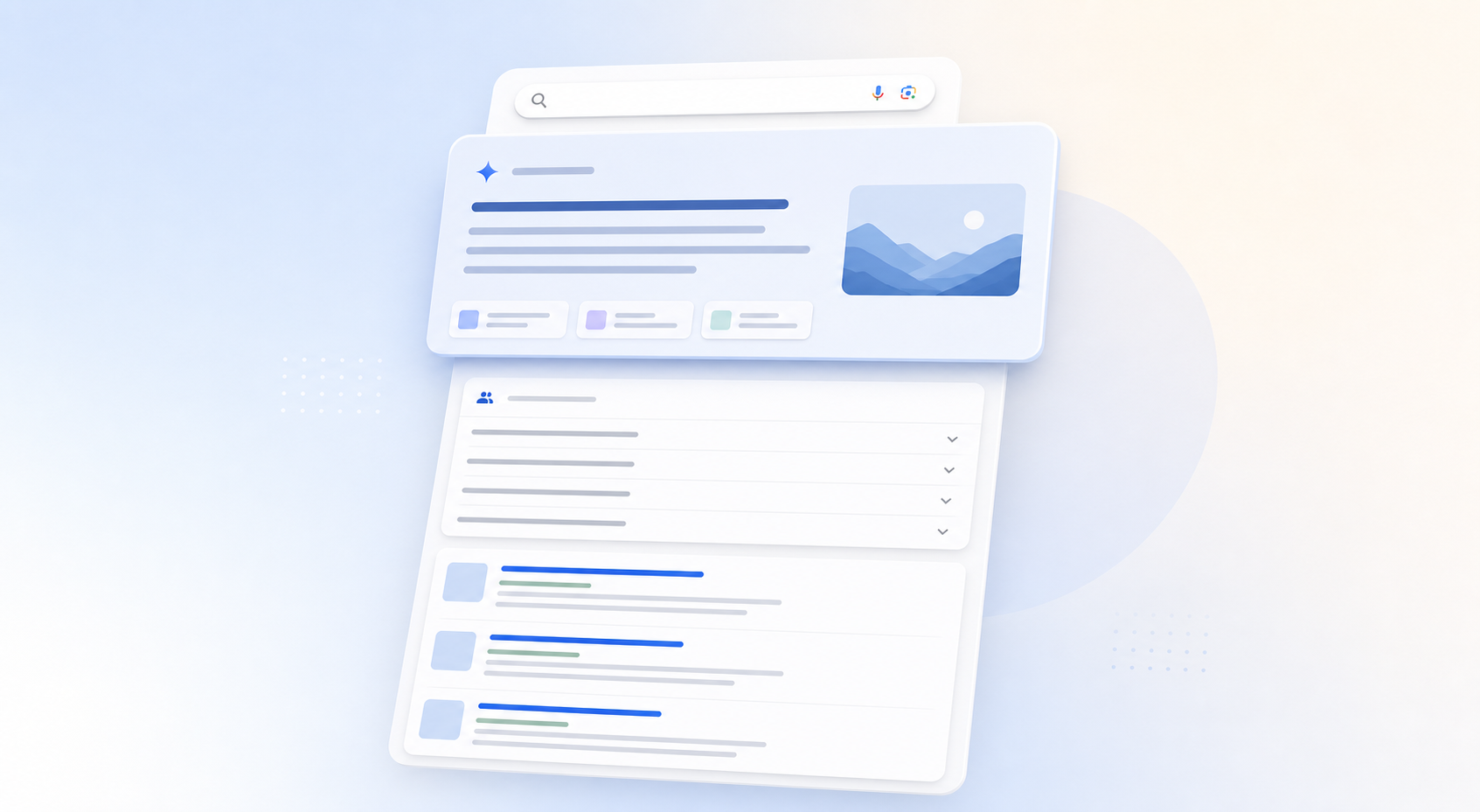
What counts as “the page” has changed. A modern Google SERP often combines an AI Overview at the top, a People Also Ask block, a video carousel, sometimes a featured snippet, and the traditional ten-blue-link organic listings underneath. The classic mental model of “ten organic results per page” is still useful as shorthand, but it’s no longer the whole story. Knowing where your link actually sits inside that SERP — and what’s above it — matters more than knowing your raw rank.
What Is Organic Click Through Rate?
Click-through rate (CTR) is the percentage of people who click on a search result after seeing it. The formula is simple: divide clicks by impressions, then multiply by 100.
If your page appears in 100 search results and 10 people click through, your CTR is 10%. In Google Search Console, an impression is counted every time your URL appears in a SERP a user views, and a click is counted every time someone clicks through to your site from that result. CTR is the link between visibility and traffic.
Why Is Organic CTR Important?
There are two reasons organic CTR keeps coming up in SEO conversations.
The first is direct: CTR is the lever between your rank and your traffic. You can hold position 3 for a high-volume query and still get fewer clicks than the page in position 2, because your title, your description, and the rich features around you all influence whether searchers actually pick your result.
The second is more debated: whether CTR itself influences Google rankings. Backlinko’s CTR-by-position data shows that CTR tends to be higher at higher rankings — which isn’t proof that CTR causes rankings, but it’s hard to ignore. Google has publicly acknowledged using click data in past testimony (its representatives said as much in FTC proceedings years ago), while more recent statements from Google search advocates have been more cautious about CTR’s role. Treat the ranking-signal question as long-running and unsettled. The traffic argument, though, is settled: better CTR at a given rank means more visits, full stop.
Organic Click Through Rate by Search Position: 2026 Benchmarks
Across the major 2026 datasets, average CTR drops sharply with position. The exact numbers depend on the study, the query type, the device, and which SERP features appear, but the shape of the curve is consistent: position 1 takes the lion’s share, the top three results together capture roughly half of all clicks, and the bottom of page one converts at a fraction of those rates.
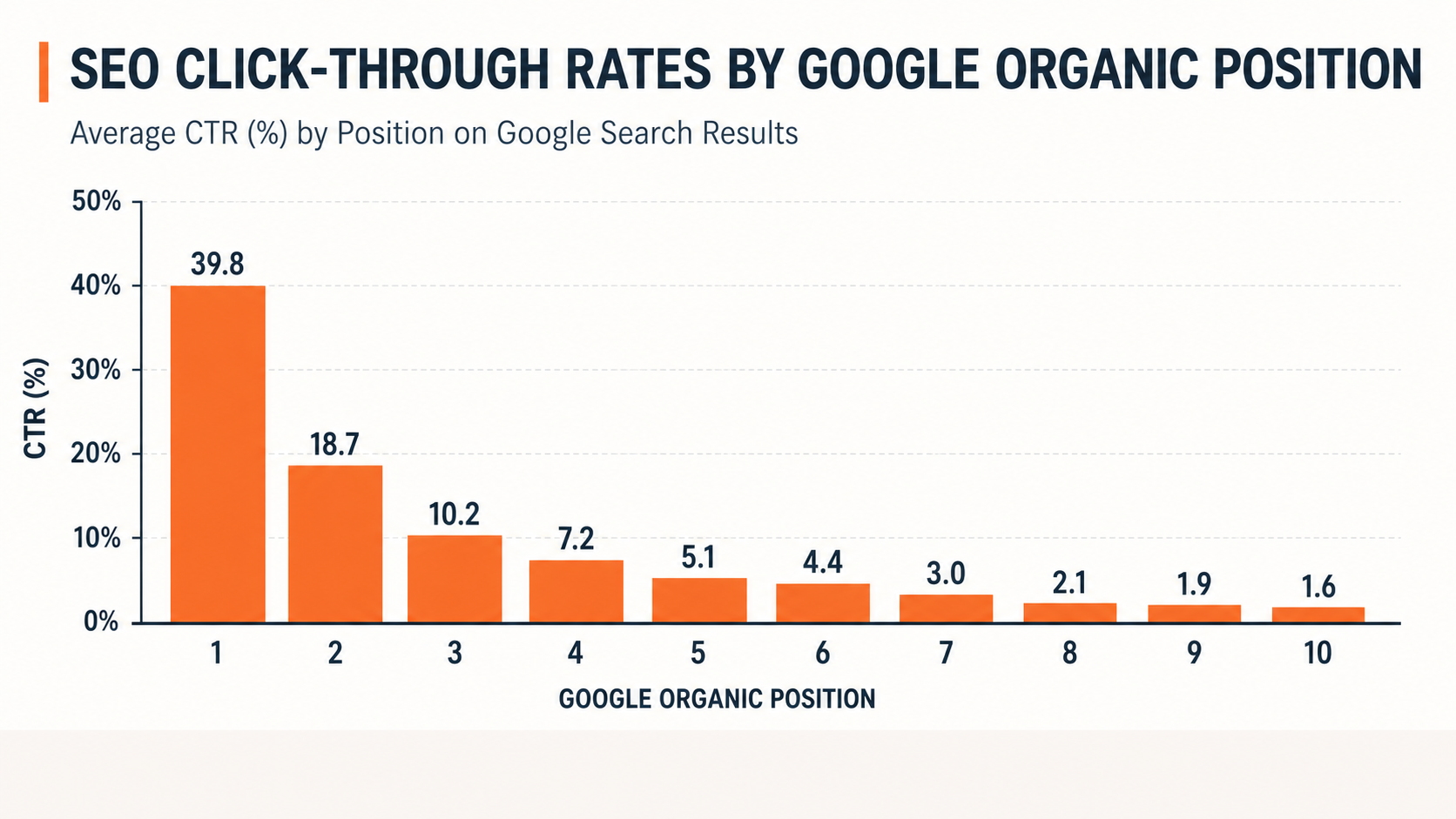
A widely cited 2026 reference table from First Page Sage’s meta-analysis looks like this:
| Google organic position | Average CTR |
|---|---|
| 1 | 39.8% |
| 2 | 18.7% |
| 3 | 10.2% |
| 4 | 7.2% |
| 5 | 5.1% |
| 6 | 4.4% |
| 7 | 3.0% |
| 8 | 2.1% |
| 9 | 1.9% |
| 10 | 1.6% |
That table is one snapshot, not a universal benchmark. Across recent studies, position 1 CTR has been reported anywhere from roughly 20% to 40%, depending on whether the dataset focuses on informational vs. branded queries, on mobile vs. desktop, and on SERPs with or without AI Overviews. Backlinko’s analysis of 4 million search results put the average position 1 CTR at 27.6%. Desktop position-1 CTR tends to run higher than mobile because mobile SERPs surface AI Overviews and rich features more aggressively above the fold.
Move that into revenue terms and the case for ranking higher becomes obvious. Imagine a query that drives 50,000 monthly searches. At position 1’s roughly 27.6% CTR, you’d see about 13,800 monthly clicks. At position 9’s roughly 1.9% CTR, you’d see about 950. With even a modest $5 average value per click, the difference is about $69,000 vs. $4,750 per month for the same query — for the same product, sold to the same audience. The numbers above are an illustration, not a guarantee for any specific query, but the pattern holds: each position up the SERP is worth materially more traffic, and CTR is what makes the math real.
A useful self-test: pull your top queries from Google Search Console, look at the average position alongside the CTR, and compare against the benchmark for that rank. If you’re well below benchmark at your position, the next paragraphs explain why — and what to do about it.
SERP Features CTR: AI Overviews and What Changed in 2026
The biggest change to organic CTR since this article was first written isn’t a new ranking algorithm — it’s the AI Overview block now sitting above many SERPs.
In a February 2026 study, Ahrefs analyzed 300,000 keywords (half with AI Overviews present, half without) and reported that AI Overviews correlate with a 58% reduction in click-through rate for top-ranking pages. The headline quote: “For every 100 clicks you could historically earn for a top-ranking page, Google now ‘keeps’ 58.” Position 2 saw a 50.8% drop, position 3 a 46.4% drop, and the impact shrank further down the SERP.
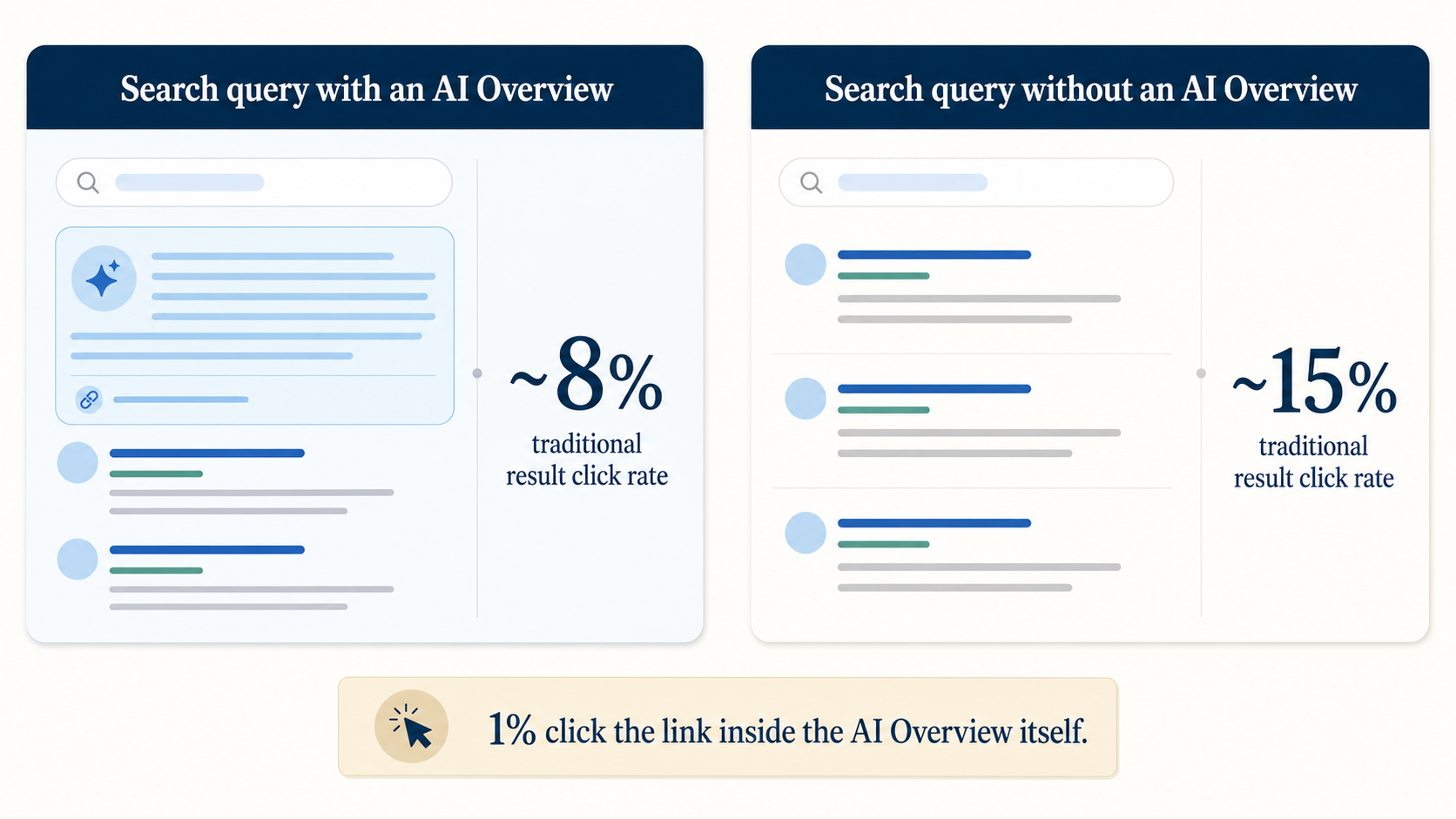
Pew Research Center’s July 2025 study, which tracked actual browsing behavior from 900 U.S. adults, found a comparable pattern from a very different methodology: Google users encountering an AI summary clicked on a traditional search result in 8% of visits, compared to 15% of visits when no summary was present. Only 1% of users clicked a link inside the AI summary itself, and roughly 26% ended their browsing session entirely after an AI summary appeared (vs. 16% without one).
It’s worth noting one outlier: First Page Sage’s meta-analysis argues that AI Overviews have “minimal impact” on organic CTR. The weight of newer evidence, from independent methodologies, runs the other way.
The practical takeaway: position 1 still wins, but the win is smaller and conditional. Two adjustments matter. First, segment your reporting — separate queries that trigger AI Overviews from queries that don’t, because mixing them flattens what’s actually two different click economies. Second, work the citation angle: in an April 2026 Seer Interactive study, pages cited inside an AI Overview earned roughly 120% more organic clicks per impression than uncited pages on the same queries. Citation-lift estimates vary by study period and methodology, but the direction holds, and it’s enough to recover a meaningful share of the AI-Overview loss for queries you can earn that citation on.
Organic CTR vs. Paid CTR
CTR for paid search ads on Google has historically run in the low single digits across most industries — well below organic CTR for top-ranked results. The math behind that gap is straightforward: organic listings sit underneath features and ads on more and more SERPs, but they also benefit from the trust that users put in non-paid results.
A useful comparison. If 100 impressions on a high-intent commercial query produce roughly 30 clicks at position 1 organically and roughly 3 clicks on a paid ad, the per-click economics tilt heavily toward organic for sites with strong rankings — your cost-per-click is whatever you pay your SEO team and content writers, amortized over months and queries. Paid clicks, on the other hand, are predictable and immediate; you pay the bid, you get the click, and you can scale up or down on a daily budget.
Neither channel wins on its own. The sites that hold position 1 for their best queries usually pair that with paid coverage for queries they don’t yet rank for, branded-search defense, and high-intent retargeting. OuterBox runs both sides for clients in SEO and PPC because the right answer for most sites is “do both, and let them feed each other.”
What Affects Organic CTR?
At any given position, a few things move CTR more than anything else.
Title tags. The title is the click magnet on the SERP. Backlinko’s data shows titles between 40 and 60 characters drive about 33% higher CTR than titles outside that range, mostly because they avoid truncation on desktop and mobile. Front-load the keyword, lead with a clear value proposition, and avoid title sentence patterns that read like every other result on the page.
Meta descriptions. Google sometimes rewrites these, but a well-crafted description still gets used often enough to matter — and even when Google rewrites, your description shapes what Google believes the page is about. Make it specific. A vague “learn more about [topic]” loses to a description that names the question and the answer.
URL structure. Keyword-rich URLs correlate with about 45% higher CTR in Backlinko’s analysis. Short, readable, topical URLs outperform parameter-stuffed strings — which is one of several reasons we don’t recommend slug changes on pages with existing rankings unless there’s a specific reason.
Brand recognition and SERP features. The largest single CTR multiplier on real SERPs is whether the user already knows your brand. A trusted brand at position 3 routinely outperforms an unknown at position 1, especially on branded or near-branded queries. SERP features further muddy the picture: an AI Overview, a featured snippet, a video carousel, or a sitelinks pack belonging to a competitor can all push your link below the fold even when your rank looks healthy. Schema markup that earns rich results — review stars where they apply, FAQ where it still renders, HowTo where Google supports it — is one of the few levers that adds visual weight to your listing.
Query format matters too. In Backlinko’s position-1 analysis, 10-to-15-word queries earned about 2.6 times the CTR of single-word queries, because the searcher’s intent is sharper and the SERP is usually less crowded.
How Do You Track Google SERP CTR?
Google Search Console is the primary tool. The Performance report shows clicks, impressions, average position, and CTR for every query, page, country, and device combination. Filter by individual queries to see which terms are underperforming for their rank, then look at the title tag, the meta description, and the SERP composition for those queries before deciding what to change.
A few practical moves:
- Compare against benchmarks for your position. If you’re at average position 4 with a 2% CTR, you’re well below benchmark — there’s likely a title, description, or SERP-feature problem worth investigating.
- Segment by AI Overview presence. GSC doesn’t natively flag AIO-present queries, but you can build a list manually by reviewing your top queries in a private browser, then split your CTR analysis between the two segments. The economics are genuinely different.
- Pair GSC with GA4. GA4 shows what happens after the click — engagement, conversions, revenue. GA4 doesn’t give you CTR directly, so use it alongside GSC, not instead of it.
- Use external tools sparingly. Advanced Web Ranking publishes a free Google Organic CTR tool that’s useful as a sanity check on your own GSC numbers, but it’s a benchmark, not your data.
Get the CTR Boost You Need With OuterBox
OuterBox has 20+ years of experience providing full-service search engine optimization. Whether you need SEO consulting to fix a specific CTR problem, a full SEO package to lift rankings and clicks together, or Google Ads management to fill the gaps where organic doesn’t yet rank, our team has the playbook.
Get a free estimate and let’s talk about what’s possible for your site.