By: Jeff Hirz
Maybe you still can’t woo the world’s largest search engine with candy and flowers. But you can make your site much easier for Google to understand, crawl, trust, and show in search results.
That is what “Google loves” should mean in 2026. Not tricks. Not a secret switch. Not changing a date stamp and hoping rankings move. Strong Google SEO comes from pages that help real people, give crawlers clean signals, and build trust over time.
If your site has been left alone for years, the fix is not always a full rebuild. Start with the fundamentals: content, relevance, URLs, speed, links, and authority. OuterBox’s SEO services team works through those basics every day, because durable rankings usually come from getting the simple things right and keeping them right.
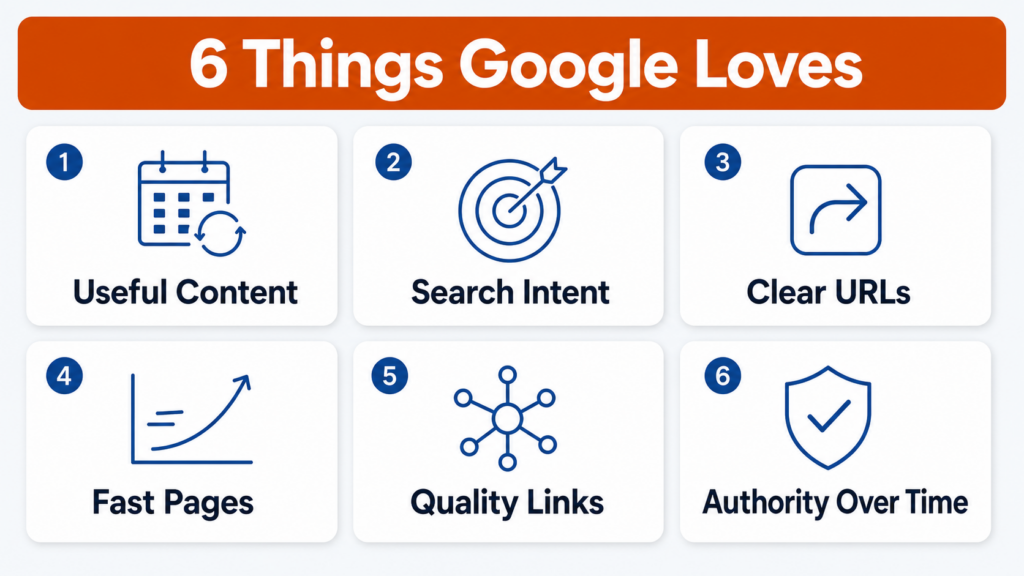
6 Ways To Make Search Engines Love Your Site
- Keep useful content current.
- Match each page to the reader’s search intent.
- Use clear URLs and a crawlable site structure.
- Make important pages fast and easy to use.
- Build links that help people and earn trust.
- Grow authority with proof, consistency, and time.
1. Keep Useful Content Current
Google does not reward freshness for freshness’ sake. A page updated only to change the date is not suddenly more helpful. Google has said its systems are built to reward helpful, reliable, people-first content, and it specifically warns against making pages look fresh when the content has not substantially changed.
That does not mean old content should sit untouched. It means content updates need a reason. A product changed. A process changed. Screenshots are stale. Source links are dead. Pricing or terminology moved. Search intent shifted. The page no longer answers the question as well as it used to.
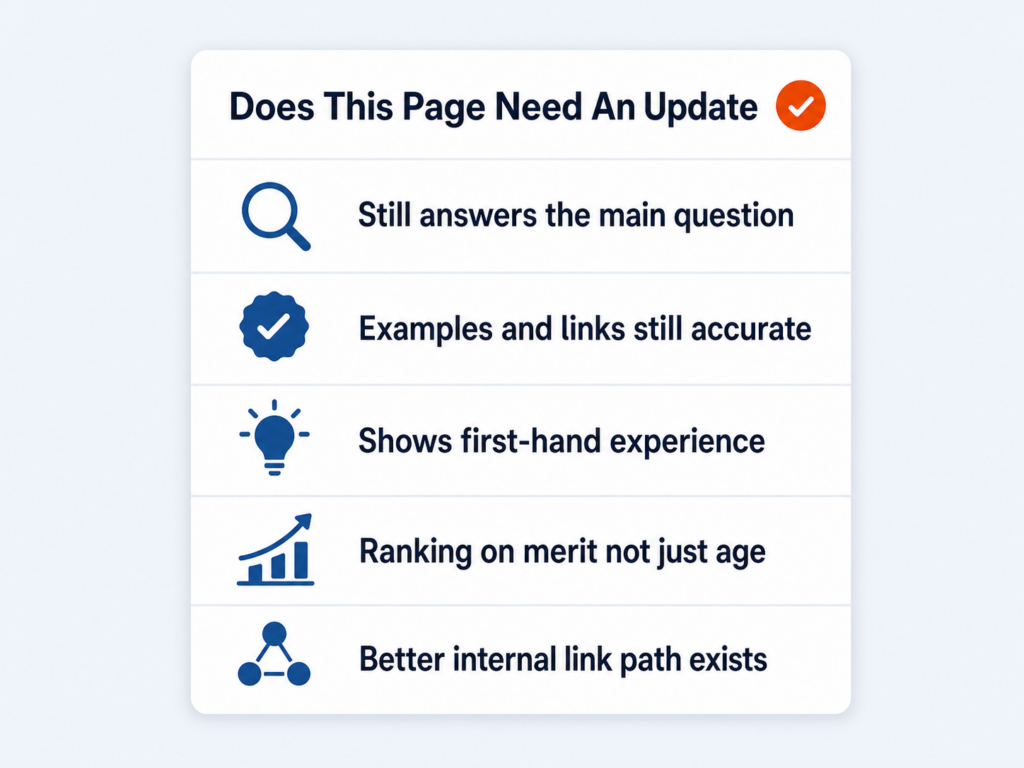
Run content audits around those signals, not around a calendar reminder alone. For each important article or service page, ask:
- Does the page still answer the searcher’s main question?
- Are examples, screenshots, stats, and links still accurate?
- Does the page include first-hand experience or expert review?
- Are weak sections ranking because of age, or because they still help?
- Is there a better internal link path to the page now?
Google’s SEO Starter Guide says content should be useful, organized, unique, up-to-date, and people-first. The “up-to-date” part matters most when the topic actually changes. A legal update, a Shopify platform change, a Google documentation change, or a new pricing model deserves a real refresh. A timeless explanation may need only a light cleanup.
An SEO audit should separate those cases. Some pages need a rewrite. Some need a source update. Some need consolidation. Some should be left alone because their existing explanation is still the clearest answer on the site.
2. Match Each Page To Search Intent
Relevant content still builds SEO value. The old version of this article said Google wants your website to be everything you say it is. That is still a useful way to think about search intent.
If a title promises a pricing guide, the page needs real pricing guidance. If a service page promises technical SEO, it needs to talk about crawling, indexing, JavaScript, canonical tags, structured data, site speed, and implementation. If an article promises six SEO things Google loves, the reader should leave with six practical areas to inspect.
Google’s helpful content guidance pushes the same idea from the reader’s side. Will someone leave feeling they learned enough to achieve their goal? Does the content demonstrate experience or expertise? Would a reader trust the page because the sourcing, author, site reputation, and facts hold up?
Use a quick intent check before you rewrite a page. What did the searcher probably know before they clicked? What decision are they trying to make next? Which details would make them trust the answer: a process, a price range, a technical limitation, a source, or a real example? Those answers should shape the page more than a keyword count.
That is why keyword matching alone is not enough. A page can repeat the right phrase and still miss the job. Strong SEO content usually does three things at once:
- Answers the obvious query quickly.
- Adds expert detail the reader did not know to ask for.
- Gives the next step without turning every paragraph into a sales pitch.
For OuterBox content, that means plain explanations, real tradeoffs, and calm specificity. A page should not sound like it was written to satisfy a spreadsheet. It should sound like someone who has fixed the problem is walking the reader through what matters.
3. Use Clear URLs And A Crawlable Site Structure
Google does not need a perfect URL to understand a page, but clear URL structure still helps users and search engines. The SEO Starter Guide notes that URL parts can appear as breadcrumbs in search results, and that useful words in a URL help people understand what a result is about.
The old article used a simple example: a page called bean-bag-chairs.html tells a clearer story than page1.html. The modern version of that advice is broader:
- Use readable words instead of long IDs when you can.
- Use hyphens between words.
- Keep URL parameters under control.
- Group related pages in logical directories.
- Keep canonical tags, sitemaps, and internal links consistent.
- Avoid changing established URLs unless there is a real migration reason.
Google’s URL structure guidance also warns that overly complex URLs with many parameters can create crawl inefficiency. That matters for eCommerce sites, filtered category pages, blog archives, search result pages, and any site where one page can turn into dozens of near-duplicates.
This article’s own URL is a good example of a page identity worth preserving: /articles/seo/six-seo-things-google-loves/. It is readable, topical, and already tied to the article’s history. Changing it to chase a cleaner keyword would create migration risk without improving the reader’s experience.
Technical SEO is where these details get checked together. A URL can look fine in the browser while the canonical tag points somewhere else, the sitemap lists a redirected path, or internal links keep sending Google through old versions. Google can often sort that out, but clean signals make its job easier.
4. Make Important Pages Fast And Easy To Use
Google cares about page experience because users care about page experience. A slow page makes every other SEO investment work harder. A cluttered page hides the answer. A broken mobile layout turns useful content into a frustrating visit.
Speed is part of that, but it is not the whole story. Google’s page-experience guidance says site owners should not focus on only one or two aspects. The AI Search guidance says pages should display well across devices, load with acceptable latency, and make the main content easy to distinguish from everything around it.
Start with the pages that matter most: service pages, top articles, category pages, product pages, and conversion paths. Then check the causes users actually feel:
- Large images or videos loading before they are needed.
- JavaScript that delays the main content.
- Fonts, scripts, or third-party tags blocking rendering.
- Layout shifts that move buttons or text while the page loads.
- Popups, ads, or modules that crowd the answer.
- Mobile templates that hide important copy or links.
Core Web Vitals can help diagnose the problem, but the business question is simpler: can a visitor get the answer, trust the page, and take the next step without friction?
That is why speed work belongs beside crawl and content work. A page that is fast but thin will not earn durable rankings. A page that is useful but painfully slow may lose the reader before the value lands. Google loves the combination: useful content, accessible code, and a page experience that lets the answer do its job.

5. Build Links That Help People And Earn Trust
Links still matter, but the word “links” covers several different jobs.
Internal links help Google and users understand how your pages relate. A blog post about SEO fundamentals can point readers toward an audit, a technical SEO service, or a deeper article on eCommerce SEO strategy when those links genuinely help. A service page can point to supporting case studies, FAQs, related services, or comparison resources.
External links help when they support the page’s claims. A source link to Google Search Central is useful because it lets readers verify guidance. A citation to a study, documentation page, or original data source can make a page more trustworthy.
Earned backlinks are different. When relevant websites cite your page because it is useful, original, or authoritative, that can strengthen trust and discovery. Google’s ranking systems guide still describes link systems, including PageRank, as part of how Google understands pages. But PageRank has evolved, and spam systems are built to handle manipulative link behavior.
So the practical rule is simple: build pages worth linking to, and use links to make the reader’s path clearer.
Avoid the shortcuts that create cleanup work later:
- Irrelevant directory links.
- Paid links placed only for ranking value.
- Guest posts with thin, recycled content.
- Footer or sidebar links repeated across unrelated sites.
- Internal exact-match anchors repeated unnaturally.
Google does not need you to hoard links or force them into every paragraph. It needs a site structure that makes sense, citations that support the page, and real reasons for other sites to reference your work.
6. Grow Authority With Proof, Consistency, And Time
The old article said older domains often rank better. There is a truth underneath that, but age alone is not the strategy.
Older sites often have advantages because they have had more time to publish useful pages, earn links, build brand recognition, collect reviews, improve templates, fix technical problems, and develop topical depth. Those are authority signals. The calendar is not the point. The proof accumulated over time is the point.
Google’s helpful content documentation says its systems aim to identify content that demonstrates experience, expertise, authoritativeness, and trustworthiness. It also says trust is the most important part of that mix. For business sites, trust shows up in practical ways:
- Clear authorship or expert review.
- Accurate claims and current sources.
- Real examples, case studies, and proof where available.
- Consistent service and topic coverage.
- A site structure that shows which pages are central.
- Helpful pages that solve related problems, not one-off keyword stubs.
Authority also comes from restraint. Do not publish a page just because a keyword exists. Do not expand a section because a competitor wrote more words. Do not promise results the page cannot support. Durable SEO grows when the site becomes a better source, not just a bigger one.
OuterBox has worked in SEO since 2004, and that history matters because the work has changed many times. The fundamentals have not disappeared. Helpful content, clean technical signals, useful links, and earned trust keep holding up because they serve both people and search engines.
How To Make Google Love Your Site Without Chasing Every Signal
Google uses many ranking systems and many signals. That can make SEO feel like a moving target, but the first pass does not need to be complicated.
Start by checking the pages that already matter to revenue or visibility. Are they helpful? Are they current where they need to be? Do the URLs, canonicals, and internal links agree? Can Google access the content? Does the page load cleanly on mobile? Do sources, proof, and links make the page easier to trust?
Then prioritize by impact. Fix crawl and indexation blockers before polishing a paragraph. Fix thin high-value pages before expanding low-value posts. Clean up internal links before chasing risky backlinks. Update stale pages because readers need better information, not because the date looks old.
That is the kind of SEO Google tends to reward because it is the kind of SEO users can feel.
FAQ About What Google Loves For SEO
What does Google love most for SEO?
Google rewards helpful, reliable, people-first content supported by clean technical signals and trustworthy site authority. No single tactic is enough. Strong SEO usually combines useful answers, crawlable pages, clear structure, good user experience, and links that help people verify or explore the topic.
Does Google love fresh content?
Google values fresh content when freshness matters to the query. A page about current pricing, platform settings, or legal rules may need frequent updates. A timeless explanation may not. Changing dates without a real content update is not a useful SEO strategy.
Do URLs still matter for Google SEO?
URLs still matter because they help users, search engines, and site owners understand page relationships. Descriptive URLs, logical folders, consistent internal links, and clean canonical signals make crawling and interpretation easier. Do not change a stable URL unless the migration benefit outweighs the risk.
Are backlinks still important for Google rankings?
Backlinks can still support discovery and authority, but quality, relevance, and trust matter more than raw link count. Internal links and external citations matter too. Avoid link schemes, paid ranking links, and low-quality placements that create risk without helping readers.
How often should I update SEO content?
Update SEO content when the page is stale, inaccurate, incomplete, underperforming, or missing important reader intent. Some pages need quarterly review. Others only need annual checks. The trigger should be usefulness and accuracy, not a blanket publishing schedule.
Bring The Fundamentals Back Into Focus
SEO gets noisy because the details change. Google updates systems, competitors publish more content, AI search changes how people ask questions, and technical debt builds quietly in the background.
The steady path is still the same: make important pages useful, clear, fast, connected, and trustworthy. If your site needs that kind of cleanup, OuterBox can help you diagnose what matters first and build an SEO plan that holds up beyond the next update.