By: Jeff Hirz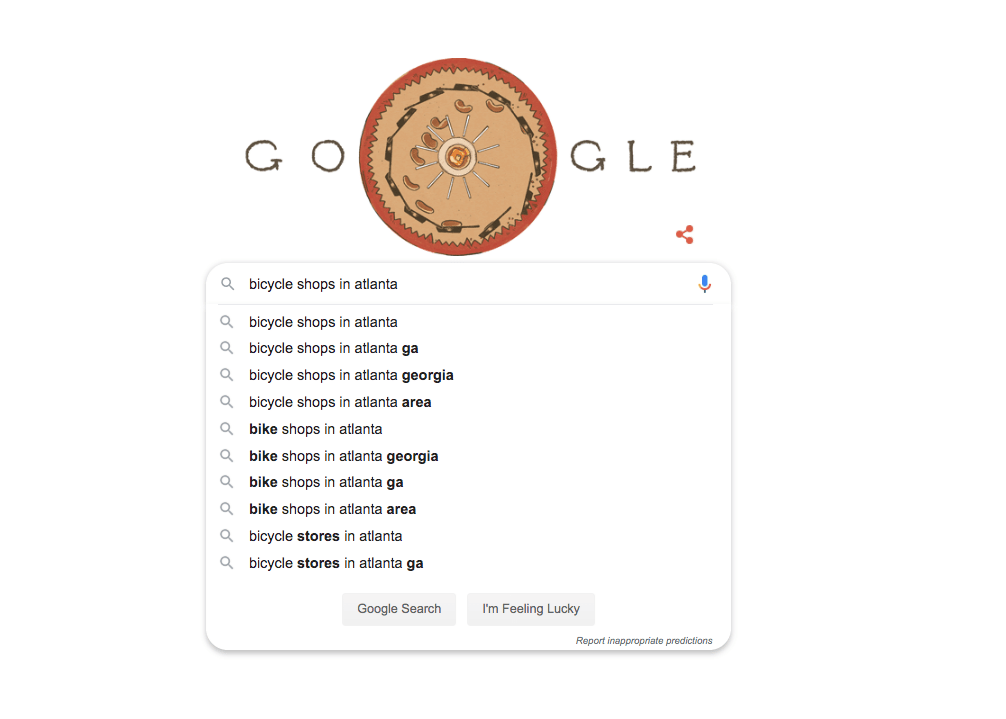
SEO is one of those marketing terms that gets used everywhere and explained badly. Business owners hear it in sales calls. Marketing teams see it in reports. Leaders know they probably need it, but still ask the practical question: what is SEO, and how does SEO work on a real website?
Search engine optimization is not a shortcut for tricking Google. SEO works by making your website easier for search engines to crawl, understand, index, and show for relevant searches, while making the page useful enough that a real person wants to choose it.
What Is SEO?
SEO stands for search engine optimization. In plain terms, SEO is the process of improving a website so search engines can understand its pages and users can find those pages when they search for something relevant.
Think about a bicycle shop in Atlanta. If someone searches for “bicycle shops in Atlanta,” the search engine has to decide which local pages are relevant, trustworthy, and useful enough to show. SEO helps that bicycle shop explain what it sells, where it is located, which pages matter, how customers can contact the business, and why the page deserves to appear for that search.
Google’s SEO Starter Guide frames the work around both search engines and users. That matters. A page written only for a crawler usually reads badly to people. A page written only for people, but hidden behind poor structure or technical issues, may never get the chance to perform.
Good SEO sits in the middle: useful content, clean technical setup, clear page structure, and enough authority signals for search engines to trust the result.
How Does SEO Work?
SEO works by improving how a page moves through the search process. Google Search Central describes that process in three broad stages: crawling, indexing, and serving search results.
Crawling is discovery. Google finds URLs through links, sitemaps, and pages it already knows about. If important pages are buried, blocked, broken, or missing from internal links, they may be harder for crawlers to reach.
Indexing is understanding and storage. After a page is crawled, Google analyzes the content, title, images, canonical signals, and other page information. Crawling does not guarantee indexing. Thin, duplicate, blocked, low-quality, or technically confusing pages can still be left out.
Serving results is the ranking moment. When someone searches, Google looks through its index and returns pages it believes are relevant and useful for the query. Search results can change based on language, location, device, search intent, freshness, and many other signals.
SEO improves each stage. Technical work helps search engines reach the page. Content work helps them understand it. Authority and trust signals help the page compete when several good answers exist.
Organic SEO is separate from paid search. Google does not accept payment to crawl a site more often or rank a page higher organically. Ads can buy visibility in ad placements. SEO earns visibility in the unpaid results.
What Is Website SEO?
Website SEO is the ongoing work of making a site clear, accessible, useful, and competitive in organic search. It is not as simple as putting one phrase in a homepage title.
The bicycle-shop example still works here. A homepage title like “The Best Bicycle Shop in Atlanta” might help describe the business, but it does not solve SEO by itself. The site also needs service pages, product or repair information, local details, internal links, readable copy, fast pages, working forms, reviews, accurate business information, and content that matches what people actually search.
Website SEO also has to hold together across the full site. A strong article can struggle if it has no internal links. A useful product page can disappear if filters create duplicate URLs. A service page can rank for the wrong query if the heading, title, and body copy point in different directions.
Search engine optimization works best when every important page has a clear job.
The Four Main Parts of SEO
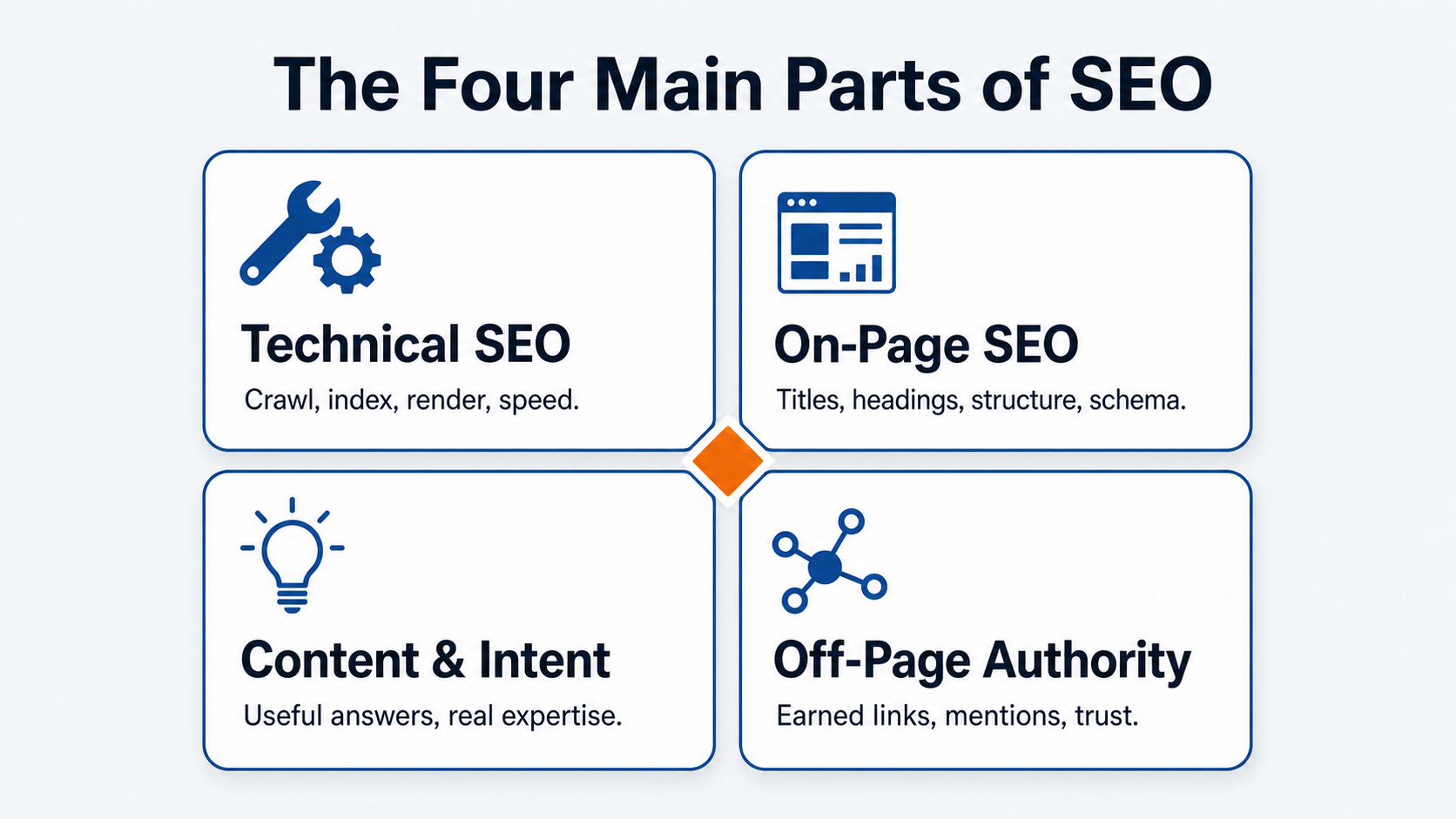
Most SEO work falls into four connected categories: technical SEO, on-page SEO, content and search intent, and off-page authority. The categories are useful because they show where a problem lives, but they should not be treated as separate projects. A page usually needs several of them working together.
Technical SEO
Technical SEO helps search engines access, render, and understand your site. It includes crawl paths, indexation controls, redirects, canonical tags, XML sitemaps, page speed, mobile usability, structured data, JavaScript rendering, and broken-link cleanup.
Technical work matters because a page cannot perform if Google cannot reach it or understand the version you want indexed. JavaScript is a good example. Google can render JavaScript with a recent version of Chrome, but important navigation, copy, product listings, or metadata can still create SEO problems if they are hard to access reliably.
On-Page SEO
On-page SEO is the work done on a specific page to clarify its topic and value. Titles, meta descriptions, H1s, H2s, image alt text, internal links, schema, and body copy all help search engines and users understand what the page is about.
On-page SEO should make the page clearer, not louder. Repeating a keyword over and over is not strategy. Google’s spam policies call out keyword stuffing because unnatural repetition is written to manipulate rankings, not help users.
Content and Search Intent
Content gives the page something useful to rank with. Strong SEO content answers the searcher’s real question, uses the language they use, and gives them enough context to act.
The old version of SEO advice often centered on keywords and density. That misses the point. A page about bike repair should answer the repair questions customers actually have, show the shop can handle those problems, and guide the visitor to the next step. The keyword helps name the topic. It does not replace usefulness.
Google’s people-first content guidance is a useful standard: content should help readers achieve their goal, show real knowledge, and avoid being written mainly to attract search traffic.
Off-Page SEO and Authority
Off-page SEO covers signals outside your website that help people and search engines understand whether your business is credible. The biggest piece is still links: relevant, earned links from trusted sites can help search engines discover and evaluate your pages.
Link building should not mean buying links, swapping links at scale, or manufacturing citations just to manipulate rankings. Google’s spam policies treat manipulative link schemes as link spam.
Social media can still support SEO, but not because a certain number of likes or shares automatically lifts a page in Google. Google’s documentation frames social promotion as a way to help interested audiences and search engines discover content. Treat social as distribution and trust-building, not a direct ranking switch.
Why SEO Matters for a Business
OuterBox looks at SEO as a path to customers and sales, not just traffic. Rankings matter because they can put the right page in front of the right person at the right moment. But a rank report is only the middle of the story.
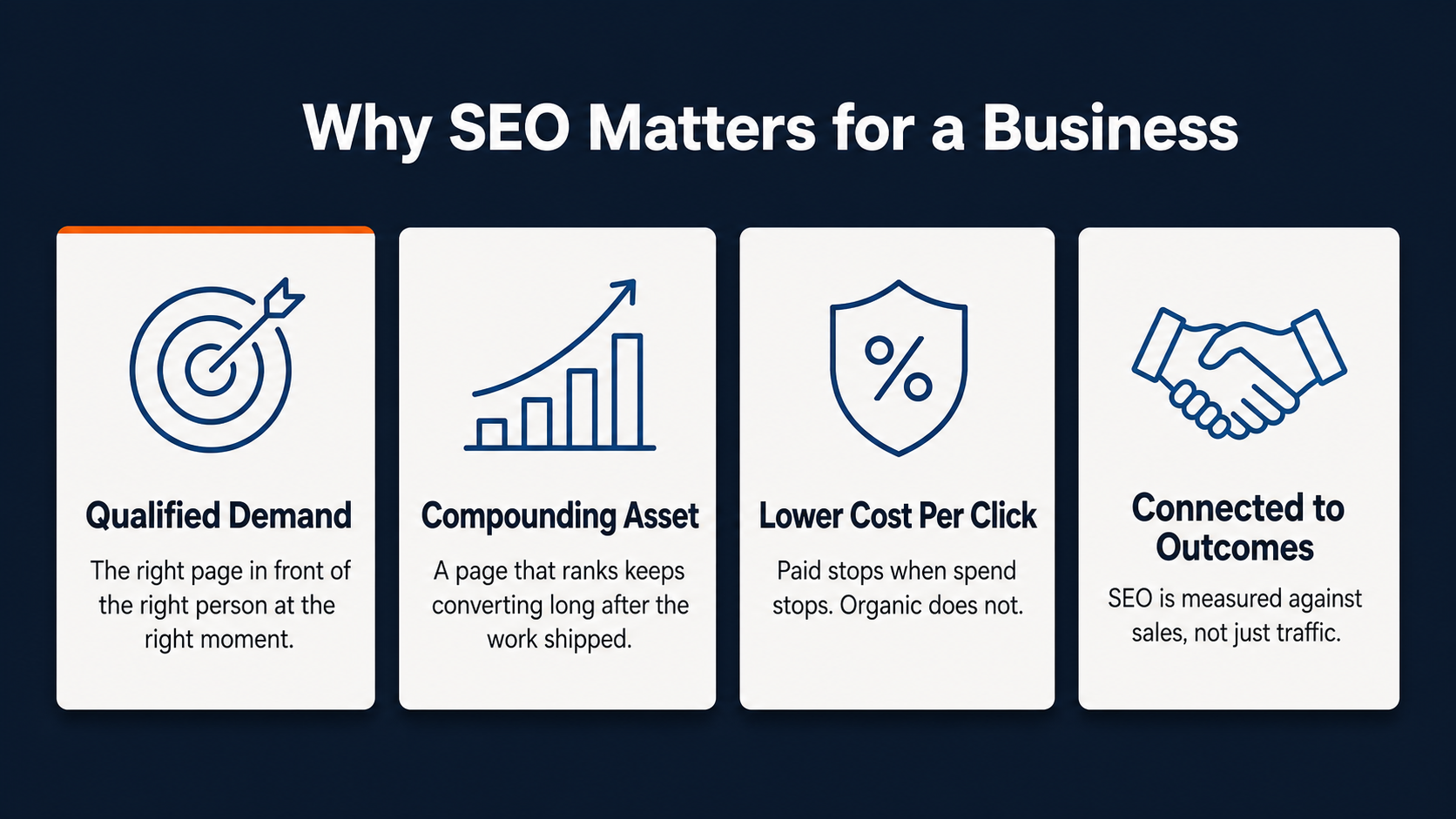
SEO can help a business earn qualified demand without paying for every click. A service page can bring in prospects comparing agencies. A category page can capture shoppers before they know a brand by name. A how-to article can answer a question early and build trust before the sales conversation starts.
SEO also compounds when the foundation is strong. Paid media stops when spend stops. A useful page that ranks, earns links, and keeps converting can support the business for months or years, as long as it stays accurate and competitive.
That does not make SEO free or automatic. It takes technical work, content decisions, authority building, measurement, and maintenance. The value is that the work builds an asset your business owns.
How Long Does SEO Take to Work?
SEO does not usually improve a website overnight. Search engines need time to crawl changes, process them, compare your pages against other results, and gather enough signals to decide whether visibility should change.
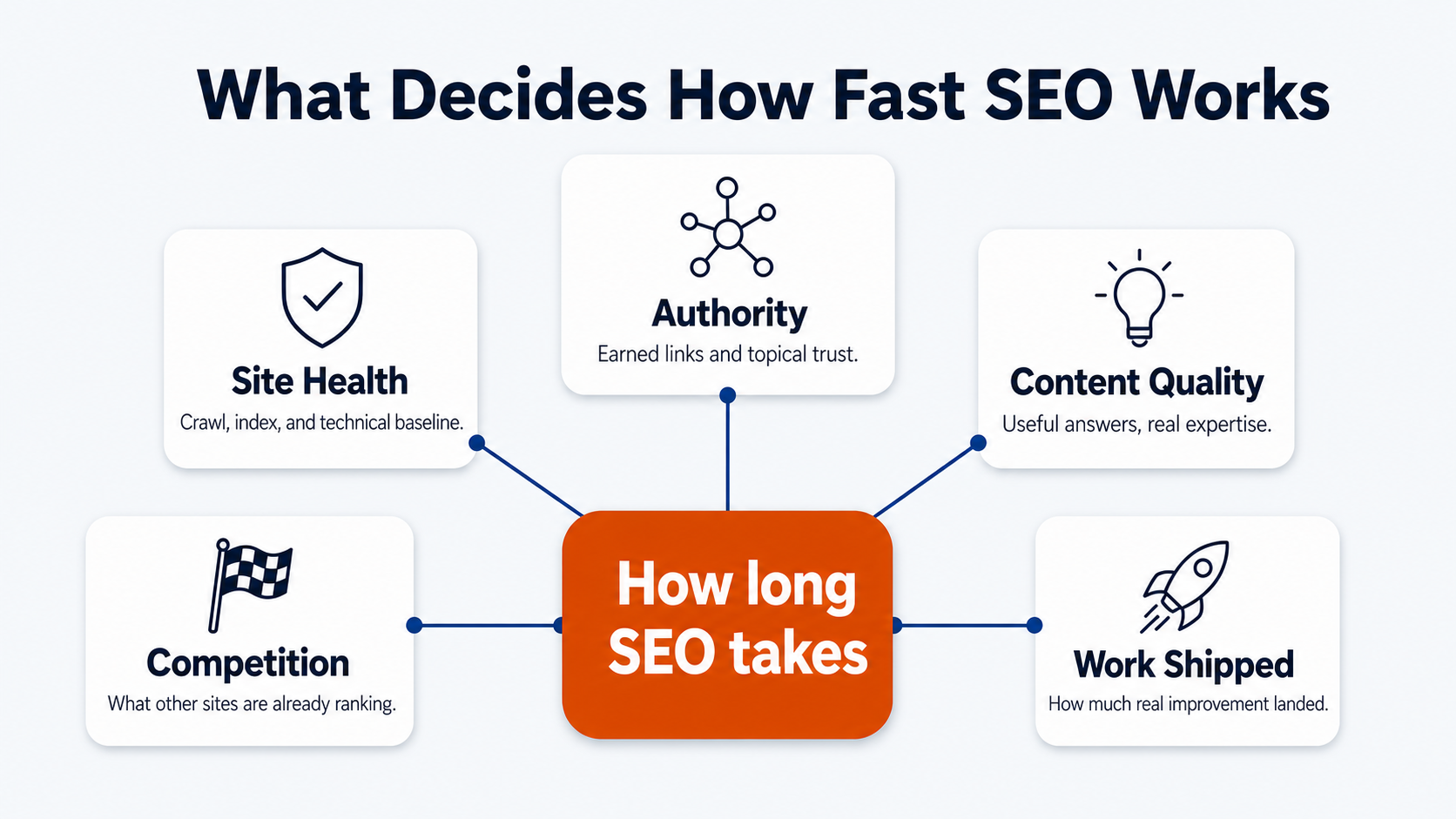
How long SEO takes depends on the site. A healthy site with clear pages and existing authority can move faster than a site with technical problems, thin content, weak links, or heavy competition. A local service page and a national eCommerce category page are not playing the same game.
The more useful question is not “how fast can SEO work?” It is “what needs to be fixed first?” A crawl issue may need immediate technical work. A page targeting the wrong intent may need a rewrite. A strong page with weak authority may need better internal links and outside citations.
For a deeper breakdown, see our guide on how long SEO takes.
How Do You Know Whether SEO Is Working?
SEO is working when visibility turns into meaningful business movement. Rankings are part of that, but they should not be the only measure.
Google Search Console shows impressions, clicks, average position, indexed pages, and many crawl or indexing issues. Analytics and CRM data show what happens after the click: engaged visits, form submissions, calls, qualified leads, assisted conversions, and revenue.
The right measurement depends on the page. An article may be judged by qualified organic traffic, assisted conversions, internal-link movement, and visibility for informational queries. A service page should be judged closer to the business outcome: calls, forms, opportunities, and revenue influence.
OuterBox’s approach to measuring SEO performance starts with that distinction. Traffic is useful. Traffic that never reaches the right audience is a vanity metric.
How AI Search Changes the SEO Conversation
Search results now include more than blue links. AI Overviews, AI Mode, featured snippets, People Also Ask results, local packs, shopping results, and rich results can all change how someone sees information before clicking.
AI search does not erase the fundamentals. Google’s AI Search materials still describe experiences that connect people with links, sources, brands, and websites. That means clear, crawlable, trustworthy pages still matter.
The practical change is that content has to be easier to understand and cite. Pages should answer the main question directly, use clear headings, identify entities consistently, support claims with sources where needed, and avoid burying the answer under filler.
For more on this shift, read our guide to AI search optimization.
A Simple SEO Starting Point
If you are starting from zero, use the four SEO categories in order. First, confirm important pages can be crawled and indexed. Then match each priority page to a real search intent. Next, improve titles, headings, copy, and internal links on those pages. Technical fixes move to the front when something is broken; otherwise, fix blockers as they surface. Once the page deserves attention, work on earning relevant links and mentions. Finally, measure outcomes, not just rankings.
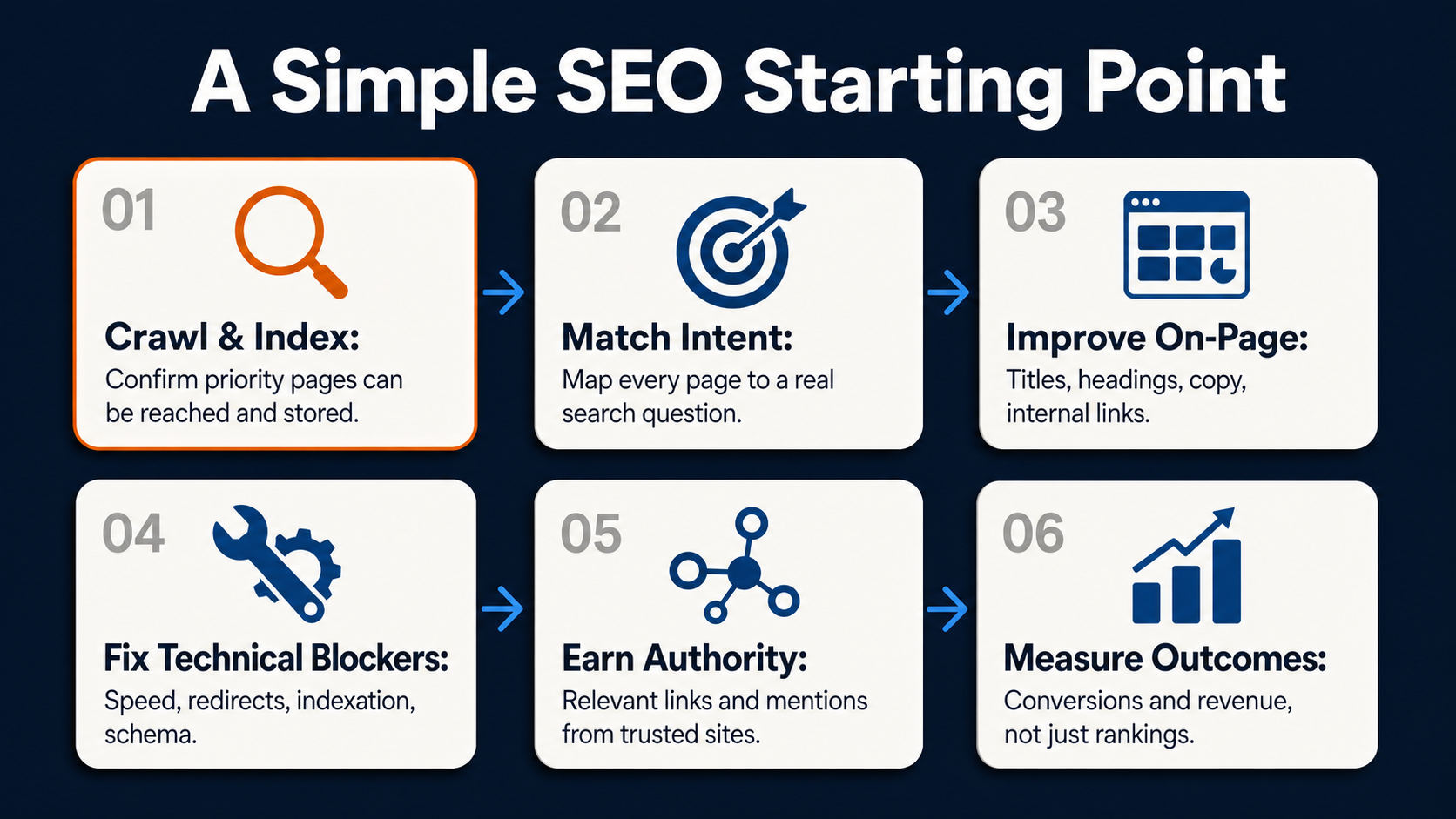
That order keeps SEO practical. It prevents teams from chasing backlinks to a page that does not answer the query, or rewriting copy on a page Google cannot index.
Frequently Asked Questions About SEO
What is SEO in simple terms?
SEO is the work of improving a website so search engines can understand it and people can find it when they search. Good SEO combines technical setup, useful content, clear page structure, internal links, and authority signals.
How does SEO work step by step?
SEO works by helping pages move through crawling, indexing, and ranking. Search engines discover URLs, analyze the page, store eligible content in an index, then return the most relevant results when someone searches.
What is the difference between SEO and paid search?
SEO earns visibility in unpaid search results. Paid search buys ad placement. Both can support a search strategy, but paying for ads does not make Google crawl more often or rank a page higher organically.
Can I do SEO myself?
You can handle basic SEO yourself if you understand your audience, pages, and website platform. Start with crawlability, clear titles, useful content, internal links, and Search Console. Larger or more competitive sites usually need deeper technical and strategic support.
How long does SEO take to work?
SEO timing depends on site health, competition, authority, content quality, and the amount of work shipped. Some fixes can be noticed quickly, but meaningful organic growth usually takes sustained improvement rather than one isolated update.
Is SEO still worth it with AI search?
SEO is still worth it because AI search still depends on clear, accessible, trustworthy web sources. The work is shifting toward stronger answers, better structure, real expertise, and broader visibility across search features, not away from SEO fundamentals.
What Is SEO and How It Works
Let's Map Out Your SEO Plan
Tell us where the site stands today and what you want SEO to do for the business. We’ll review your pages, your visibility in search, and the work most likely to move the needle. No rank guarantees, just a practical plan.
Services
"*" indicates required fields
Turn SEO Basics Into a Plan
SEO starts with understanding how search works, but it only becomes valuable when that understanding turns into priorities. Which pages should rank? Which pages are blocked? Which topics matter to customers? Which fixes are likely to create business movement?
OuterBox helps companies answer those questions and turn them into practical SEO services work. The goal is not to chase every possible ranking. It is to build a search foundation that brings the right customers to the right pages and keeps improving over time.