By: Adam Littell
Press release SEO has changed. A release can still help people discover your company, your news, and the page you want them to visit. It just should not be treated as an easy way to manufacture authority through syndicated links.
The old playbook was simple: write a release, distribute it widely, add keyword-rich links, and hope those links helped rankings. Google has spent years reducing the value of that kind of shortcut. Its spam policies specifically call out links with optimized anchor text in press releases distributed on other sites when those links are meant to pass ranking credit (Google Search Central).
That does not mean a press release has no SEO value. It means the value is different. A strong release can earn coverage, reinforce brand and entity signals, send referral traffic, support branded search demand, create a useful owned news page, and give journalists or industry sites a clear source to cite. The release helps search when it is newsworthy first and optimized second.
This guide keeps the original OuterBox framework: research, stronger copy, keywords, headlines, the 5 Ws, natural links, visuals, and a clear call to action. The difference is the 2026 filter. Every SEO press release decision should pass the same test: does this help a real reader, reporter, customer, partner, or search engine understand the news more clearly?

8 Steps to Optimize a Press Release for SEO
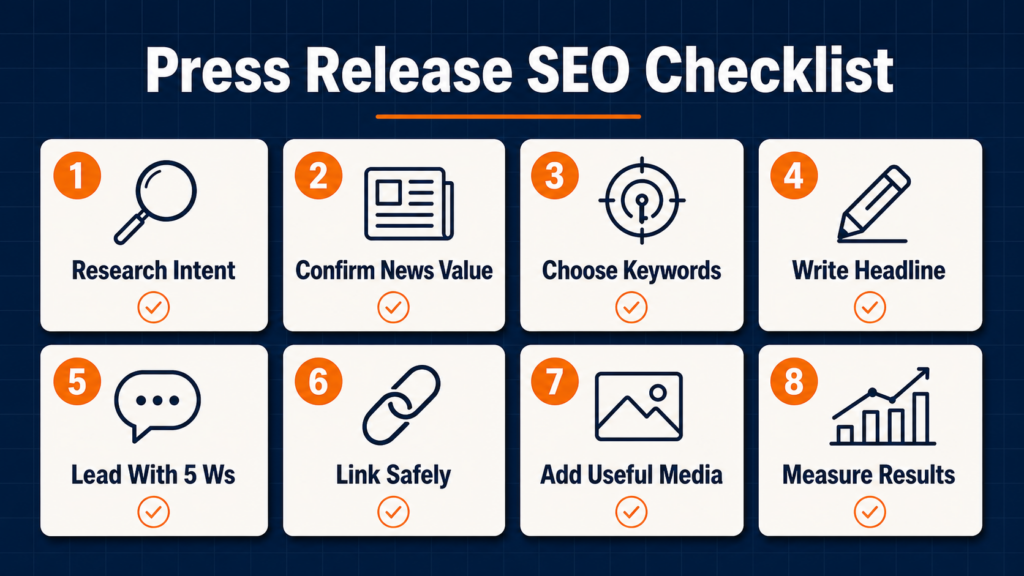
Use this checklist before drafting, distributing, or publishing a press release for SEO:
- Research search intent, competitors, publications, and audience questions before writing.
- Make the release newsworthy enough that someone outside your company would care.
- Choose press release keywords that match the announcement and the page you want readers to find.
- Write a headline and summary that are clear to searchers and useful to journalists.
- Lead with the 5 Ws: who, what, when, where, and why.
- Use links safely, sparingly, and only when they help the reader.
- Add useful visuals, accessible media, and structured data on your owned page.
- Close with a goal-specific call to action and measure what happens after the release goes live.
Those steps are intentionally practical. Press release SEO best practices are not about turning PR copy into a keyword landing page. They are about helping a real announcement travel farther without creating SEO risk.
Do Press Releases Still Help SEO?
Press releases can help SEO, but usually through indirect paths. A distributed release link is rarely the ranking asset people imagine. The release is more useful when it creates discoverable source material that other people can cover, quote, reference, or search for later.
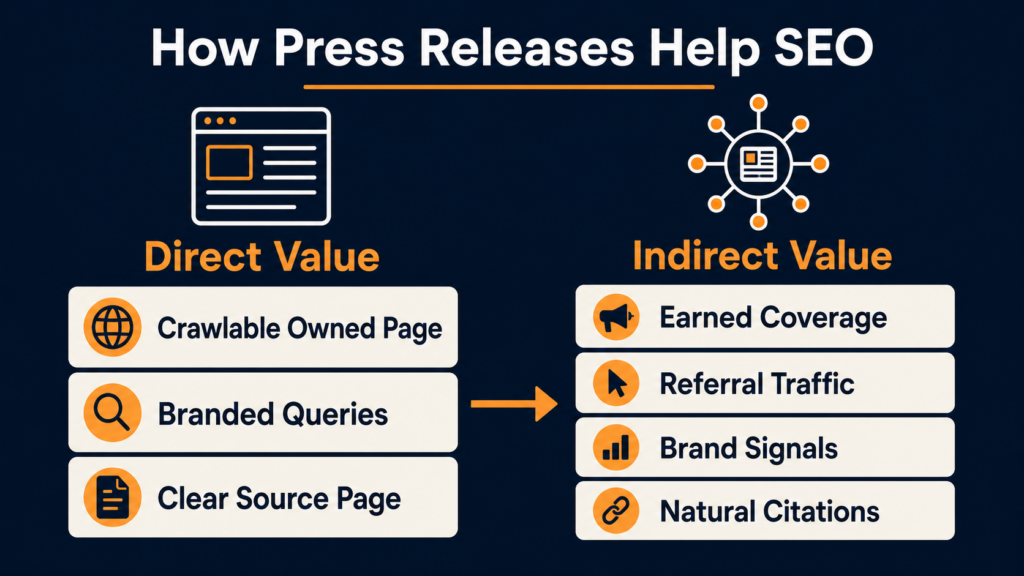
The cleanest way to think about press release and SEO value is to separate the direct and indirect benefits.
Direct SEO value can come from your owned press release page if it is crawlable, well structured, internally linked, and useful. That page can rank for branded announcements, product launches, executive hires, funding news, event names, local announcements, or other specific queries. It can also give Google and users a clear source for the announcement.
Indirect SEO value comes from what the release helps trigger. A journalist may cover the story. A trade publication may cite your data. A partner may share the launch. A local business journal may mention your company. Branded searches may increase after the announcement. Referral traffic may introduce qualified visitors who later return through organic search. Those outcomes are harder to force, but they are much safer and more valuable than chasing low-quality syndicated links.
This is where press releases fit with link building. A release should support earned links, not pretend every syndication link is earned authority. If the story is thin, the release will not become valuable just because it was distributed. If the story is strong, distribution can help the right people find it.
Research Search Intent, Media Fit, And Distribution Before Writing
The original article started with competitor research. Keep that step, but widen the lens. Keyword research is one input. The bigger question is whether the announcement deserves a release, who would care about it, and where it could realistically earn attention.
Start with the search result. Look at the queries around the topic, the pages that rank, the questions people ask, and the language used by customers or journalists. For this article, Search Console shows real demand around questions like press release seo, press release for seo, how to optimize a press release for seo, and do press releases work for seo. That tells us the searcher is not asking for a generic PR template. They want to know whether the tactic still works and how to do it safely.
Then check the media fit. A product update, acquisition, funding round, executive hire, new location, study, award, event, partnership, or major company milestone can be release-worthy. A routine blog post, minor feature tweak, or thin promotional announcement probably needs another content format.
Before writing, answer these questions:
- What audience is most likely to care: customers, local media, trade publications, investors, partners, employees, or industry analysts?
- What query or branded phrase should the release help clarify?
- Which page should readers visit next if they want more detail?
- Which outlets or journalists cover this kind of announcement?
- What evidence makes the announcement credible: data, quotes, dates, product details, customer impact, or market context?
This research step keeps the release focused. It also connects the announcement to a broader content marketing strategy instead of treating distribution as the whole plan.
Create Newsworthy, Shareable Press Release Content
A press release has to earn attention before it can help search. That sounds obvious, but many SEO press release drafts fail here. They read like a company announcement written only for the company.
PRSA defines public relations as a strategic communication process that builds mutually beneficial relationships between organizations and their publics (PRSA). That definition is useful because it pulls the release away from pure link acquisition. The release should communicate something true and useful to an audience.
The strongest releases usually include at least one of these ingredients:
- A real announcement with timing, stakes, and a reason people should know now.
- A clear story angle that explains why the news matters outside the company.
- A quote that adds perspective rather than repeating the headline.
- Specific data, product details, market context, or customer impact.
- A concise explanation of what changes for buyers, partners, employees, or the market.
The old article recommended telling a story, including quotes, and using data or examples. Keep that advice. The refresh is to make the story accountable. PRSA’s code of ethics says practitioners should adhere to high standards of accuracy and truth when communicating with the public (PRSA Code of Ethics). If a release exaggerates the news, hides sponsorship, or turns a minor update into a breakthrough claim, it may get attention for the wrong reason.
Think like a journalist before you think like an optimizer. What is new? Why now? Who is affected? What proof supports the claim? What would a reporter need to verify the story quickly?
Use Press Release Keywords Naturally
Keywords still matter in press releases. They help readers, search engines, and media databases understand the announcement. The mistake is forcing a keyword into every possible position.
Start with one primary phrase that matches the announcement and audience. For a product launch, that might be the product category plus the problem it solves. For a local opening, it might be the city, service, and brand. For a research release, it might be the topic of the study. For a search engine optimization press release, the phrase should describe the news rather than hijack it.
Use press release keywords in a few natural places:
- The headline, if the phrase reads like real news.
- The opening paragraph, if it helps explain the announcement.
- One or two body sections where the topic is discussed in detail.
- Image alt text or captions when the image actually represents the topic.
- The owned release page title, meta title, and URL if your CMS workflow allows it.
Avoid keyword stuffing. A release about a new warehouse management integration does not need the phrase repeated in every paragraph. It needs a clear explanation of the integration, who it helps, why it matters, and where readers can learn more.
This is also where SEO copywriting discipline helps. The best press release keywords are usually close to the language customers, reporters, and analysts already use. If the exact phrase reads awkwardly, use a close variant. Search engines can understand related wording better than readers can tolerate unnatural copy.
Write A Headline And Lead That Work For Search And Journalists
The current article’s headline guidance is still right: if the headline does not create interest, the release has little chance of being read. The refresh is to make the headline specific, not louder.
A good SEO-friendly press release headline should tell the reader what happened and why it matters. It can include a keyword, but it should not sound like a title tag wearing a news costume.
Weak headline: Company Announces New Solution For Better Results
Stronger headline: Manufacturer Launches Same-Day Parts Portal For Midwest Distributors
The stronger version gives readers a company action, a product category, a benefit, and an audience. It is also easier for search engines to associate with relevant entities and topics.
After the headline, use the lead to answer the 5 Ws:
- Who is making the announcement?
- What happened?
- When is it happening or when did it happen?
- Where does it apply: market, region, platform, audience, or location?
- Why does it matter?
The keyword can appear in the lead if it fits naturally. Do not sacrifice clarity to squeeze it in. A press release that clearly answers the 5 Ws is usually easier to understand, easier to quote, and easier for search systems to classify.
Use Links Safely And Purposefully
The link section is the most important part of a modern press release SEO refresh. Old-school press release optimization often treated links as the main payoff. That is the part that needs the most caution.
Google’s spam policies include links with optimized anchor text in articles, guest posts, or press releases distributed on other sites when those links are intended to pass ranking credit. That does not ban links in press releases. It does mean the links should be useful, qualified when appropriate, and not written like a ranking manipulation tactic.
Use these rules:
- Link to the most helpful next page, not every page you want to rank.
- Use branded, navigational, or descriptive anchor text instead of repetitive exact-match anchors.
- Keep the link count low. One to three useful links is usually enough for a standard release.
- Point links to pages that match the announcement, such as a product page, event page, research report, newsroom page, or service explainer.
- Avoid promotional anchors that make the release read like an ad.
Google’s link guidance says good anchor text is descriptive, concise, and relevant to both the source page and destination page (Google Search Central). That is the standard to follow.
If a placement is paid, sponsored, or advertorial, qualify the link. Google says paid placements should use the sponsored value (Google Search Central). Many distribution platforms nofollow links by default. That is normal. The goal is not to fight the attribute. The goal is to make the release useful enough that the right people discover and reference the news.
Add Multimedia, Accessibility, And Structured Data
The original article encouraged visuals and videos. Keep the idea, but remove the dated visual-processing statistic. Better guidance is simpler: media helps when it makes the announcement easier to understand.
Useful media can include product photos, executive headshots, charts, short demo clips, event images, location photos, infographics, or screenshots. The media should support the story. A decorative stock image rarely adds much value.
For owned press release pages, optimize media like any other SEO asset:
- Use descriptive file names when your workflow allows it.
- Add alt text that describes the image’s information or function. Google calls alt text the most important image metadata for more context, and W3C says images need text alternatives when they represent information or function (Google Search Central, W3C WAI).
- Add captions when they help readers understand the asset.
- Compress and size images appropriately.
- Provide captions or transcripts for videos. W3C describes captions as text versions of speech and non-speech audio information needed to understand media (W3C WAI).
Structured data can also help on your owned article or newsroom page. Google’s Article structured data documentation says Article markup can more explicitly tell Google what your content is about, even though markup is not required for eligibility in Google News features such as Top stories (Google Search Central). Use that as a clarity aid, not a promise of news visibility.
Distribute The Release Where It Can Earn Attention
Distribution matters, but not because every distribution URL becomes an SEO win. Distribution matters because it can put the news in front of journalists, industry publications, local media, partners, customers, and people who search within news databases.
Choose distribution based on fit:
- Local business news for openings, hiring, community involvement, and regional growth.
- Trade publications for product, manufacturing, healthcare, industrial, technology, or category-specific announcements.
- Investor or corporate channels for funding, acquisitions, executive changes, or major partnerships.
- Customer-owned channels such as email, social, and the company blog when the release supports a broader campaign.
- Industry journalists when the release includes data, a useful trend, or a clear expert point of view.
Do not distribute every minor update everywhere. A broad wire can be useful for certain announcements, but relevance usually matters more than raw syndication count. The better question is whether the audience that sees the release is likely to care, search, cite, visit, or share.
Disclosure also matters. PRSA’s code says consumers of media have the right to expect disclosure about anything that might compromise the integrity of the information they receive. If the placement is sponsored, paid, or advertorial, treat it that way in both PR and SEO handling.
Measure Press Release SEO Performance
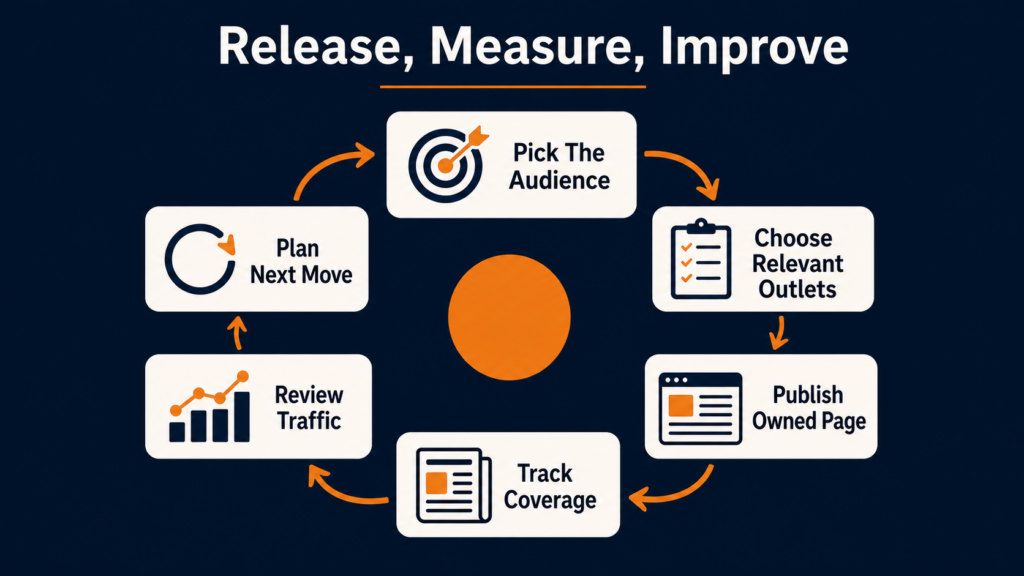
A press release should have a measurable goal. Without one, it is easy to mistake distribution activity for business value.
Common goals include:
- Earned coverage from relevant publications.
- Referral traffic to the announcement, product page, event page, or campaign page.
- Branded search growth around the company, product, event, or executive.
- Organic rankings for the owned press release page on branded or announcement-specific queries.
- Assisted conversions after visitors first arrive through news, referral, or organic search.
- New links or citations from publications that covered the announcement independently.
- Engagement with a goal-specific CTA, such as demo requests, event registrations, downloads, newsletter signups, or quote requests.
Use UTM-tagged links where appropriate, but keep public-facing links clean and reader-friendly. Watch Search Console for queries tied to the announcement. Review referral traffic in analytics. Track media pickups separately from syndicated copies. A pickup from one relevant publication can matter more than dozens of low-quality duplicates.
This is also where the CTA from the original article deserves more detail. A product launch release might send readers to a product detail page. An event release might drive registrations. A research release might drive report downloads. A company expansion release might send readers to a location page or careers page. A release tied to a broader visibility campaign might support a guide on how to increase website traffic.
Let OuterBox Help You Build Press Release SEO Value
Press releases work best when they are part of a larger search and content system. The release can announce the news. Your owned page can explain it. Supporting content can answer deeper questions. Outreach can put the story in front of the right people. Measurement can show whether the announcement created attention that matters.
OuterBox helps companies connect those pieces through SEO services, content strategy, technical SEO, and digital marketing measurement. If your team needs help turning company news into search visibility, referral traffic, and stronger content assets, our strategists can help you decide what deserves a release, how to optimize it, and how to measure the results.
Press Release SEO FAQs
Do press releases help SEO?
Yes, but usually indirectly. A press release can support SEO by creating a crawlable owned news page, earning relevant coverage, increasing branded search demand, driving referral traffic, and giving other publishers a clear source to cite. Press release syndication links should not be treated as guaranteed ranking authority.
Should press release links be nofollow or sponsored?
Paid, sponsored, or advertorial links should be qualified. Google recommends rel="sponsored" for paid placements, and many distribution services use nofollow links by default. That is acceptable. The safest SEO value comes from useful coverage and relevant reader paths, not from trying to force link equity through a paid release.
How many links should a press release include?
Use as few links as the reader needs. One to three useful links is often enough: the company homepage, the announcement page, a product or service page, an event page, or a supporting resource. Too many links can make the release look promotional and reduce the clarity of the next step.
Where should keywords go in a press release?
Use the main keyword or a close variant in the headline if it reads naturally, the opening paragraph, one or two body mentions, image metadata when relevant, and the owned release page metadata. Do not repeat the keyword in every paragraph. The release still needs to read like news.
Can a press release rank in Google?
Yes, especially for branded, announcement-specific, product, event, executive, local, or niche industry queries. Ranking for broad non-branded terms is harder because a press release is usually tied to a specific moment. If the topic deserves evergreen search demand, support the release with a guide, product page, service page, or article.
How often should a company publish press releases for SEO?
Publish when there is real news. A steady stream of thin releases can weaken trust and create low-value duplicate content. A smaller number of accurate, useful, well-distributed releases is better than publishing on a fixed cadence with no meaningful announcement.