
Hospital Marketing Agency for Health Systems
A hospital marketing agency should understand what happens after demand reaches your organization. OuterBox connects demand generation and digital experience to the markets, services, access paths, and capacity your health system can support. The result is a program built around the choices your team actually needs to make.






Hospital Marketing Has To Work Across The System
Hospital marketing often breaks at handoffs. A campaign may reach the right audience, then send that person to the wrong facility, an unclear service page, or a phone queue. Channel reports can look healthy while access teams see something else.
A health system may balance enterprise brand standards with local market and facility needs. Leaders need consistency to protect the system brand and local context to make the message useful.
Access and capacity belong in that discussion before media or content scales. Online scheduling and phone access may show different wait times.
No-shows or staffing limits can change which demand is useful. Marketing does not own those conditions, but it should not ignore them.
One service line may offer direct scheduling in one market and a call path in another. The landing experience, media exclusions, and local message must reflect that before launch.
Decision rights matter too. Physician and service-line leaders may need a view into access performance. Clinical reviewers join when work makes a care claim.
Privacy and legal owners join when data use changes. IT joins for platform changes. Operations and finance own capacity and budget, while executives set priorities.
OuterBox documents who the priority must reach, which service and access condition shape the next step, the review owner, and the business signal. Your team gets a growth program it can govern instead of a channel plan it has to reverse-engineer.
What Your Buying Team Needs From A Marketing Partner
Hospital marketing agencies should bring each stakeholder’s concern into view without letting every choice stall in committee. Four perspectives shape the evaluation from the start. Each needs a clear question, an accountable owner, and a way to feed what it learns back into the larger program.

Marketing leaders need a clear view of audience fit in priority markets and consistency with the system brand. Ask how the agency will distinguish qualified demand from raw response volume and connect channel findings to conversion.
The record should show what changed, why budget moved, and what the team expects to learn next. It should also name which facility or service gets the next test.
Your internal teams should have enough context to challenge an assumption before it quietly becomes a budget rule.
Access and operations leaders know where the journey breaks after a person clicks, including phone queues, scheduling limits, or facility-level capacity. A hospital digital marketing agency should gather that input and turn it into targeting and landing-page changes. It aligns campaigns with current operating conditions, reduces known mismatches, and returns useful demand signals to the people who own access across facilities.
This input is especially useful when conditions differ across facilities and the same campaign promise cannot be served through every destination.
Clinical, privacy, and legal owners need narrowly defined review questions before the campaign is built. The brief identifies the service claim and intended audience first.
If the work reaches a new market, changes how data is used, or introduces a platform, the agency routes that choice to the qualified owner. Those boundaries then carry into creative, landing paths, tracking, and reporting. That reduces rework and keeps sensitive questions with the people qualified to answer them. Qualified owners make the sensitive decisions, and the agency records their direction before work moves forward.
Finance and executive leaders need to see how the program supports priorities and controls spend when measurement is incomplete. IT and data owners need a realistic view of the platforms, permissions, and technical handoffs involved. Those gaps need to stay visible.
A credible hospital marketing company defines the available signals and exposes gaps. Its reporting gives leadership a clear view of performance signals, measurement gaps, and the next decisions each investment requires.
Leadership connects each major investment choice to an organizational priority, an evidence threshold, and a named next move.
Connect Search, Paid Media, And Conversion
Search, paid media, and conversion work better when they share signals. Our webinar explains how those disciplines inform one another. For a health system, a search insight can reach the content plan and a media lesson can reach the landing path. A conversion finding can then guide the next channel move.
See how connected search and conversion decisions turn separate tactics into one measurable growth program.
Better Marketing Outcomes Start With Better Definitions
Hospital growth outcomes start with the growth goal. One service may need sound demand where access can serve it. Another may need fewer wrong-site calls or clear facts on each site. We keep one set of key issues in view: which service and market need demand, where the path loses it, and which change could help. That shared view helps teams test, learn, shift spend, fix access gaps, or pause work based on what the system can support right now.

Healthcare SEO at Health-System Scale
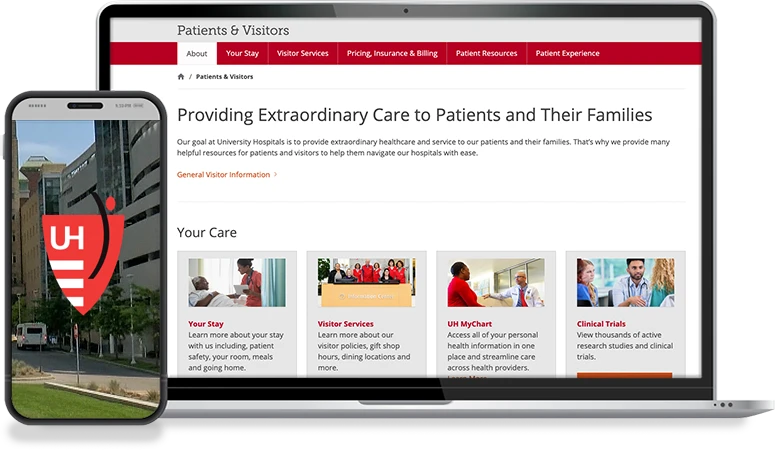
See what coordinated SEO can do across a major site launch, complex service-line content, and more than 28,000 indexed pages.
University Hospitals: 340% More Organic Traffic
OuterBox supported University Hospitals through a major website launch, then worked with its digital marketing team and service line directors on technical SEO, design, and content. Organic traffic increased more than 340%, while organic keyword rankings increased 321%.

Meet The OuterBox Team
Your health system needs specialized depth without another layer of fragmented management. OuterBox brings SEO, paid media, content, web, conversion, and analytics into one operating structure.
A USA-based team of more than 300 digital marketing experts (a.k.a. “Boxers”) works across those disciplines against a single roadmap, with clear ownership at every step. When search demand reveals a content gap, or analytics surfaces a handoff that needs an owner, we diagnose the connection, document the choice, and stay in the room as the program changes.
20+
Years Digital Marketing Agency
1000+
Successful Client Partnerships
2M+
Page #1 Google Rankings
300+
USA-Based, In-House Experts
Hospital Marketing Agency for Health Systems
Build A Hospital Marketing Program Around Real Priorities
Bring your priority markets, facilities, audiences, services, access paths, known capacity constraints, current platforms, review owners, and measurement questions. OuterBox will help your team identify the commercial problem, the dependencies around it, and the first workstream worth scoping.
Services
"*" indicates required fields
Common Failure Points In Hospital Marketing
Hospital programs rarely fail because the organization lacks another tactic. More often, a missing owner or disconnect keeps good work from adding up. These patterns expose where investment and operating reality have drifted apart early.

- Access And Capacity Shape The Plan
OuterBox asks access and operations owners for current constraints and records the plan assumption before budget scales. - Qualified Demand Has Defined Checkpoints
We define qualified demand and the next available checkpoint, then document which signals the measurement plan covers. - Decision Rights Start In Discovery
Discovery assigns decision rights early, and each brief names the audience, service, destination, data need, and qualified reviewer. - One Change Log Connects The Work
One change log brings channel and access findings together so leadership can see what should change and why.
Competitors
- Demand Plans Ignore Access And Capacity
Demand targets can send spend to services or markets that cannot support more demand. - Reporting Stops At Calls And Forms
Calls and forms give leadership an incomplete view of lead quality and downstream progress. - Review Starts After The Build
Late review forces teams to redo claims, data-use choices, and destinations. - Channels Optimize In Isolation
SEO, paid media, analytics, and access teams act on separate reports.
Hospital Marketing Resources

Digital Marketing | 5 min read
In the healthcare industry, building and maintaining a strong patient relationship is paramount. Like any other industry, the key to a thriving healthcare business lies…

Digital Marketing | 9 min read
Healthcare brands compete just like businesses in every other industry. Today, that means they need to deploy tested, effective digital marketing strategies that bring new…

Analytics | 5 min read
Thomas Jefferson once said, “Not all leads are created equal.” I think. Okay, he didn’t say that, but this sentiment holds true. Learning the elements…
From Discovery To Continuous Improvement
OuterBox gives enterprise teams a process they can govern without forcing every facility, market, or system into one mold. Each phase turns operating context into a next step and keeps dependencies visible between planning cycles.

-
1. Diagnose The Organization And Journey We inventory facilities, services, scheduling paths, access conditions, owners, and a downstream signal before selecting channels.
-
2. Prioritize Work And Dependencies We rank by value, demand, readiness, and measurability, and name scheduling or claim-review dependencies before launch.
-
3. Activate Connected Workstreams Teams use one brief, carrying approved claims and access instructions into media, facility pages, conversion paths, and reporting.
-
4. Measure, Learn, And Reprioritize We compare checkpoints with current access conditions before changing budget, audience, message, or destination, and record why.
Why Health Systems Choose An Integrated Agency Model
The right hospital digital marketing agency should reduce coordination work and make ownership clearer. That matters because its disciplines have to move together. A health system needs one plan, but every specialist still has to know what changes when access, claims, or data boundaries shift. The examples below show how an integrated partner handles a real health-system program.

Organizational Discovery Before Channel Scale
OuterBox diagnoses how a priority moves across facilities and teams. That work surfaces local constraints, review owners, and measurement limits early, giving each specialist a useful brief and your leaders a record of the assumptions behind investment.

Specialized Teams, One Growth Program
OuterBox specialists share the service, market, destination, and checkpoint behind the work. When paid search exposes a facility-location mismatch, analytics sizes the pattern, content corrects the facility page, and media changes the destination after the new path passes review.

Clear Decision Rights And Proof Boundaries
We name owners for service claims, patient-facing data uses, budgets, and capacity assumptions. A clinical leader may approve a service statement while a privacy owner decides which fields can enter an ad platform. OuterBox separates company experience, method evidence, and verified client proof.

Downstream Feedback That Changes The Work
Access, scheduling, CRM, analytics, and operations signals can change what marketing should do next. A scheduled review gives each signal an owner, a definition, and a review date. The change log then records the targeting, content, experience, or investment update for the next reporting cycle.
Related Healthcare Marketing Services



Make The Next Growth Decision Easier
Share the organizational priority, constraints, and teams around it. We will help you identify the next useful move for a durable hospital marketing program.
"*" indicates required fields
"*" indicates required fields
Hospital Marketing Agency FAQs
Hospital and health-system buying teams often need to resolve operating questions before they can compare agency plans. These answers focus on scope, ownership, and the first work a partner should make visible.
What Does A Hospital Marketing Agency Do?
A hospital marketing agency coordinates strategy and execution around the services and markets an organization wants to grow. It accounts for facility differences and the access path behind each priority.
The scope may include channel work, digital experience, and reporting. The agency should also define handoffs with the client teams that own claims, data use, access, and budget.
How Is Hospital Marketing Different From General Healthcare Marketing?
Hospital and health-system programs often need to account for several brands and facilities across different markets. The agency evaluation therefore includes portfolio priority, organizational handoffs, and measurement across systems. A broader healthcare marketing agency may serve many provider types, while this work centers on hospital and health-system operating complexity.
What Happens When Access Constraints Conflict With Growth Targets?
Name the business priority, the access constraint, and the earliest downstream signal both groups trust. Access leaders own the current capacity view; marketing owns the campaign changes available.
If the evidence does not resolve the tradeoff, the service-line sponsor or executive owner decides whether to redirect demand, pause investment, or accept a defined risk. Record the threshold that will trigger another review.
How Can Reporting Work When Facilities Define The Same Service Differently?
Start with a shared reporting dictionary and document each local exception. The dashboard can preserve facility-level definitions while mapping them to an agreed enterprise category for comparison. When two signals are not equivalent, keep them separate and explain the limitation rather than forcing a misleading rollup.
How Do Privacy And Claim Review Affect The Marketing Plan?
Review cycles shape launch sequence and timing. Ask the agency to identify which service statements and assets need qualified review.
Each request should present one narrow question and a roadmap turnaround. Channel teams can then build approved work without waiting on one broad, late-stage review.
Qualified clinical, privacy, legal, and compliance owners retain authority. The agency organizes review steps, records decisions, and aligns channel teams with approved direction.
What Should The First 90 Days With A Hospital Marketing Agency Produce?
The first 90 days should produce a documented operating view and prioritized roadmap with named owners. Timing varies with scope and access to systems. The team should know which workstream moves first, which dependency controls it, and what the initial reporting cycle is meant to learn. The roadmap should also show which decisions remain with access, privacy, clinical, finance, and IT owners so work can move without blurred authority.