
SaaS SEO Services for Software Growth
SaaS SEO services have to match how software buyers actually evaluate vendors. They read problem articles, compare feature sets, ask peers, check integrations, scan pricing pages, and return when a demo or trial feels worth the time. SaaS SEO services should help that whole path become easier to find, easier to trust, and easier to measure.
OuterBox builds SaaS SEO around how software companies grow: qualified demand, demo requests, trial paths, and content-assisted sales conversations.
"*" indicates required fields
"*" indicates required fields






SaaS SEO Services Built Around Software Buying Cycles
SaaS SEO is different because the website has to support multiple jobs at once. A founder might need early category visibility. A growth team might need more qualified demos. A RevOps team might need cleaner source attribution. A product marketing team might need comparison, integration, and use-case pages that match how buyers evaluate the platform.
The keyword map has to reflect that reality. Pain-point content reaches buyers before they have category language. Solution and feature pages capture people who understand the problem and need a shortlist. Integration pages show fit with tools already in the stack. Comparison and alternatives pages help a buyer defend the decision internally.
That is why a SaaS SEO company should not hand you a blog calendar and call it strategy. The work has to connect search demand to your product, sales process, CRM stages, and conversion paths. Otherwise organic traffic grows while the pipeline conversation stays vague.
What’s Included in Our SaaS SEO Services
A full-funnel, ROI-focused program that connects strategy, execution, and measurement for product-led and sales-assisted SaaS.
Full-funnel strategy, technical excellence, and content that converts.

SaaS SEO services mapped to the searches that create trials, demos, and pipeline
Your keyword map has to reflect how software buyers actually evaluate a category. SaaS SEO services should separate pain-point searches from solution searches, comparison pages, alternatives queries, integration intent, and competitor terms, then route each group into an SEO program that supports the right page type.
- Pain-point terms help you reach buyers before they know which platform or feature category solves the problem.
- Solution and feature terms shape pages for buyers who already understand the category and need a shortlist.
- Comparison and alternatives queries support the moment prospects are choosing between vendors.
- Integration and use-case terms connect organic demand to the workflows your product already supports.
That mapping keeps SEO for SaaS from becoming a blog calendar detached from revenue. It also gives startup, scale-up, and enterprise software teams a clearer way to prioritize work by pipeline value instead of raw search volume.
Pipeline grows when every keyword group points to the page type and buyer moment it can actually influence.
SaaS technical SEO that keeps your marketing site, app paths, and docs indexable
Your SaaS site may look like one experience to users, but search engines see a mix of marketing pages, docs, app subdomains, gated content, JavaScript routes, and release notes. Technical SEO keeps the pieces that should rank crawlable while protecting areas that belong behind login.
- JavaScript rendering checks confirm that feature copy, internal links, pricing details, and schema appear for crawlers without waiting on fragile client-side execution.
- Subdomain and subdirectory decisions clarify whether docs, blog content, integrations, and app-adjacent pages build authority together or split signals.
- Authenticated content rules keep private product areas out of the index while exposing public docs and use-case pages that support discovery.
- Core Web Vitals and deployment QA protect speed, crawlability, canonicals, redirects, and indexation after product and marketing releases.
A SaaS SEO expert should understand the difference between fixing a website and governing an evolving software property.
Search engines rank the pages that can be rendered, crawled, and trusted every time the product changes.
Content that moves SaaS buyers from problem research to vendor shortlist
SaaS content has to educate without trapping buyers in awareness mode. Strong content marketing connects product value to the questions prospects ask as they move from problem research to feature evaluation, vendor comparison, internal justification, and sign-off.
- Problem and use-case articles explain the workflow pain your software solves before a buyer searches for a category name.
- Solution, feature, and integration pages show how the platform fits into the stack prospects already use.
- Comparison and alternatives pages help evaluators understand tradeoffs without leaving the SERP to let another vendor frame the decision.
- Case studies, templates, and gated assets support sales-assisted motions when a champion needs proof for finance, IT, or leadership.
SaaS SEO services work best when the content plan mirrors the buying process rather than publishing disconnected topics. Each asset needs a job: attract demand, clarify fit, support evaluation, or help sales convert a qualified account.
Buyers move faster when your content answers the next objection before another vendor owns that answer.
Authority signals that help SaaS categories trust your product before the demo
Software buyers look for proof outside your site before they schedule a demo. A strong SEO agency for SaaS builds authority through the ecosystem your prospects already trust: partner programs, review sites, category publications, community resources, and credible bylined expertise. That makes link building a trust program, not a quota.
Partner marketplace listings and integration directories can reinforce the software stack your product fits into. Category roundups, resource pages, and technical explainers help buyers validate the product during research. Thought leadership gives your team a presence in the conversations shaping the category, while digital PR can earn coverage when product updates, benchmark data, or customer insights deserve attention.
The risk is chasing links that inflate a report but add no trust. SaaS authority should connect your product, category, ecosystem, and buyer problems in places real evaluators already use.
Authority builds faster when the web around your brand confirms the same product strengths your sales team needs buyers to believe.
Reporting from a SaaS SEO company that connects rankings to revenue signals
SaaS reporting has to connect search visibility to the way your go-to-market team measures growth. Rankings and organic sessions still matter, but a SaaS SEO company should also show how organic traffic contributes to demos, free trials, MQLs, SQLs, pipeline, CAC efficiency, and expansion opportunities through analytics consulting.
- GA4 key events track form starts, demo requests, trial signups, pricing-page engagement, and content-assisted conversions.
- CRM lifecycle stages connect organic landing pages to MQL, SQL, opportunity, and closed-won movement.
- Page-level reporting separates awareness content from comparison, integration, feature, and solution pages so performance is judged by the right goal.
- CAC, LTV, and ARR context helps leadership see whether organic growth is creating efficient acquisition or just more unqualified traffic.
The report should make the next decision obvious: which page type needs investment, which queries are moving qualified accounts, and where technical or CRO work is blocking revenue.
Leaders get a clearer budget conversation when SEO performance is tied to the metrics their pipeline already runs on.
CRO and UX collaboration that turns SaaS SEO traffic into activated users
Organic traffic is only useful when the next step matches the buyer’s intent. A prospect reading an alternatives page may need proof and comparison detail, while a visitor on a feature page may need a product tour, demo path, or free-trial flow. Conversion rate optimization connects SaaS SEO services to those conversion moments.
- Demo forms ask for enough information to qualify the lead without making high-intent buyers abandon.
- Free trial flows explain setup effort, onboarding expectations, and activation steps before the account is created.
- Pricing page UX handles plan comparison, procurement questions, security concerns, and sales-contact paths without hiding the answer buyers came for.
- A/B tests turn organic intent data into hypotheses for headlines, proof placement, form length, and product screenshots.
SEO, UX, analytics, and CRO need to share the same signals because the journey does not stop at the landing page. The best organic pages help prospects understand fit and move into product experience with less friction.
Traffic becomes more valuable when the page helps qualified buyers take the next SaaS-specific step.
SaaS Technical SEO for Product-Led Sites
SaaS technical SEO has to account for the way software sites are built. A public marketing site may connect to documentation, app routes, subdomains, gated resources, release notes, pricing pages, and product-led signup flows. Search engines do not see one brand experience. They see crawl paths, renderable content, canonical signals, redirects, links, and index rules.
A SaaS technical SEO audit should review:
- JavaScript rendering for feature copy, pricing details, internal links, and schema.
- SPA routing patterns, including crawlable links and clean URLs for public routes.
- Documentation structure, including authority support or signal-splitting risk.
- Public app pages, login walls, and noindex rules so private software areas stay private.
- Release and deployment QA for redirects, canonicals, status codes, XML sitemaps, and internal links.
The right SaaS SEO expert knows the difference between fixing a website and governing a software property that changes every sprint. Technical recommendations have to be clear enough for marketing and engineering to act on without creating product risk.
How 1 EDI Source Lifted Organic Conversions 57%
1 EDI Source — B2B SaaS Lead Generation
1 EDI Source came to OuterBox looking for stronger lead quantity and quality after briefly working with another agency. OuterBox focused on foundational SEO and PPC work, including title tag updates, H1 optimization, meta description updates, review schema, article optimization, and new landing page creation.
The result was not just more activity. The numbers below are specific to that account, and they should be treated that way. The larger point is the operating model: diagnose the highest-impact blockers, connect SEO and paid media where the buyer journey overlaps, report on the metrics that matter, and keep improving after the first round of fixes ships.
Reporting That Connects Organic Search To Pipeline
SaaS SEO reporting has to answer a harder question than “Did traffic go up?” Organic growth can look healthy while lead quality gets worse. A page can rank well but send visitors into a weak trial flow. A comparison article can assist opportunities without being the last touch before conversion.
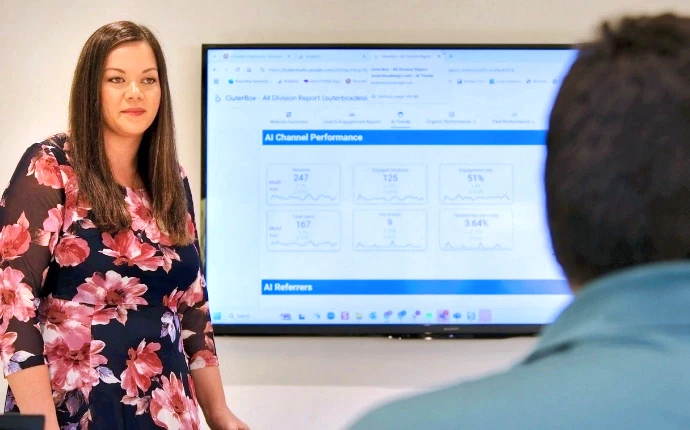
OuterBox reporting separates those signals so the next decision is clearer. Rankings, impressions, and organic sessions show visibility. Demo requests, free trial starts, form quality, pricing-page engagement, MQLs, SQLs, opportunities, and closed-won influence show the business value behind that visibility. CAC efficiency and LTV context help leadership decide where organic should support the broader growth model.
That is where analytics consulting matters. GA4, CRM data, call tracking, and form tracking need to agree well enough that your team can see which pages create qualified demand and which pages only create noise.
The report should make the next priority obvious: a technical fix, a new comparison page, stronger proof on a feature page, a better trial CTA, or CRO work on the path between organic landing page and sales conversation.
How SaaS SEO Works at OuterBox
Discover the strategies behind securing top search positions for competitive software terms. We explain how our team aligns technical SEO with strategic content to meet users at every stage of the funnel.
Watch how our SaaS SEO strategies drive recurring revenue through top-three rankings.
Meet the SaaS SEO Expert Team Behind the Work
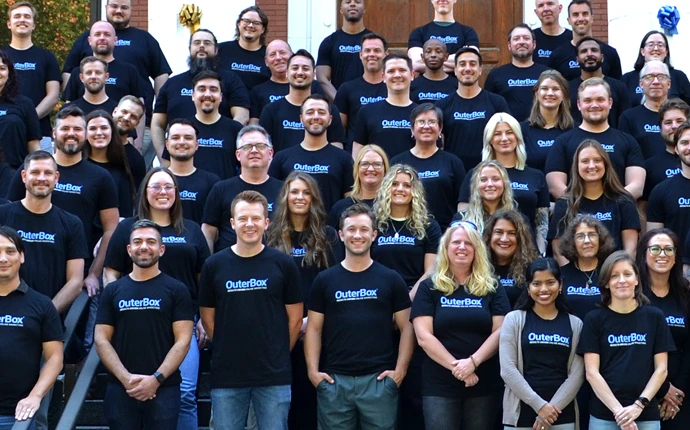
OuterBox has worked in SEO since 2004, which matters for SaaS teams because search programs rarely fail for one reason. The issue may sit in content strategy, technical SEO, analytics, CRO, development, or the handoff between marketing and sales. Your program needs specialists who can diagnose the real constraint and stay with the work.
Our team members (a.k.a. "Boxers") include SEO strategists, writers, developers, analysts, designers, CRO specialists, and paid media experts. That structure gives your SaaS SEO roadmap more than recommendations. It gives your team a partner that can help prioritize, document, build, measure, and adjust as the product and market change.
20+ Years
Digital Marketing Agency
1000+
Successful Client Partnerships
2M+
Page #1 Google Rankings
300+
USA-Based, In-House Experts
Why Choose OuterBox for SaaS SEO
Choosing an SEO agency for SaaS should feel less like buying a deliverable and more like choosing an operating partner. Your site, product, sales motion, and reporting system all influence how organic search becomes qualified pipeline.
OuterBox SaaS SEO
- Starts with SaaS buyer paths, product pages, technical constraints, and revenue measurement.
- Maps pain-point, solution, feature, integration, comparison, alternatives, and pricing intent.
- Reviews JavaScript rendering, docs, subdomains, app-adjacent routes, redirects, and index controls.
- Connects SEO with CRO, analytics, content, and paid media where the buyer journey overlaps.
- Uses SaaS proof carefully including 1 EDI Source lead and cost-per-conversion movement.
- Reports on visibility, lead quality, demos, trials, CRM stages, opportunities, and budget efficiency.
- Builds a roadmap your marketing, product, engineering, and RevOps teams can understand.
Typical Generic SEO Provider
- Starts with keyword volume and a standard content calendar.
- Treats all non-branded searches like blog topics.
- Runs a basic site audit without understanding software release cycles.
- Keeps SEO in a separate lane, even when the conversion path is the problem.
- Relies on broad case-study claims that do not fit the software buyer.
- Reports on rankings and sessions without showing what changed for sales.
- Sends recommendations that sit between teams with no owner.
SaaS SEO Plan
Get a SaaS SEO Plan Your Team Can Use
Your SaaS SEO plan should show what to fix first, why it matters, and which team needs to be involved. OuterBox can review your current search footprint, technical foundation, content gaps, trial or demo paths, and reporting setup, then help turn that diagnosis into a roadmap.
Bring us the problem as you see it: weak rankings, low-quality demos, stalled trials, unclear attribution, technical debt, or a site that no longer matches the product. We will help you sort what is actually blocking growth.
Services
"*" indicates required fields
Other SEO Services from OuterBox
Related Services for SaaS Growth



SaaS SEO FAQs

What are SaaS SEO services?
SaaS SEO services improve the organic search visibility, technical foundation, content strategy, authority, and conversion paths for software companies. The work usually includes keyword mapping, technical SEO, product and feature page strategy, content planning, internal links, reporting, and CRO collaboration.
How is SaaS SEO different from traditional SEO?
SaaS SEO has to account for software buying cycles, product-led flows, demos, free trials, integrations, docs, pricing pages, comparison searches, and CRM reporting. Traditional SEO fundamentals still matter, but the strategy has to connect search behavior to how buyers evaluate software.
What should a SaaS SEO expert review first?
A SaaS SEO expert should start with the business goal, then review the keyword map, technical crawl and render issues, product-page structure, content gaps, internal links, conversion paths, and measurement setup. That order keeps recommendations tied to qualified demand instead of activity.
Can SEO services for startups work with a small site?
Yes, but the roadmap has to be focused. Startup SaaS teams usually need the highest-impact pages first: homepage positioning, solution pages, feature or integration pages, comparison content, technical cleanup, and a measurement layer that shows which organic leads are worth pursuing.
How long does SaaS SEO take?
Timing depends on your site condition, competition, implementation speed, content gaps, and sales cycle. Some technical or on-page fixes can be implemented quickly, while authority, content depth, and pipeline impact usually build across multiple cycles of work. OuterBox scopes the roadmap after diagnosis instead of promising a fixed timeline.
Should SaaS companies build comparison and alternatives pages?
Often, yes. Comparison and alternatives pages can help buyers evaluate tradeoffs before another vendor controls the story. The page needs to be honest, useful, and grounded in real product differences, not written as a thin competitor takedown.
How should SaaS SEO reporting connect to revenue?
SaaS SEO reporting should connect rankings and organic traffic to demo requests, free trial starts, form quality, MQLs, SQLs, opportunities, and closed-won influence where the data is available. The goal is to understand which pages create qualified demand, not just which pages attract visits.
Do AI Overviews change SaaS SEO?
AI search surfaces still rely on standard SEO foundations. Google’s AI features guidance says standard SEO best practices remain relevant for AI Overviews and AI Mode, with no special requirements beyond normal Search eligibility. SaaS teams should strengthen the foundations instead of chasing a separate trick.
Talk to OuterBox About SaaS SEO
If organic search is not creating the right demos, trials, or sales conversations, the next step is diagnosis. Reach OuterBox at (866) 647-9218 or use the form, and we will help identify the first SaaS SEO issues worth fixing.
"*" indicates required fields
"*" indicates required fields
Related Articles: SaaS SEO Services

SEO | 9 min read
Google says no third-party SEO tool sees its ranking data. Here’s where Search Console is authoritative, and where third-party tools still earn their place.

SEO | 16 min read
SEO prices in 2026 run $100–$250 per hour, $3,000–$7,500 a month for most US agencies, or $5,000–$50,000 for project-based work. The range is wide because…

SEO | 6 min read
Searching for an eCommerce SEO Agency in 2026 feels…familiar. Every “Top 10” list looks the same. Every agency claims to be “data-driven”. And half of…