By: Sal Commisso
In June 2026, Google published new guidance on third-party SEO tools, services, and advice, plus a companion guide on AI search optimization. Industry coverage amplified it, including Search Engine Journal’s read that Google was claiming authority over SEO tools and AEO/GEO.
The documentation itself is narrower than the headlines. Google’s core points are straightforward: no third-party tool has access to its internal ranking data, no tool or agency should guarantee rankings, no one should imply a product is “Google approved,” Search Console is the first-party record of how your site performs in Google Search, and optimizing for Google’s AI features is “still SEO” rather than a separate magic system. Most of that is fair.
The real client problem shows up in how that warning gets used. Businesses are already being asked to trust too many numbers without enough context, and it is easy to stretch Google’s caution into a reason to ignore every other source of evidence.
Some of those numbers come from legitimate tools. Some come from dashboards that are useful in the right hands. Some come from vendors selling a score as if it were a fact. Google is right to push back on that last category.
Search Console is the source of truth for owned Google Search performance. It is not the whole market. Good SEO decisions still need first-party performance data, third-party market data, manual SERP review, analytics, competitor context, and the judgment to know what each source can actually prove.
What Google Is Right About
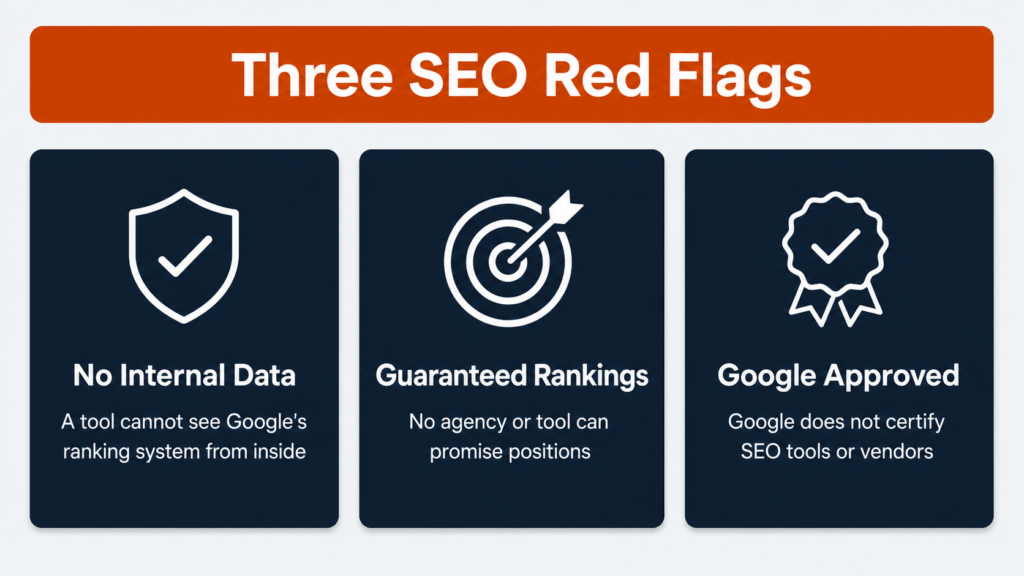
Google is right that no third-party SEO tool has Google’s internal ranking data. A tool can model search volume, estimate traffic, crawl backlinks, check rankings, inspect content, and monitor AI visibility. It cannot see the full ranking system from the inside.
Google is also right that no agency or tool should guarantee rankings. A forecast can be useful. A priority model can be useful. A keyword opportunity score can be useful. None of those should be sold as a promise.
“Google approved” language is the clearest red flag. Google does not certify SEO vendors or SEO tools as acceptable, compliant, or approved for ranking success. Any sales pitch built around that implication should disappear from serious SEO.
Search Console should also be in every SEO tech stack. It is free, first-party, and tied directly to how Google reports performance for a verified property. An agency that will not use GSC is asking you to make decisions with the most important owned-site source missing.
None of this means Google is against SEO. Its own guidance on whether you need an SEO still says many SEOs and agencies provide useful work, from content and technical review to keyword research and AI-search optimization. The real standard is critical thinking. If a claim sounds too clean, too certain, or too close to “we know what Google wants because our tool says so,” I slow down.
Where Search Console Is Authoritative
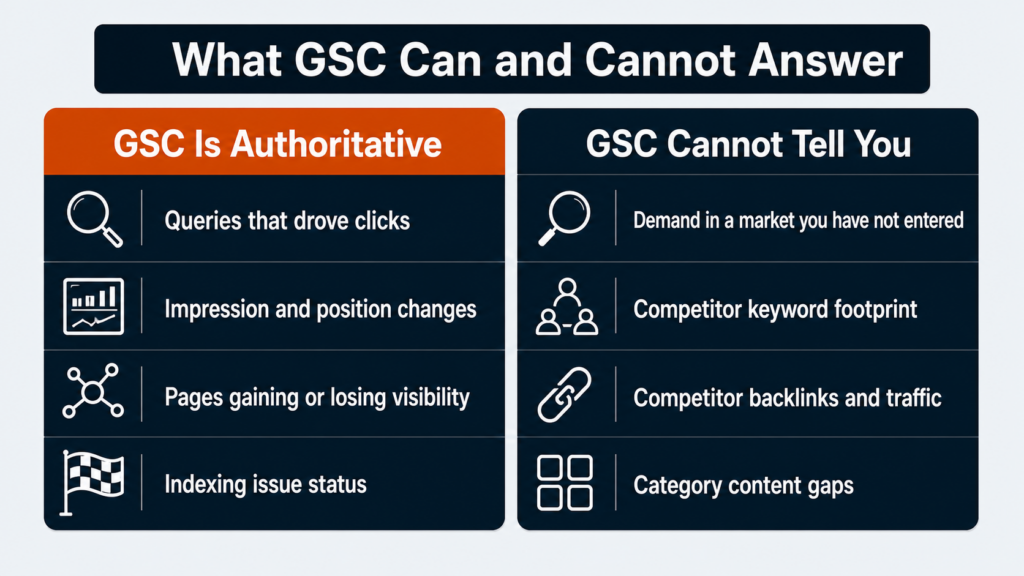
Google Search Console can answer questions that no third-party tool can answer with the same authority.
GSC can show which queries drove clicks, where impressions changed, how average position moved, which pages gained or lost visibility, and indexing issue status. For questions like “Did this update help or hurt?” or “Which Google queries actually drove clicks to our site?”, GSC is the right starting point.
But Search Console only reports on properties you can verify and areas where your site already has some relationship to Google Search. That makes it strong for measurement and weak for pre-visibility planning.
GSC cannot tell you how much demand exists in a market you have not entered. It cannot show the keyword footprint a competitor owns. It cannot show competitor backlinks, competitor traffic, content gaps across a category, or the size of an opportunity where your site currently has no impressions.
Search Console also has practical limits. Google documents query anonymization, row limits, and export limits, and GSC performance data has a 16-month window. For large sites, long planning windows, and new-market analysis, that matters.
The way I describe it to clients is simple: GSC is great for measurement of what has happened, and third-party tools are great for opportunity and competitive context.
That is the line most businesses need. GSC is actual Google Search performance data. It is not competitor intelligence, market sizing, or budget prioritization by itself.
Third-Party SEO Tools Are Planning Tools, Not Oracles
Third-party SEO tools earn their place when they are used for the right job.
Keyword volume is a modeled estimate. It is useful for prioritization and relative comparison. It is not a precise count you should multiply into a revenue forecast down to the dollar.
Keyword difficulty is useful too, but it is often a backlink proxy. A high difficulty score does not always mean “do not try.” A low score does not always mean “easy win.” The live SERP still matters, including page type, search intent, domain strength, content depth, brand mix, and what Google is actually rewarding.
Intent labels can be wrong. Plenty of third-party tools classify a keyword one way while the live results tell a different story. A keyword tagged as informational may have a commercial SERP. A keyword tagged as transactional may be full of guides, forums, or comparison pages. The label is a clue, not a decision.
Rank tracking has similar limits. Personalization, location, device, data center variation, and SERP volatility mean a ranking number is directional. It can help you spot movement, but it should not be treated as the complete truth of what every customer sees.
AI visibility scores are the newest version of the same issue. The same prompt can return different citations hour to hour. A prompt-tracking platform can help you monitor trends, see where your brand is or is not being cited, and compare movement over time. It should not be sold as a truth metric or a guaranteed outcome.
The cleanest way I can put it is this: the data is directional, the opportunity is real.
Directional data still has value. The number just needs to be tied to a decision, a confidence level, and the assumptions behind it.
Build Recommendations From Multiple Signals
Strong SEO recommendations do not come from one perfect data source. They come from several imperfect sources pointing toward the same decision.
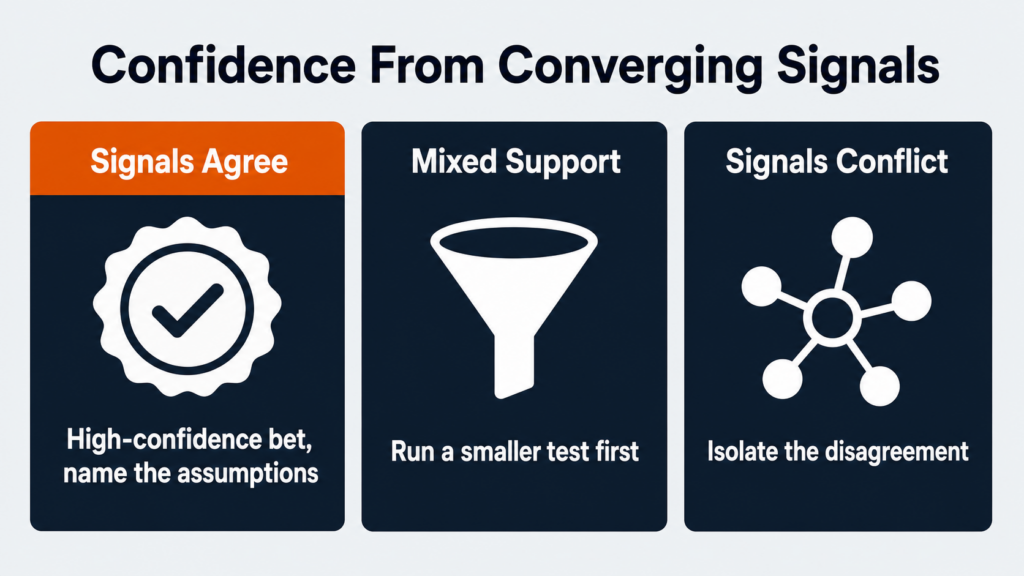
When GSC impressions, third-party search volume, and manual SERP review all point in the same direction, that is a high-confidence bet. You still name the assumptions, but the logic holds.
When one source supports the idea and the others are missing or mixed, the right move may be a smaller test. That could mean one article instead of a 20-page content plan, one technical fix before a larger rebuild, or one category expansion before a full market push.
When the evidence conflicts, the job is to isolate the disagreement. Is GSC showing low visibility because the market is small, because the site has not earned visibility yet, or because the page type is wrong? Is third-party volume overstating demand, or is the brand missing a category competitors already own?
Forecasts should be framed as ranges and direction. The assumptions should be visible. If the model depends on ranking movement, click-through rate, conversion rate, content velocity, or link acquisition, say that plainly.
Here is the part I want clients to hold onto: uncertainty in the number doesn’t mean uncertainty in the recommendation. The prioritization logic holds even if the forecast is only 40%.
That is how mature SEO planning works. The goal is not to pretend the forecast is exact. The goal is to make a smart decision with clear assumptions and a sane margin of error.
AI Search Optimization Is Not A Separate Magic System
Google’s AI search guidance is useful because it pushes back on tactical theater. For Google’s AI surfaces, the fundamentals still matter: crawlable pages, helpful content, clear structure, authority, and signals that make a brand or author understandable.
That does not mean AI visibility work is fake. It means AI search should not be sold as a secret discipline disconnected from SEO.
The useful differences are narrower and more measurable. Citation behavior can vary by vertical. Third-party and review content may be cited instead of a brand’s own site. Structured data choices matter, but that does not mean every page should be stuffed with FAQ schema because someone read a thread about AI citations.
OuterBox’s position is straightforward: AI search visibility planning extends the same foundation. We prioritize clear entity signals and appropriate schema, including Article, Author, Organization, and Product schema where they fit. We do not treat AI visibility as a magic layer that replaces crawlability, content quality, authority, or technical SEO.
Google is also only one surface. A client’s customers may find answers through Bing, DuckDuckGo, ChatGPT, Perplexity, Copilot, Reddit, YouTube, marketplaces, and other discovery points. Google’s guidance is naturally shaped around Google products. SEO planning still has to account for where customers actually research.
OuterBox tracks AI visibility, including AccuLLM prompt tracking, as trend monitoring. That can be useful. It can show citation movement, compare prompts over time, and help identify where a brand is missing from answer surfaces. Our broader answer-engine strategy work treats those signals as monitoring inputs, not as ranking guarantees, revenue forecasts, or proof that one tactic will force an AI engine to cite you.
Businesses should be especially careful with AI-search claims that sound too certain. A tool guaranteeing AI citations is overclaiming. A pitch that says llms.txt will get you cited is selling hygiene as a growth lever. A single-number AI visibility score sold as the KPI turns an early trend signal into a false finish line.
SEO Vendor Claims Businesses Should Question
The best question is not “Which tool is right?” The better question is “What can this source prove?”
Use that standard when a vendor or agency presents a metric:
- Is this first-party data, third-party modeled data, or opinion?
- What decision is this metric supposed to support?
- What assumptions sit underneath the forecast?
- What would change the recommendation?
- Is the source being used for proof, prioritization, monitoring, or prediction?
- Is anyone implying Google approval, internal access, guaranteed rankings, or guaranteed AI citations?
Those questions protect the budget before the work starts. They also make the recommendation easier to defend when performance changes.
A keyword-volume estimate can support prioritization. It should not be treated as guaranteed demand. A difficulty score can flag competitive pressure. It should not replace SERP review. A rank tracker can show movement. It should not replace Search Console, analytics, or revenue data. An AI visibility report can show trend movement. It should not become the whole performance story.
SEO tools are useful when they are honest about their lane. Once the number is presented without the limits, the tool has stopped supporting the strategy and started distorting it.

The Real Job Is Prioritization
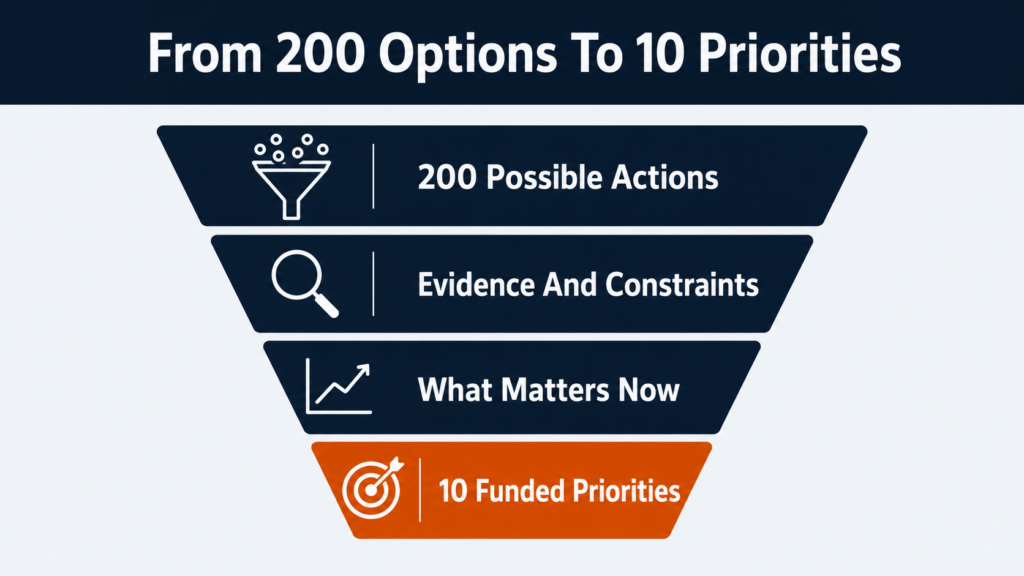
Google documentation can tell a business how Google wants sites to be built, crawled, structured, and evaluated. It cannot tell that business which 10 of 200 possible actions should get budget first.
That is the work practitioners are paid to do.
An SEO team has to combine Search Console, analytics, CRM data, third-party market data, crawl data, manual SERP review, competitor research, and business constraints. Then the team has to decide what matters now, what waits, what needs a test, and what is not worth chasing.
That planning work exists before visibility exists. It exists when a brand is entering a new market. It exists when competitors own content gaps the site has never touched. It exists when AI summaries change click behavior and the client needs to know where brand visibility still matters.
Execution still matters. Technical fixes, content updates, internal links, schema, digital PR, and reporting all have to happen. But prioritization is what keeps a business from treating every tool warning, every AI-search claim, and every keyword score as equal.
Google is right to push back on false authority. Good SEO is not tool worship. Good SEO is evidence literacy: know what each source can prove, what it cannot prove, and what decision it should support. For businesses that need help turning imperfect evidence into a focused plan, SEO strategy and prioritization support should start with the same standard.
The data is directional. The opportunity is real. The job is to make the direction clear enough to act.
What Google’s New SEO Tool Guidance Actually Means for Your Strategy
Are You Ready to Rank #1
If you want help turning imperfect SEO data into a focused, defensible plan, our team can pressure-test your current strategy, tools, and priorities. Call us at 866-647-9218 or request a quote below.
Services
"*" indicates required fields