By: Matt Prater
Most companies are past the point of asking whether they should use AI.
That phase moved quickly. Teams tested ChatGPT. Software platforms added copilots. Productivity tools got AI buttons. Analytics platforms started generating summaries. People built prompts, shared hacks, attended webinars, and created enough internal AI task forces to make consultants everywhere nod approvingly.
And to be fair, a lot of that experimentation has been useful.
AI can help teams draft, summarize, brainstorm, research, and generally get through the blank-page problem faster, with less staring into the void. I personally support anything that reduces the number of times a smart person has to type “per my last email.”
But now that the novelty has worn off a bit, the question has changed.
The question I hear more often from executives is: How do we make AI meaningfully useful inside the actual business?
That is where things get more interesting.
Because many AI tools are impressive in isolation. They can produce a solid answer to a well-structured prompt. They can summarize a document, generate ideas, review a spreadsheet, or help a team move faster on a specific task.
The gap shows up when the work requires context.
AI might know a lot about marketing in general. It does not automatically know your margin structure, your sales cycle, your campaign history, your customer segments, your creative standards, your CRM quirks, your board-level goals, or the reason everyone still gets nervous when someone mentions “the Q3 landing page test.”
Every business has context. Some of it lives in systems. Some of it lives in documents. Some of it lives in reporting. A surprising amount of it lives in Slack threads, meeting notes, and the brains of three people everyone pings when they cannot find something.
Like every executive who has ever said “we need a source of truth” with a straight face, I have contributed to this problem.
That is why I think the next meaningful step for AI adoption is context.
Generic AI Has a Context Problem
The first wave of AI adoption gave teams access to powerful general-purpose tools. That access matters, but it has limits.
Generic AI can be useful for generic work. The more specific the business problem gets, the more AI needs to understand the environment around that problem.
For a marketing or eCommerce team, useful context might include current priorities, historical performance, brand positioning, channel-specific strategy, etc., and without that context, AI tends to create outputs that still require a lot of human translation.
Sometimes that is fine. A first draft or summary does not need to understand the entire business. But if the goal is better decision-making, faster planning, smarter reporting, or more consistent execution, the bar is higher.
The AI needs to know what matters.
That is the shift I’m most interested in: moving from generic AI tools to what I’d call client-native intelligence.
What I Mean by Client-Native Intelligence
Client-native intelligence means building AI around the specific operating environment of a business.
It connects to the systems, data, files, goals, assets, and workflows that shape how the business actually runs. It has access to the information teams already use and, ideally, helps them make sense of it without creating yet another disconnected destination.
Most teams are already drowning in platforms. They have docs in Google Workspace, project details in a project management tool, working conversations in Slack, assets in shared drives, reporting in dashboards, CRM data in one system, ad performance in another, and strategy somewhere in a deck named something like “Final_Final_v7_ACTUALFINAL.”
The dream is rarely “give me one more portal to check.”
The real opportunity is to build AI into the flow of work.
That can mean integrations with systems like Google Workspace, Slack, Notion, ad platforms, analytics tools, CRM systems, and any number of other repositories.
The value comes from the context layer around the AI: what it can reference, how it is structured, how it is governed, and whether it fits the way teams actually work.
A generic AI tool can help answer a question.
A client-native intelligence environment can help answer the question with an understanding of the client’s goals, history, constraints, and current priorities.
That difference sounds subtle until you are the person trying to make a business decision at 4:47 p.m. before a meeting you should have prepared for yesterday.
Hypothetically, of course.
Building AI Into the Operating System of the Business
I have been using the phrase “building AI into the operating system of the business” because it captures where I think this is going.
The operating system is where work happens. It is the mix of tools, processes, data, decisions, meetings, habits, and institutional knowledge that keeps a company moving.
AI becomes more valuable when it can plug into that environment.
For a marketing team, that might mean using AI to get up to speed on a client or business unit faster or to organize campaign files and creative inputs. What if it could identify open questions before a strategy discussion and connect performance trends back to business goals?
This is where AI starts to feel less like a novelty and more like an enablement layer.
And yes, there are governance questions. There are data quality questions. There are security questions.
There are accuracy questions. There are change management questions. Anyone pretending those are minor details has probably not had to deploy anything across real teams.
The real work is designing the system around the business, not giving everyone a login, and hoping productivity magically appears.
How We’re Thinking About This at OuterBox
At OuterBox, this thinking is shaping how we build and use OBxIntelligence.
OBxIntelligence is our approach to creating client-native AI environments that bring together business context, marketing knowledge, performance history, project information, assets, and workflow support in a way our teams can actually use.
The goal is practical. We want our teams to move faster, find context more easily, improve research, support reporting, organize projects, and connect marketing activity back to each client’s specific business goals.
For a client environment, that context can include things like goals and KPIs, financial context, content plans, or working project files.
We can build custom agents for each client that function as a knowledge base and a thinking partner. That phrase matters to me. A knowledge base alone is passive. A thinking partner should help teams synthesize, question, organize, and apply the information in front of them.
In an agency setting, that has real value.
Every client has a different business model, competitive landscape, internal language, performance history, and set of goals. The faster our teams can access and apply that context, the more time we can spend on higher-value thinking.
It also helps when teams change, which they inevitably do on both the agency and client side. New people join. Roles shift. Priorities evolve. If too much context lives only in people’s heads, every transition creates a knowledge gap.
A client-native intelligence environment helps close that gap faster. It gives new team members access to the history, decisions, assets, performance trends, and strategic rationale behind the work. It does not replace human judgment or relationship knowledge, but it does make the partnership more resilient
That is also why we are piloting these workflows internally first.
Before we ask clients to adopt a new AI-enabled way of working, we want to know how it performs inside our own business. Our teams are using these systems under the pressure of real client work: research, reporting, project organization, planning, and strategic synthesis.
My view is pretty simple: if an AI workflow cannot improve the way our own teams work, we should be cautious about recommending it to a client.
The reverse is also true. When it helps our teams work better, faster, and with more context, we have a stronger foundation for helping clients apply the same thinking inside their organizations.
That is an important distinction. We are not trying to sell theory. We are building, testing, breaking, refining, and occasionally discovering that the thing we thought would be brilliant is mostly a complicated way to create a meeting summary. Humbling, but useful.
A Client-Specific Example
We are already seeing this model take shape in client-specific environments.
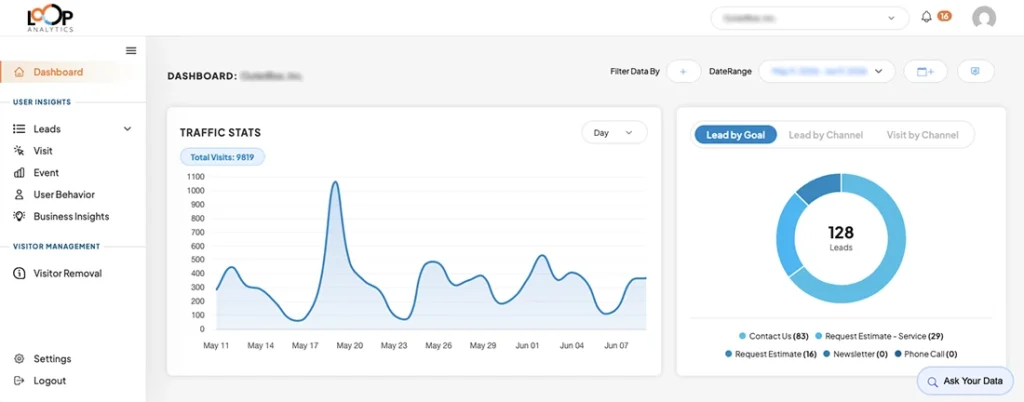
One example is a workflow we’ve built around a client’s performance and call intelligence data. The system pulls from LOOP data and full analytics call transcripts, then uses that context to identify sentiment trends, surface coaching opportunities, and send a summarized set of insights directly to the client’s inbox.
The concept is straightforward: create an AI-enabled environment that centralizes business context, performance data, customer conversation history, and working insights so teams can access and apply that information more effectively.
In this case, the value is not a shiny interface or another dashboard someone has to remember to check.
The value is that the system is doing useful synthesis in the background and delivering it where the client already works. It helps answer questions like:
- What themes are showing up across calls?
- Where is customer sentiment improving or declining?
- What coaching opportunities are emerging?
- Which insights should leadership see without having to dig through transcripts?
- How does this connect back to the business outcomes we are trying to influence?
That is the kind of workflow where client-native intelligence starts to feel tangible. It reduces manual review, improves visibility, and turns a pile of raw information into something a team can actually use.
And maybe most importantly, it helps reduce the number of moments where someone asks, “Where does that live?” and everyone quietly opens five tabs.
Again, hypothetically.
What This Means for AI Adoption
One of the more interesting shifts with AI is that the technical capability is moving faster than most organizations can absorb.
AI can already do a lot. In many cases, the limiting factor is no longer whether the technology can summarize, analyze, classify, draft, retrieve, synthesize, or automate. The harder challenge is whether teams know how to implement it in a way that actually changes how work gets done.
That gap usually shows up as siloed experiments. One team builds a useful workflow, but nobody else knows it exists. A few power users get impressive results, while the broader organization is still unsure where to start. Teams test tools without enough business context, so the outputs feel generic. Leaders approve AI initiatives, but the day-to-day behaviors never really change.
I say that without judgment. This is hard to do well.
The companies that make progress will likely be the ones that pair AI infrastructure with AI enablement. The system needs the right context, integrations, data, and governance. The people need the right training, use cases, expectations, and confidence to apply it.
That is a major focus for us at OuterBox.
With OBxIntelligence, we are focused on building client-native environments that understand the business context. But the environment alone does not create adoption. Teams need to know how to use it, when to use it, where human judgment belongs, and how it fits into the workflows they already own.
That is why training and implementation matter as much as the underlying capability.
For client teams, that can mean helping define:
- Which workflows are the best starting points
- What information the AI environment needs access to
- How teams should prompt, review, and validate outputs
- Where AI can reduce manual effort
- Where human expertise should remain central
- How to build repeatable habits across departments
- How to avoid a collection of disconnected AI experiments
The goal is to make AI feel less like a side project and more like a practical part of how teams operate.
Because the companies that win with AI probably will not be the ones with the longest list of tools. They will be the ones that build the right context around the technology and the right skills across their teams.
The Next AI Advantage Is Context + Adoption
Generic AI tools will continue to matter. They are useful, accessible, and improving quickly. But for businesses trying to create durable value, the bigger opportunity is building AI around their own context.
That is the move from generic AI tools to client-native intelligence.
And for marketing, eCommerce, and growth teams, I think it is where the next meaningful chapter begins.
From Generic AI Tools to Client-Native Intelligence
Need a Custom AI Development Company That Knows Your Business?
We hope this guide cleared up the pricing confusion and gave you a framework for making a more informed decision about the SEO company that’s right for your business. If you have remaining questions or want to discuss your website with an SEO expert, call us at 866-647-9218 or request a quote below.
Services
"*" indicates required fields