By: obxadmin
Engineers are a discerning lot. They research specifications before talking to anyone, weigh all the evidence, and cringe at overt salesyness. Put differently, if the marketing overtures you’re directing at engineers feel too much like marketing, they could hurt more than they help.
Many industrial brands struggle to shoot this gap, but doing so is invaluable for growth. The technical rigor that makes engineers skeptical of hype also makes them consistent buyers. Once a vendor checks these boxes, they tend to forge lasting customer relationships. With the right technical content, they can meet that threshold before their competitors do.
For manufacturers selling complex products, a focused OEM marketing strategy aligns technical content with search, paid media, and the long evaluation cycles behind technical purchases.
Engineers Aren’t Buying for Themselves
A typical B2B purchase involves a whole team. In manufacturing, that can include the engineer evaluating fit, a procurement lead vetting cost, an engineering manager checking integration, and potentially an IT or compliance reviewer. Each does independent research at a different point in the same evaluation, and each will encounter your content or your competitor’s.
That means no single ad or piece of content will likely close anything. Building a pipeline in technical B2B demands consistent presence across a long evaluation cycle, and your content needs to work for readers who are asking fundamentally different questions. The engineer wants to know how it works. Procurement wants to justify the spend. Compliance wants to know what risks they’re inheriting.
A coordinated program supported by the right manufacturing marketing services gives each stakeholder a useful path without fragmenting the company’s core message.
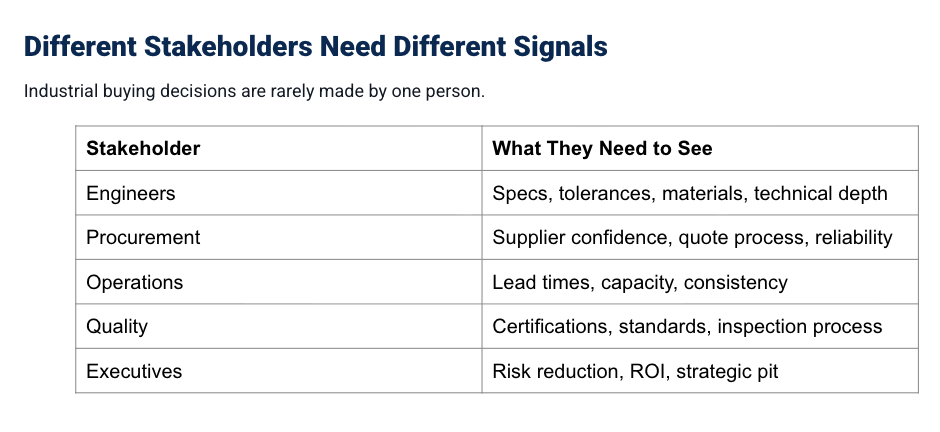
A vendor whose content only speaks to one of them leaves the others to find answers somewhere else, often with a competitor who thought to provide them. The goal isn’t to produce a different campaign for every stakeholder. It’s to build a content library deep enough that each person in the evaluation can find what they need — because that depth is also what signals to the engineer doing the initial research that you’re a serious vendor worth bringing to the rest of the team.
Search: Show Up Where Engineers Actually Look
Engineers need to seek out comparisons (“stainless steel vs. aluminum enclosure”), documentation (CAD files, spec sheets, datasheets), and credibility (third-party certifications, case studies) before they make any key decisions.
To earn visibility across traditional search results, you’ll need organic content that answers real technical questions ( “how to size a hydraulic cylinder for X load”) built atop a strong SEO framework. That means targeting the specific phrases engineers actually use when researching solutions (“custom hydraulic cylinder manufacturer”), not broader terms that look good in a traffic report but attract the wrong audience (e.g., “hydraulic parts”). For paid search, that means eschewing generalist terms to focus on consistently matching specific, high-intent phrases that engineers would use while querying for things that you offer.
AI tools like ChatGPT or Google’s built-in AI Mode are an increasingly significant part of where that research happens. Even professionals have begun to use LLMs like these as a starting point for search journeys and comparisons. Fortunately, similar principles apply to generative engine optimization (GEO) as SEO: authoritative, specific content that directly answers technical questions is what typically gets cited in AI responses, the same way it earns rankings in traditional search.
Video Can Explain Better Than Text
Video is a prime format for in-depth explanations and product demos. In manufacturing, it can make your offerings far more tangible than abstract technical text.
YouTube is the natural home for this content and a more significant search channel than most marketing teams treat it. Its content surfaces in Google results for technical queries, and an engineer evaluating your product who can’t find a video walkthrough may find a competitor’s. A well-maintained video library works alongside your site content to build a complete picture for buyers at every stage of the evaluation.
The bar for quality is higher than it used to be, but the bar for quantity is lower than you might think. A handful of genuinely useful, technically credible videos will outperform a large library of polished but shallow ones.
For B2B, LinkedIn is A Strong Bet
On the social side, LinkedIn is of particular utility. As a career-focused platform, it’s the only platform where you can target by job title, seniority, industry, and company simultaneously, which matters when your buyer is a controls engineer at a mid-market manufacturer in a specific vertical. While CPMs run higher than other social platforms, the precision and fit are what matter. No one goes on Instagram to read about tolerances, after all.
LinkedIn also offers a range of useful ad formats, including document download ads and thought leadership ads. Thought leadership ads average a 6x better click-through rate than single image ads. That gap exists because format signals intent: an ad that teaches something reads as a resource, not a pitch, and engineers have spent careers learning to ignore the latter.
Following Up With Email
Believe it or not, 77% of B2B buyers prefer to be contacted via email over other channels. But email is where a lot of technical B2B marketing loses ground it has already earned—because it lacks purpose.
An engineer who has read your content, watched your demo, and engaged with your LinkedIn ads is a warm lead. You don’t have to continually remind them of your existence, but instead to actually advance the conversation. That means fewer sends, more specificity, and copy that assumes the reader already knows what you do. A sequence that follows up on an RFQ submission, for example, shouldn’t read like a newsletter. It should open with a direct acknowledgment of what they submitted, follow with a case study from a similar application, and make a single, specific ask.
The same principle applies to a trade show marketing strategy: capture what the engineer cared about at the booth, then follow up with technical resources they can revisit and share.
Technical Content Outperforms Promotional Content With This Audience
One of the most important things to remember is that the messaging always matters. Engineers evaluate vendors the same way they evaluate anything else: on evidence. Your goal is to sell things without selling too hard.
Content that demonstrates competence earns credibility in a way that purely promotional copy never will. A vendor whose case studies show exactly what changed, how it was measured, and what the outcome was can give an engineer something to believe in. Adjectives without evidence don’t add much to technical evaluation.
That is the core of content marketing for manufacturers: turning technical knowledge into specific, verifiable proof buyers can use.
In paid media, the creative and copy decisions you make are often as important as the targeting. Once you have their attention, what are you doing with it? In limited space—whether in paid search ads or visual ad formats—you need to quickly and efficiently reflect high-intent, relevant concepts that will instantly click with your audience. Vague claims won’t cut it, and cleverness can’t come at the expense of detail. The viewer should know that the ad is relevant to them and what they can expect to learn before they click your ad. Otherwise they probably won’t click it.
Email follows the same logic from a different angle. HubSpot’s own testing found that plain text consistently outperforms HTML on open rates, and the heavier the design, the worse it performs. An email that looks like it came from a person gets treated like one. Heavy design signals broadcast, and engineers aren’t looking for a newsletter from a vendor they haven’t decided to trust yet.
Marketing to Engineers? OuterBox Can Help
The through-line across all of this is specificity. Specific content earns search visibility. Specific targeting puts it in front of the right people. Specific follow-up moves the conversation forward. Engineers reward vendors who demonstrate they understand the work, and penalize those who don’t with their silence.
If your business sells to engineers or technical decision-makers and your marketing isn’t keeping pace with how that audience evaluates vendors, reach out to OuterBox. As an industrial marketing agency, we build content, paid media, and SEO strategies for B2B companies in technical verticals—earning credibility before the first conversation happens.
Reaching Engineers: FAQs

What are effective strategies for marketing to engineers?
Specificity beats persuasion with this audience. Engineers respond to real tolerances, real data, and real application detail, and they tend to distrust content that oversells or generalizes, the same instinct that makes a spec sheet more persuasive to them than a case study built on adjectives instead of numbers.
How do engineers prefer to receive marketing information?
In a form they can reference and verify, not a form they have to sit through. Technical documentation, comparison charts, and detailed spec content get used like a manual, pulled up for a specific answer, which is different from how a general business buyer might read a narrative case study.
What type of content resonates most with engineers?
Content built around a real technical problem and a specific, provable outcome, not abstract claims about quality or expertise. Dell’s “I.T. Squad” campaign built trust with technical decision-makers by grounding its message in real, specific pain points instead of generic reassurance, and the same principle holds for industrial engineering audiences.
How important is technical accuracy in marketing to engineers?
It’s close to the whole game. An engineer who catches one inaccurate spec or an overstated capability tends to discount everything else on the page, since accuracy is the baseline qualification for being taken seriously by this audience at all.
How does the engineering buying process differ from other B2B buyers?
Engineers are usually one voice in a larger buying group, often six to ten people total, and their evaluation criteria, tolerances, materials, compliance, are frequently different from what procurement or finance is weighing at the same time. Content built for one generic buyer persona tends to miss the engineer’s actual questions entirely.
How can case studies be used effectively for engineering audiences?
Lead with the number, not the narrative. A case study that states the measurable outcome, a specific performance result, a load tolerance, a reduction in failure rate, up front earns more attention from an engineer than one that opens with a story and saves the data for the end.
What social media platforms do engineers use for work?
LinkedIn carries the most weight professionally, both for its base of users who influence real business decisions and for supporting longer, more technical content formats than most other platforms. It functions less as a discovery channel and more as a place engineers verify a company’s credibility once they’ve already found it elsewhere.
What is the significance of peer recommendations in marketing to engineers?
The same foundation as any industrial site: tolerances, materials, capacity, and certifications stated plainly, plus something a machine shop in particular tends to skip: proof of the specific work you’ve actually done, by material and part type, not just a generic capabilities statement. A buyer comparing shops is trying to rule most of them out quickly, and specific proof is what lets them do that in your favor.
How to Market to Engineers
Need a Manufacturing Marketing Agency That Knows Engineers?
We hope this guide cleared up the pricing confusion and gave you a framework for making a more informed decision about the SEO company that’s right for your business. If you have remaining questions or want to discuss your website with an SEO expert, call us at 866-647-9218 or request a quote below.
Services
"*" indicates required fields