By: obxadmin
B2B purchasing is a long, non-linear journey. Buyers circle back through stages, compare vendors simultaneously, and consult multiple internal stakeholders before any RFQ gets submitted. In a long sales process, content marketing is essential for assuring that prospective buyers have the information they need to make the right decision.
Most content marketing advice, however, is built for B2C vendors and the very-different challenges they face. If you’re an industrial OEM, you’re unlikely to benefit from the same strategies that help eCommerce brands sell shoes.
In this article, we’ll focus on the unique aspects of content marketing for industrial B2B, which content formats actually work, and how to build a program that generates real leads.
What Makes B2B Content Marketing Different
If you’re an industrial B2B company, your buyers are engineers, procurement specialists, plant managers, and OEM partners. These professional audiences need a lot of content from you in order to make informed decisions: specifications, tolerances, certifications, and process documentation. All of this information serves different purposes for different stakeholders at different stages of the purchase journey—and they’re all necessary.
You’re focusing on winning over a team of decision-makers over a long consideration period, not convincing an individual to make a quick purchase. Whereas a typical retailer may be able to make their ends meet just pursuing a high volume of traffic over wide demographics, your SEO strategy is less about volume and more about specificity.
Broad keywords can attract B2C traffic or throw you out there against retail competition. Your buyers know this—so if they’re searching for precision fasteners, they’ll type in “A286 stainless steel fasteners ISO 9001 certified” rather than just “bolts.” Manufacturers that build content around what buyers actually type win searches where their competitors are not even showing up. Even if that success doesn’t translate into eye-popping site traffic numbers, it will manifest itself in increased leads.
Know Your Buyer Before You Write
Industrial buyers typically move through several stages: problem identification, solution research, vendor comparison, internal alignment, and RFQ. Each stage requires different content. A buyer in the research phase needs educational material explaining capabilities. A buyer in the comparison phase needs specifications, certifications, and proof of results.
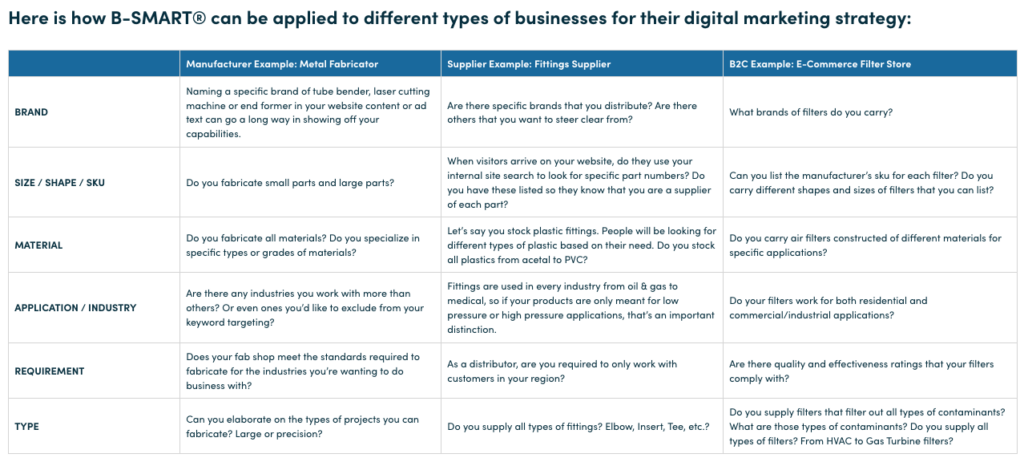
Buyer mapping is the foundation of useful keyword research. The B-SMART framework (Brand, Size/Shape/SKU, Materials, Applications, Requirements, Types) is a structured vocabulary for how industrial buyers actually search. A bolt distributor targeting “bolts” competes with Home Depot. The same distributor targeting “A286 steel fasteners” or “hex bolts grade 8 zinc-plated” is in front of buyers with genuine purchase intent.
Starting from buyer vocabulary rather than category-level terms is what makes industrial content findable by the right audience. On the paid media side, too, this can keep Google Ads campaigns from bleeding spend on irrelevant traffic.
The Content Types That Drive Industrial Leads
Effective content marketing for manufacturing companies requires several formats, each serving a different stage of the buying process. No single type does everything.
That content works best when it supports a broader manufacturing marketing strategy rather than operating as a standalone channel.
Blog posts and application content
Blog content serves the early research stages, when buyers are still defining requirements. A well-structured post explaining the specification differences between alloy grades, or the process trade-offs between two fabrication methods, builds organic rankings for the mid-specificity terms buyers use during discovery.
Data often reveals unexpected content gaps. One manufacturer’s analytics showed users searching its site for building use cases the company had never documented. Adding pages and posts covering those use cases produced a 531% increase in average monthly organic blog sessions, with overall organic site traffic rising 81.83% in the same period.
Technical product and capability pages
Product-focused content will always be your foundation. Pages organized around specific materials, tolerances, certifications, processes, and applications answer the specification questions buyers arrive with. They serve buyers who already know what they need and are confirming whether you can provide it. The depth of these pages will be what separates a manufacturer’s site from a distributor catalog—and what separates your site from less-discerning competitors.
White papers and technical guides
Industrial purchases are rarely approved by one person. A downloadable guide covering your process, quality certifications, tolerancing standards, or material capabilities is something a buyer can circulate internally. It reduces the friction of multi-stakeholder alignment, which is one of the real bottlenecks in long industrial sales cycles.
Case studies
Late-funnel buyers need proof that your process works for applications like theirs. Case studies with specific metrics, materials, and outcomes carry more weight than capability claims. The detail matters. “Machined to 0.0002-inch tolerances for an aerospace application” is more persuasive than “precision manufacturing for demanding industries.”
Video: facility tours and process demonstrations
Not every business has the capacity to create quality video content—but if you have the means, it’s worth exploring. Prospects often want to see the facility and the production process before a conversation happens. A facility tour video answers the capability question that spec sheets cannot fully address and give potential partners a better understanding of your business. It also supports discoverability: video results now take up significant real estate on Google’s search engine results page.
Building a Manufacturing Content Strategy
Most manufacturer sites have reasonable product pages and minimal mid-funnel content. Buyers in the research and comparison stages have nothing to engage with, so they leave. That indicates a lack of strategy.
Just writing a bunch of blog posts or filming some videos does not constitute a content strategy. They need to be created based on a sturdy understanding of which buyers they are meant to reach and at what stage of their decision. Tactics follow from that foundation.
The starting point is an honest coverage audit. Does your current content serve buyers well? Are all of your offerings fully represented with all necessary specs laid out? What questions do you constantly find yourself fielding that could have instead been answered by your website?
Next, map keywords by buyer stage using B-SMART logic: broader application and process terms for early-stage awareness, specific material and specification terms for consideration, and RFQ-intent and certification terms for decision. The same keyword intelligence behind organic content also powers paid search campaigns, and the two programs work best when they share a strategy.
Your own data is your best resource for building out a content program. Call recordings, form fill language, internal site search queries, and input from your sales team all reveal the vocabulary real buyers use and the questions they are consistently asking. Mining this data before creating new content means building what buyers actually need rather than what seems logical from the inside.
Measuring What Works in Industrial Content Marketing
The metrics that matter for industrial content are not the same as those typically tracked in B2C or general B2B programs.
Page views and session counts are proxies. What actually matters is lead quality: are the people filling out forms or calling your sales team buyers with real purchase intent? Form fill analytics and call tracking answer that. They also identify which pages generate qualified leads versus general traffic, so you can invest more in what is working.
Content-assisted conversions deserve specific attention in long-cycle industrial purchasing. A buyer who reads a technical blog post six weeks before submitting an RFQ rarely appears as a direct conversion in standard analytics. Attribution that accounts for the full buyer path shows the actual contribution of content to revenue.
Keyword rankings for specific terms are a more commercially-meaningful SEO indicator than rankings for broad category terms. Ranking well for “316L stainless steel heat exchanger manufacturer” drives more qualified traffic than ranking for “heat exchangers,” even if the volume numbers are disparate.
Where Your Content Marketing Strategy Starts
Content marketing for manufacturing companies works when it is built around what your buyers are actually searching for, at the technical depth they require, and in the formats they use during a purchase decision. The manufacturers who do this consistently are harder to displace from search results and from vendor shortlists.
If you want to build a content program grounded in what your specific buyers are searching, reach out to OuterBox. We work with manufacturers and industrial companies across a range of verticals and can help you identify where your content gaps are and how to close them.
Manufacturer Content Marketing FAQs

What is content marketing for manufacturers?
It’s content built around what buyers are actually trying to figure out—spec sheets, application guides, comparison pages, case studies—rather than content built to promote the company. For an industrial buyer doing independent research for weeks or months, that content often matters more than any single sales conversation.
Why do manufacturers need content marketing?
Because the majority of the buying process happens before a buyer ever contacts sales. If the content answering their questions during that research phase doesn’t exist on your site, they’re finding it, and forming an opinion, somewhere else, often a competitor’s.
What types of content work best for manufacturing companies?
Technical, specific content wins over generic brand content: spec sheets, tolerance charts, material compatibility guides, and case studies with real numbers. Strategic storytelling, framing a real business challenge and outcome rather than an abstract claim about quality, makes that technical content more persuasive without making it less accurate.
How long does it take for manufacturing content marketing to show results?
Organic visibility typically builds over months, since a manufacturer is competing for rankings already held by established competitors. Content aimed at buyers already close to a decision, comparison pages, detailed spec content, tends to convert faster than broad top-of-funnel content, which pays off on a longer timeline.
How is B2B manufacturing content marketing different from B2C?
The buying group is bigger, the sales cycle is longer, and the content has to hold up to technical scrutiny a consumer purchase never faces. A single piece of content also has to serve several different roles reading for different reasons, engineer, procurement, finance, rather than one consumer persona.
What are the best content marketing channels for industrial companies?
Organic search and the manufacturer’s own site carry the most weight, since that’s where a self-qualifying buyer already goes to compare specs and vendors. LinkedIn is a real secondary channel for the same content, particularly for reaching the specific job titles and seniority levels involved in an industrial buying group.
How can small manufacturing companies start content marketing?
Start narrow. A small manufacturer doesn’t need a full content calendar, it needs the handful of pages that answer the exact questions its buyers ask on every sales call: capabilities, certifications, minimums, turnaround. That’s a smaller lift than it sounds, and it closes the gap between what sales already explains verbally and what the website actually says.
What content formats do engineers prefer?
Specific and skimmable over polished and narrative. Spec sheets, dimensional drawings, comparison tables, and technical documentation get used the way a manual gets used, referenced for an answer, not read start to finish, so content built for that behavior outperforms long-form brand storytelling with this audience specifically.
What is the ROI of content marketing for manufacturers?
While impossible to quantify blindly, it shows up as lower-cost, more qualified pipeline over time rather than an immediate spike, since organic content keeps working after it’s published instead of stopping when ad spend stops. Measuring it requires tracking content’s influence on deals that close months later, not just form fills, or the real return gets missed.
Content Marketing for Manufacturers: A Guide to Getting Found by Industrial Buyers
Ready for Content Marketing Services Built for Manufacturers?
We hope this guide cleared up the pricing confusion and gave you a framework for making a more informed decision about the SEO company that’s right for your business. If you have remaining questions or want to discuss your website with an SEO expert, call us at 866-647-9218 or request a quote below.
Services
"*" indicates required fields