
Industrial Web Development Services
Industrial web development gets complex when product data, quote paths, customer accounts, and technical documentation all have to work together. A standard business site can survive with static pages and a contact form. Your site may need part lookup, account pricing, distributor routing, ERP data, PIM-managed attributes, CAD files, SDS sheets, and RFQs that sales can actually use.
OuterBox builds industrial web development services around that reality for manufacturers, OEMs, distributors, and industrial ecommerce teams. We help manufacturers, OEMs, distributors, and industrial ecommerce teams turn complex operations into websites buyers can search, qualify, quote, and maintain after launch.
"*" indicates required fields
"*" indicates required fields



Industrial Websites Need Operational Architecture
Industrial website development starts before templates are designed or code is written. The project needs a working map of product families, system ownership, customer account rules, lead routing, quote requirements, and the technical content buyers expect to see before they contact sales.
That planning matters because the website is rarely a standalone asset. Product specs may live in a PIM. Pricing and inventory may live in an ERP. Sales activity may need to land in HubSpot, Salesforce, Microsoft Dynamics, or another CRM. Product pages may need cut sheets, CAD files, SDS documents, certifications, dimensions, materials, and cross-reference data close to the buying decision.
Strong web development consulting turns those requirements into a build plan. Your team gets clearer ownership rules, fewer manual updates, and a site structure that can keep supporting buyers as products, systems, and sales workflows change.
Our Proven Industrial Web Development Approach
Industrial websites are more complex than most agencies realize. Product data lives in ERPs and PIMs, pricing varies by account, and buyers expect spec-level detail before they'll pick up the phone. Here's how we approach industrial website development projects.

Systems mapping for industrial website development before code starts
Your industrial website development project gets safer when the business systems are mapped before design, content, and code move too far. Strong web development consulting turns ERP, PIM, CRM, middleware, sales routing, and customer-specific pricing requirements into a build plan the whole team can trust. That planning keeps the site from becoming another disconnected catalog.
- Your data-flow map shows which system owns product specs, pricing, inventory, lead times, customer accounts, and quote status.
- Integration requirements surface early enough for API limits, middleware needs, and legacy database constraints to shape the build.
- Sales and operations teams see where RFQs, distributor leads, and account requests should route before form logic is written.
- Content, UX, and development decisions stay tied to the systems that industrial buyers and internal teams already rely on.
The system map gives your website a technical blueprint before expensive assumptions turn into rework.
Product data architecture for spec-heavy industrial catalogs
Engineers and procurement teams need product data arranged around how they search, compare, and qualify parts. Effective industrial web development turns SKU families, attributes, CAD files, SDS sheets, cross-reference terms, and technical documents into a catalog structure that works for people and search engines. Strong industrial SEO depends on that architecture because spec-level content has to be reachable, indexable, and useful.
- Product families should separate materials, dimensions, certifications, applications, and part numbers without creating duplicate pages.
- Faceted navigation needs crawl controls so filters help buyers narrow choices without flooding Google with thin URL variants.
- Cross-reference search can help buyers find compatible parts by competitor number, legacy SKU, or application language.
- Downloadable assets such as CAD files, SDS sheets, cut sheets, and installation guides should live where the buying decision happens.
Product architecture helps buyers find the right item without forcing your sales team to translate the catalog by email.
ERP and PIM integrations that keep pricing, inventory, and specs aligned
Pricing, inventory, and product specifications lose trust when the website drifts from the systems your team uses to run the business. Manufacturing website development should connect the catalog to the right source of truth instead of duplicating operational data in CMS fields. For larger catalogs, Magento web development can support that integration layer when the platform, extensions, and custom APIs are planned together.
- Product data can sync from PIM platforms such as Salsify, Akeneo, or inRiver into category and product templates.
- ERP records from SAP, NetSuite, Epicor, or Infor can feed pricing, inventory, lead time, and account rules when APIs allow it.
- Customer-specific pricing, contract tiers, and minimum order quantities should respect the buyer’s account state.
- Internal teams need clear ownership rules for which system updates descriptions, specs, images, documents, and availability.
The integration layer keeps the website aligned with the operational data your buyers and sales team already trust.
Quoting workflows that fit manufacturer and distributor buying paths
Buyers often arrive with a drawing, a BOM, a material requirement, or a repeat order that does not fit a simple contact form. Manufacturing website development should turn that complexity into a guided path instead of another open-ended message box. Practical B2B eCommerce web design helps each RFQ collect the inputs sales needs while keeping the experience clear for engineers and purchasing teams.
- RFQ forms should support drawings, PDFs, quantities, dimensions, materials, coatings, tolerances, and required delivery dates.
- Configurators can narrow options step by step so buyers understand what combinations are available before they request pricing.
- Lead routing should account for territory, product line, distributor relationships, national accounts, or OEM opportunities.
- CRM handoff to HubSpot, Salesforce, or Microsoft Dynamics 365 keeps the quote history connected to the buyer record.
The quoting path gives buyers a cleaner way to share technical requirements and gives sales a cleaner record to price.
Catalog-scale performance for 10,000+ SKU industrial sites
Large industrial catalogs put pressure on templates, databases, search, filters, images, and hosting long before a brochure site would notice. Industrial website development has to account for 10,000+ products, deep attribute sets, downloadable files, and mobile buyers who still expect fast pages. Ongoing web development maintenance keeps that performance from slipping as products, integrations, and content expand.
- Database query tuning helps category pages, filtered results, and product detail pages load without dragging through every attribute.
- Server-side caching and CDN delivery protect speed when image libraries, spec sheets, and traffic volume increase.
- Core Web Vitals checks should cover priority templates rather than only the homepage.
- Search logs and error monitoring can reveal slow filters, broken downloads, and catalog paths buyers keep abandoning.
Performance discipline keeps the catalog usable when product depth, buyer demand, and backend complexity all grow.
Launch controls and ongoing development after the industrial site goes live
Launch is where an industrial web development project proves whether the planning, integrations, redirects, and measurement setup can hold under real traffic. A careful SEO migration protects search visibility while the team validates product paths, quote forms, analytics, and business-system connections. The launch plan should also define what gets monitored after the first week.
A strong go-live checklist covers redirect maps, XML sitemaps, canonical rules, Google Search Console, GA4 events, CRM form testing, ERP/PIM syncs, uptime checks, and security settings. After launch, the same roadmap can prioritize integration fixes, feature sprints, catalog expansions, conversion improvements, and platform updates. That cadence matters because industrial sites rarely stay static once the first version is live.
Launch governance keeps the website improving after go-live instead of letting integrations, rankings, and buyer workflows drift.
How OuterBox Builds for Industrial Companies
See how our team approaches industrial web development, from ERP integration planning and catalog architecture to configurator builds and post-launch optimization.
Building industrial websites that drive qualified leads.
Platforms we optimize











Why OuterBox For Industrial Web Development
OuterBox has worked in digital marketing since 2004, with 300+ USA-Based, In-House Experts across the disciplines industrial sites depend on. Strategy, UX, development, industrial SEO, paid media, CRO, analytics, and content share the same plan, so a quote form that misses sales context or a migration that breaks SKU-level search visibility does not slow the program after launch. Your project plan gets documented around the decisions that move buyers: page hierarchy, content model, integration scope, RFQ logic, catalog performance, analytics events, redirects, and the post-launch roadmap. The result is a website your team can keep improving because the structure behind it is easier to own. That structure makes web development for industrial clients easier to own after launch because strategy, UX, SEO, CRO, analytics, and development stay connected.
20+ Years
Digital Marketing Agency
1000+
Successful Client Partnerships
2M+
Page #1 Google Rankings
300+
USA-Based, In-House Experts
Real Industrial Results
Industrial Sites That Grew Conversions, Traffic, And Revenue
Industrial web development works best when the site build, content structure, search plan, and conversion path are planned together. Here are two engagements where that approach produced measurable results.
Brazos Fasteners
Brazos Fasteners rebuilt its site with stronger design, navigation, and content plus the B-SMART Method. Conversions rose 442%, organic traffic 158% YoY, and total sessions 93%.

Fanucworld.com (TIE Industrial)
Fanucworld.com (TIE Industrial) got custom cart functionality and SKU-level search, then a BigCommerce replatform. The account saw 550% revenue growth, 249% more traffic, and 744% ROAS; the migration lifted transactions 31.82%, sessions 8.51%, and new users 15.14%.
Get A Free Web Development Quote
Your industrial website should make technical products easier to evaluate and internal workflows easier to manage. Tell us what your current site needs to support, which systems have to connect, and where buyers or sales teams are getting stuck.
Prefer to talk now? Call (866) 647-9218
"*" indicates required fields
"*" indicates required fields
Related Services
Industrial Services That Work Together



Industrial Web Development FAQs

What makes industrial web development different?
Industrial web development has to support technical product data, quote workflows, system integrations, buyer documentation, account rules, and search architecture. A standard business site usually does not need that level of operational planning.
Can OuterBox connect our site to ERP, PIM, or CRM systems?
Yes, when the systems, APIs, and business rules support the connection. Discovery defines field mapping, sync timing, data ownership, error handling, security, and fallback behavior before build work starts.
How do you handle large industrial catalogs?
Large catalogs need clear product-family architecture, attribute rules, internal search, filter controls, document placement, performance tuning, and crawl management. The goal is to help buyers find the right product without creating thin or duplicate pages.
Can you build RFQ forms or product configurators?
Yes. RFQ and configurator workflows can capture drawings, BOMs, quantities, materials, dimensions, finishes, tolerances, and delivery needs. They can also route requests by product line, territory, distributor relationship, or account type.
Which platform is best for an industrial website?
The right platform depends on catalog size, account pricing, integrations, content ownership, ecommerce needs, and maintenance capacity. WordPress, Magento, BigCommerce, Shopify, WooCommerce, nopCommerce, or custom development may fit different industrial models.
Will the site be built with SEO in mind?
Yes. SEO should shape the architecture before launch. Product-family pages, technical content, URL structure, metadata, redirects, schema, internal links, performance, and crawl paths all affect whether industrial buyers can find the site.
Can the site support secure customer-specific pricing?
Yes, but it needs careful planning. Account pricing, distributor views, contract tiers, permissions, and private catalog rules should be documented during discovery so the website only exposes the right information to the right buyers.
Do you support industrial websites after launch?
Yes. Post-launch support can include maintenance, integration monitoring, catalog updates, SEO expansion, conversion testing, analytics cleanup, paid media landing pages, and reporting by product line, division, or buyer path.
Industrial Web Development Resources & Insights

Web Development | 5 min read
In the digital age, the importance of having an eCommerce website for your business cannot be overstated. As more and more consumers are shifting their…

Web Development | 5 min read
Are you ready to grow your business with a more advanced eCommerce platform? A new platform can help you scale your products, better manage your…
Web Development | 5 min read
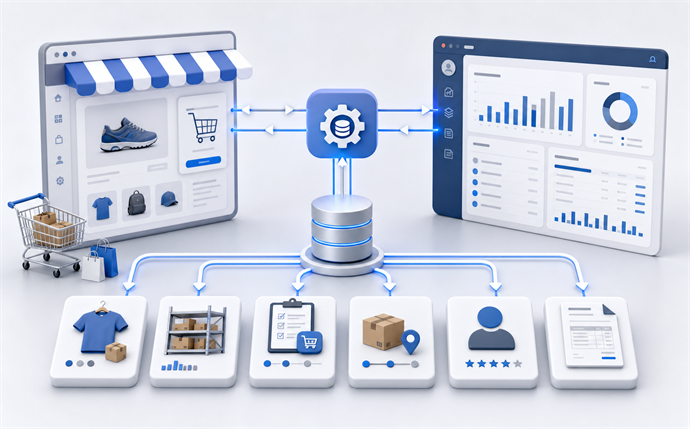
You need to integrate your ERP into your eCommerce website. With so many different ERP systems and website platforms, it’s difficult to understand how your…