By: Adam Littell

Choosing an SEO company can feel harder than it should. SEO is a long game. Whatever keywords an agency focuses on, it should be targeting the right space and using content to your advantage. That means that when you work with an agency, you’re signing up for a long-term relationship.
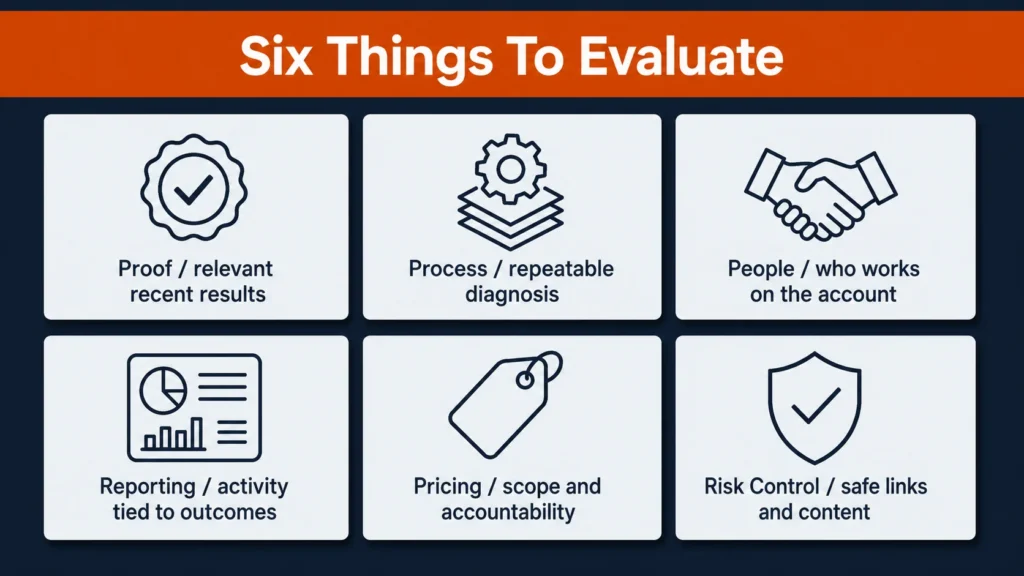
When you are choosing an SEO company, look for proof, process, people, reporting, pricing clarity, and risk control. Here’s how to choose an SEO company using those.
Step 1: Start With Proof That Matches Your Business Style or Model
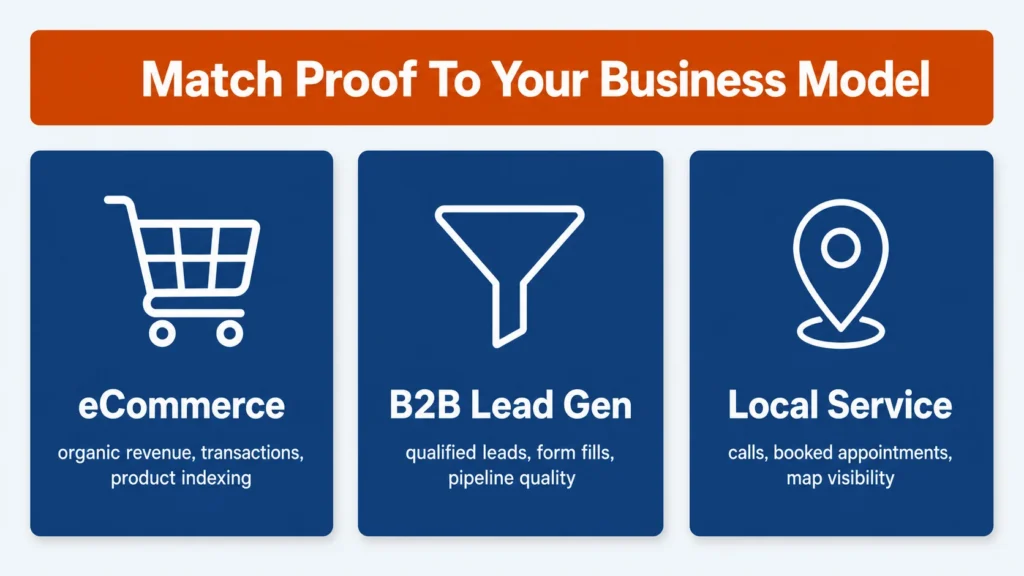
Start by asking for case studies from companies that share your conversion model, not just your general industry.
Ask for websites the agency has optimized, the problems they were hired to solve, the work they did, and the results that followed.
Recent proof matters because SEO changes quickly. Search worked one way for years, and now it’s leaning into everything coming from AI: zero-click results and the AI summaries at the top of the SERPs. Your SEO company has to stay on top of that. It’s just work that has to be done, period. With Google and its algorithm updates, you can’t not keep up.
- eCommerce companies should look for eCommerce SEO results tied to organic revenue.
- B2B and lead-generation companies should look for B2B SEO proof tied to qualified leads.
- Local or service businesses should look for examples that connect visibility to calls.
1 EDI Source came to OuterBox after another agency and wanted clearer communication and the reliable execution across SEO and PPC they were missing. The campaign produced a 66% month-over-month increase in organic leads and a 42% year-over-year decrease in cost per conversion. Warehouse Lighting needed to recover declining keyword visibility; after technical, on-page, and content work, organic revenue rose 105% and organic transactions rose 119%. Cardinal Peak saw traffic, rankings, and leads dip after a site launch; after homepage optimization, landing-page refinement, content work, and internal linking, organic traffic rose 167% year over year and organic goal conversions rose 169%.
When OuterBox sets campaign goals with a client, the ones we focus on are keywords in the top 10, organic traffic, and leads or sales and revenue. On leads, we’re talking about quality leads, things that turn into business, not leads that have nothing to do with your business and just waste people’s time. Quantity is great, but quality is the name of this game.
B2B buyers can apply that same standard to a working shortlist in our B2B SEO agency comparison.
Ask How the Results Were Produced
Case-study numbers are only useful if the agency can explain the path behind them. Everything they recommend should be backed by data: what competitors are doing, keyword gaps, cannibalization audits. A good agency doesn’t recommend something just to recommend it. The same goes for measuring results. If you tell them which leads turned into business, they can see what pages that user looked at and what keywords and source brought them in, then reverse engineer that to get more of those leads.
Step 2: Look for Strategy Beyond Rankings
Ask what business outcome the SEO plan is built to move. At the end of the day, you want qualified users who are looking to convert, so it comes down to the quality of the lead.
An agency could send you 10,000 more users per month, but if it’s bad, off-focus traffic that doesn’t convert, you can end up in a worse spot. That’s why traffic alone isn’t a good enough indicator of success.
Your buyers can do their own research before they ever reach out. They get on your website and read around to confirm: can you help me, do you do what I need, and are you credible? They get on your competitor’s website too, whittle it down and reach out to two or three of you. The majority of the battle for that opportunity gets won or lost before you even have contact.
If you’re getting impressions and clicks and some engagement, maybe what’s missing is conversion rate optimization. A UX team can A/B test how people engage with the site, and which formatting or layout changes make it easier to navigate or fill out a form.
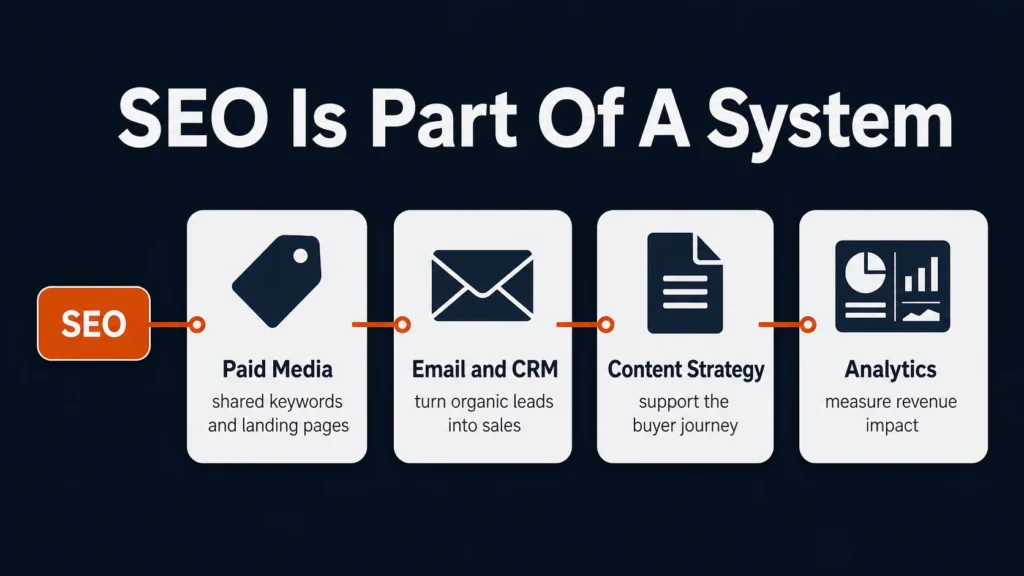
You don’t want siloed conversations. The channels all have pros and cons, and they can amplify each other:
- Paid media and SEO: the keywords work in tandem. What gets traction on one side can be tested on the other, and the top-performing queries on ad landing pages can shape more straight-to-the-point content on the organic landing page. They help inform each other.
- Email and CRM workflows: email is one of the few channels where the audience is really your own. It can remarket to people who hit your site or reached out for a quote and never got back to you.
- Content strategy: providing more supportive educational content, and building up the internal linking so folks aren’t finding that they need to navigate away from the page to find what they need.
- Analytics and attribution: at OuterBox, LOOP tracks everything. You can filter leads by organic, paid, or even AI, like someone who asked ChatGPT where to find you. It can even catch a lead that never made it to your CRM.
Then there’s AI search. Over the last two years, terms like GEO, AEO and AI search optimization have come up. Basically, it’s showing up in AI search results and getting conversions from AI traffic. At OuterBox, we call that GEO. Many of the tactics you hear for GEO or AI search have been SEO tactics for the last decade. A few things seem to work better for GEO, but whenever you’re doing something to support GEO, you’re probably helping your SEO.
SEO breaks down into three dimensions. On-page is your content and how it’s optimized. Technical is whether engines and crawlers can find, crawl and index your site. Off-page is often backlinking. For AI search, on-page and technical are very aligned: valuable, original, helpful content on a site AI crawlers can access. The biggest difference is off-page. Traditional SEO cares about the volume and quality of actual links to your site. AI search cares more about mentions. The SEO backlink is like the GEO mention.
AI visibility has a lot more to do with the content on your website than the paid programs you’re running. The website is your bread and butter. It’s what search engines, Copilot and ChatGPT pull their information from.
A good agency takes an integrated approach. Paid search and SEO work together; they’re not siloed. Organic covers the whole funnel, while paid homes in on users who are ready to convert, and each helps the other. Some people are ad averse and skip the sponsored result, but the ad may still be what sends them to your organic listing. Over a year you can see it in the traffic: wherever paid dropped, organic was able to supplement, and the other way around.
Step 3: Meet the People Who Will Work on Your SEO
Ask for an account-team introduction before you sign. At OuterBox, the first person you’ll meet is an onboarding strategist. That role is part strategy, part project manager: making sure things kick off on the right foot, the team has the access it needs and you have the information you need.
Look for an integrated team, where every channel you market with them is working toward your goals. A good agency is collaborative, both with you and across its own departments, and transparent about what it’s working on in the background. Expect status updates, deliverables and any strategy changes along the way.
You want to know who is actually touching the account after the sale. Ask direct questions:
- Who leads the SEO strategy? Your SEO strategist leads the charge and works as your main point of contact, and the SEO team lead supports more in the background to make sure the strategy is really strong.
- Who handles technical SEO? Ideally an internal website development team and technical specialists who go through and evaluate SEO health, site health and technical health.
- Who writes or edits content? A dedicated content writer, whose job is to get your voice on the page. It’s hard to match a tone of voice right off the bat, so if you have any pushback, give it to them.
- Who reviews analytics and conversion data? Ideally a whole analytics department.
- Who manages link building or digital PR? A link-building specialist on the agency’s team. If backlinks aren’t in the plan, a good agency can incorporate that task. That’s easy enough.
- How often will you meet? At OuterBox, it’s every month, typically around the second week, to discuss your previous month’s performance, and every three months you get an updated strategy plan.
- What happens when priorities change? A good agency figures out what shifts down from one month to the next, and things can shift to the next quarter. That’s fine. It’s your plan. You can mold it how you want.
At OuterBox, your strategist is your main point of contact, but they’re backed by analytics experts, content writers, UX designers and web developers. When something gets more technical or falls outside the SEO scope, it goes to our web, AI or content departments, with your strategist coordinating.
Step 4: Ask for the Audit, Reporting, and First-90-Day Plan
A credible first-90-day plan should turn an initial audit into a prioritized work sequence, with reporting that shows what changed and why.
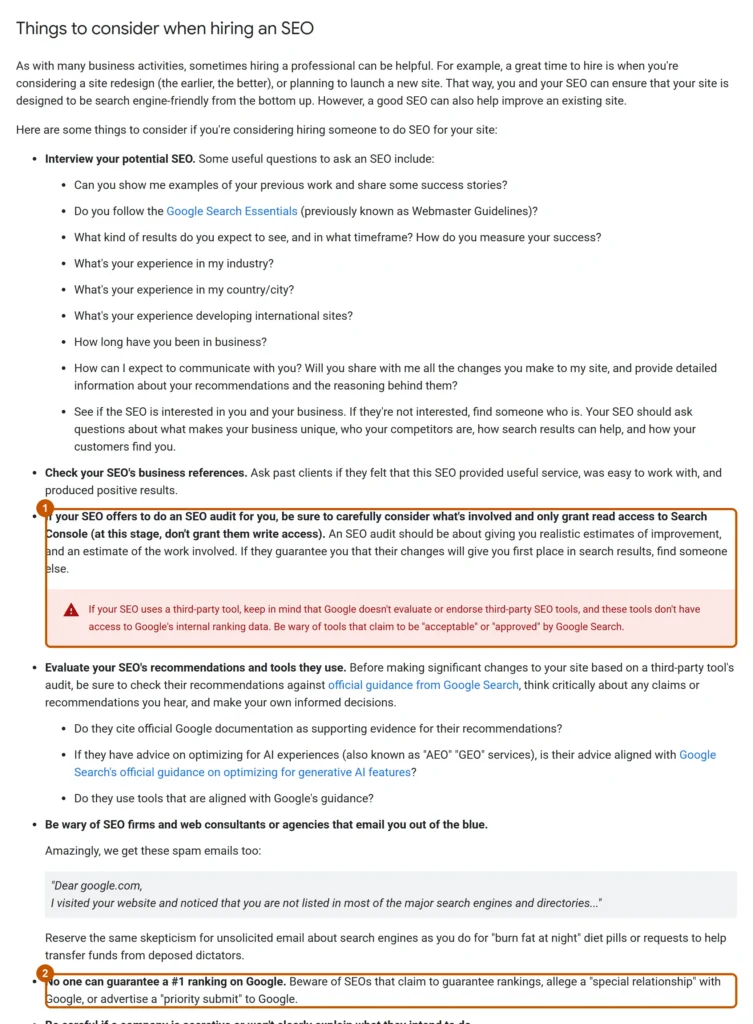
Google’s own SEO hiring guidance recommends asking a prospective SEO for a technical and search audit. OuterBox calls it an SEO audit, and it covers a handful of impact areas: technical opportunities, which go to the web development team; on-page content, which shapes the strategy; page speed; and overall linking.
A useful audit conversation should cover:
- Technical crawlability and indexation issues. A technical SEO specialist team crawls the website, and the crawl will call out all broken links, all redirected links, all orphaned URLs and issues with XML sitemaps.
- Priority page opportunities. A good agency prioritizes based on current position and the search volume of the keywords, the ones with the highest potential for driving traffic to the site.
- Title tags, H1s, and metadata. Page titles, meta descriptions and H1s are the biggest components on the page that Google is looking at first, so to speak.
- Content gaps and thin pages. Anywhere you can build content on the page and really expand and answer more questions about your products and services tends to help with the SEO rankings.
- Internal linking. Pages with nothing pointing to them need internal links. It won’t make everything suddenly rank, but it improves the way the site is structured.
- Backlink and authority risks. If you’re concerned about the amount of toxic backlinks pointing to the website, ask for an assessment there.
- Competitor visibility. There may be competitors you don’t even consider, digital competitors. If someone keeps popping up in the same search results, that’s a pattern, and a good agency looks at their H1s, page titles and meta descriptions versus what you have.
- Core Web Vitals and page speed. The agency should take a look at your site speed. Many sites run within the 30 to 50 range overall. Even if you use Google’s pagespeed test directly, your site is very unlikely to be 100. A lot of times it’s scripts being loaded in that you don’t need right away, or a really big image that should be resized. Site speed optimizations can be very technical, so make sure you have a technical partner.
- Conversion paths and tracking. An agency should be able to track where people interact with things on a site, what buttons they’re clicking and how they’re getting to certain forms.
- Reporting quality. The report is a historical snapshot, because it’s compiled at the beginning of the month for the completed previous month. For current numbers, the live tools are always more accurate.
Google also tells site owners to ask SEOs to corroborate recommendations with trusted sources. Some of it is a judgment call. Poor Core Web Vitals URLs need attention right away. URLs that only need improvement take a lot of time to fix and shouldn’t really have as big an impact on how you perform in search, so a good agency would start with on-page optimizations and prioritize those later.
Ask for a sample report before you sign. At OuterBox, our report is a multi-page report powered by Google Analytics, with LOOP Analytics for form-submission lead data and keyword rankings built in. That sets the baseline, and we measure improvements and declines from there. You have the dashboard all month, and on our monthly SEO reporting calls we walk through it together: what we’re tracking, why, and any questions you have.
In OuterBox’s onboarding process, we start with an analytics audit, linking Google Analytics and LOOP. Then initial keyword research: every keyword the site ranks for, in one list, sorted into high, medium and low priority, plus the searches you don’t want to show up for. Then the technical audit, where a crawler checks every single page for errors and missing data, including on images. From all of that, we compile a strategy for the next three months, with content and technical optimizations, and we optimize the homepage early because it carries a lot of weight. Then comes implementation: making the changes, getting you the deliverables and seeing results reflected in the data.
The technical audit checks the site map, so internal links go to the right pages and pages are categorized properly, and the headings, which tell Google what’s important. Lining up keyword targets with the right pages is the core foundation, along with fixing any 404 errors. Our technical team turns the audit into a remediation list, and we work through it in those first three months. Content expansion and additional targeting come after that.
Step 5: Compare SEO Pricing Against Scope and Accountability
Put each proposal into four columns: deliverables, seniority, exclusions, and measures of progress. Then compare the fee.
When comparing SEO pricing, do not judge proposals by monthly cost alone.
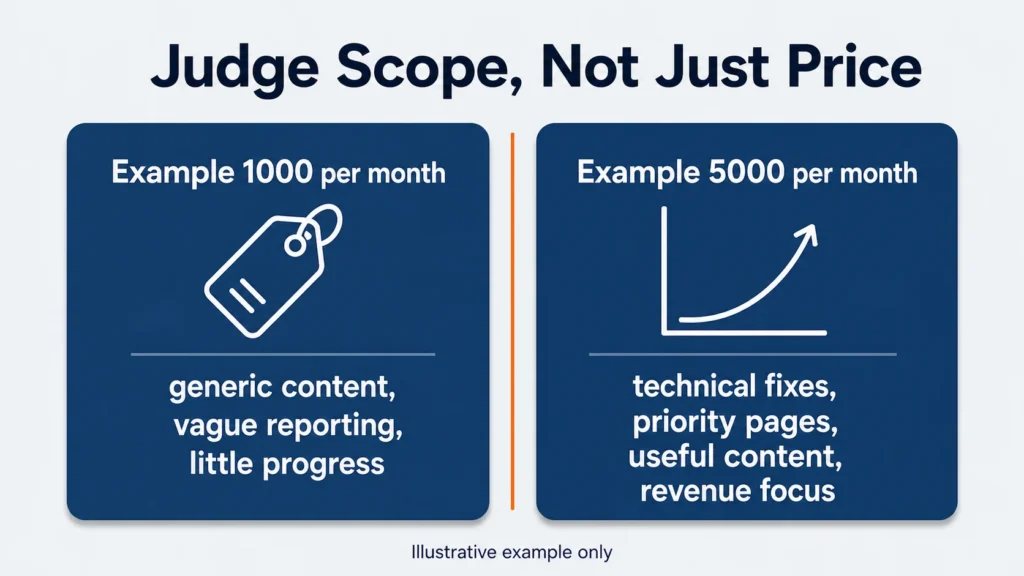
Ask how the agency plans its time. A good one plans everything against the time on the account. First there’s client communication: strategy discussions, meetings, calls and recap emails. Then the SEO work itself: new pages, new content, meta descriptions, image optimization. You don’t need to understand all the nitty-gritty, just that the plan fits within the time they have.
Ask each agency to explain the scope in plain language:
- How many priority pages will be worked on first?
- What technical SEO support is included?
- Who writes and edits content?
- Is development support included or separate?
- How is link building handled?
- What reporting is included?
- How often are strategy priorities revisited?
- What happens if the site needs more work than the package includes?
Some things should be baked in every month, regardless of hours: the marketing report with a campaign overview, weekly performance checks and the monthly calls. The rest of the time goes to tasks. If you need more, have that conversation. Something outside the scope now can still be added down the line.
The right SEO agency will help you understand the investment, not pressure you into the biggest package.
Step 6: Be Careful With Low-Cost SEO Packages
If a low price looks unusually good, ask what work is capped, templated, outsourced, or excluded.
The risk is that cheap SEO often has to cut corners somewhere: strategy time, technical review, content quality, reporting, link quality, or senior oversight.
Many low quality packages include low quality link building. Google’s spam policies describe link spam as links created primarily to manipulate search rankings. Backlinks build credibility and authority with Google, and a good agency does that work. But depending on the search, they may or may not be a very high ranking factor. Content is king. If an SEO agency will not explain its link-building approach, slow down.
A good agency focuses on useful, unique content that moves people further along their research, toward engaging with you. Traffic is a barometer for success, but it’s definitely not the sole arbiter. Blogs are a good example: if the focus is driving everything to one service, blogs on other services won’t help that service rank.
Warning signs include:
- Very cheap monthly pricing with broad promises.
- Guaranteed link counts with no quality explanation.
- Refusal to explain tactics.
- Reports that show tasks but no business outcomes.
- New pages created without expert input.
- Heavy reliance on exact-match anchor text.
- No discussion of technical SEO, analytics, or conversion quality.
A lower price is not automatically bad. The issue is whether the price matches the work required.
Step 7: Treat Guaranteed Rankings as a Major Red Flag
Treat a ranking guarantee as a credibility test. SEO isn’t as direct as paid. Google has to crawl the site and the pages, and there’s a little bit that’s out of anyone’s control. An agency does everything it can, then Google does its magic, and you show up where you show up.
SEO is the long game, so an agency has to be thinking further ahead and doing things sooner rather than later to see those results actually come to fruition. Our guide to guaranteed rankings goes deeper.
Google’s SEO hiring guidance says this plainly: no one can guarantee a number-one ranking.
Be cautious with promises like:
- “Guaranteed first-page rankings.”
- “Instant SEO results.”
- “Number-one rankings in 30 days.”
- “Secret Google method.”
- “We know someone at Google.”
- “Hundreds of backlinks every month.”
A ranking drop isn’t always about what your agency is or isn’t doing. It could be what competitors are doing: new pages, new optimizations, more content. Google decides that’s a better match for what the user is searching for, and you drop, even though you didn’t change much on your own site.
So what happens when rankings don’t move? The landscape changes constantly. When a good agency notices a drop in something that matters, it comes up with a plan to get back. It doesn’t just say it’s seasonality and move on. It looks at whether its own work, seasonality or Google’s algorithm changes are behind it, pinpoints the answer, and shifts strategy.
For our part, we will not guarantee a number-one position, and we will explain every link we build and why it is there.
Step 8: Questions to Ask Before Choosing an SEO Company
Run the same question list past every agency on your shortlist, so you are comparing answers instead of presentations.
- What would you audit first on our site, and why?
- What issues would you expect to find in the first 30 days?
- Which results from similar clients can you show us?
- Were those results tied to rankings, traffic, leads, revenue, or another metric?
- Who will work on our account after the sale?
- How do you prioritize technical SEO, content, links, and CRO?
- How do you approach AI search and AI Overview visibility without overpromising?
- What reporting will we receive each month?
- How do you measure lead quality or revenue impact?
- What link-building tactics do you use and avoid?
- What work is included in the monthly fee?
- Which SEO company should we use if we need strategy, technical fixes, and content support in the same program?
- What would require extra budget or our internal team?
- How do you handle a ranking drop?
- How do you handle recommendations that require development support?
- What would make you tell us we are not a good fit?
The last question is important. If every prospect is a perfect fit, the agency may be selling capacity rather than judgment.
Step 9: Choose the SEO Company That Can Explain the Work
After the last meeting, write down what each agency said it would do first and why. The one you can explain back to your own team without notes is usually the right choice.
Choosing the best SEO company is not about finding the loudest promise. Setting goals and expectations is the hardest part of selling marketing, so a good agency asks at the beginning what success looks like on your end. Each quarter, research and data analysis should decide the next quarter’s tasks, and after the strategy call you should get a document listing them. Those plans should be flexible enough to change with your feedback.
Choosing the best SEO company usually means choosing the team that can explain priorities. Agencies speak in acronyms. If there’s anything you don’t understand, stop them. You know your business, they know theirs. A good agency is there to teach as much as it is to get you business, and it makes sure you own your properties and understand the tools and what they’re doing for you.
If you want a second opinion on your site, our SEO services team can walk through the opportunity, the risks, and the next practical step.
What Working With OuterBox Looks Like
Every question above is fair to ask of us, so here are our answers.
OuterBox SEO programs start at $2,000 per month for the Essentials package, billed month to month, so the program has to earn its renewal every month. We recommend a custom plan for your needs after reviewing your goals, site complexity, market competitiveness, current SEO foundation, and timeline. Essentials is delivered by more than 90 USA-based, in-house SEO experts and we also have other teams that specialize in certain verticals and larger businesses.
After the kickoff comes the technical audit call, where we review the audit results. Then a strategy call, where we recommend what to tackle in the next three months: the goals and the roadmap. Then we’re heads down on implementation, followed by a report walkthrough of what’s been completed and how it’s performing. Along the way, we send each deliverable to you for review and implement it once you approve. Most things aren’t set in stone, and we can edit or revert later, but we don’t move forward with anything without your go-ahead.
OuterBox audit engagements typically include a kickoff, research and analysis, 1-on-1 strategist meetings, and a live findings review. Many audits take 3 to 5 weeks, depending on site size, data access, platform complexity, and how much implementation planning is needed. Monthly reporting shows keyword movement, traffic changes, completed work, and next-month priorities.
None of that makes OuterBox the right fit for every site. It does mean you can check our answers against the ones you get from everyone else on your list.
Frequently Asked Questions About Choosing an SEO Company
How do I choose the right SEO company?
Choose the right SEO company by comparing proof, process, team access, reporting, pricing, and risk control. Avoid agencies that promise guaranteed rankings or refuse to explain tactics.
What should I look for when hiring an SEO company?
Look for business-outcome proof, technical SEO depth, strong content standards, transparent reporting, and a team that can explain tradeoffs in plain language. All of your customers, whether they’re current customers or prospects, are multi-channel by nature, so anything an agency is doing should be integrated.
Do I need an SEO company or can I handle SEO in-house?
You may be able to handle SEO in-house if you have technical, content, analytics, and strategy resources already available. Plenty of companies are great at writing content in-house. One workflow that works well: you write and publish the page, then the agency does a full page optimization, recommends changes, gets approval and implements them, so the page is fully optimized within a month of publication. An agency’s research and outlines can also give in-house writers direction.
How much should I pay for an SEO company?
SEO pricing should match site size, competition, technical complexity, content needs, and growth goals. The right question is what the fee includes and how progress will be measured.
Can an SEO company guarantee results?
An SEO company cannot guarantee a specific number-one ranking on Google. Rankings aren’t immediate. New content takes two to three months to show true organic rankings, because Google needs time to crawl it and decide where it belongs. Be careful with agencies that promise instant or guaranteed rankings.