
Manufacturing Marketing Agency
A manufacturing marketing agency has to connect product and capability searches to buyers who are ready to evaluate, quote, and buy. OuterBox builds SEO, paid media, web, CRO, content, analytics, and lead-quality feedback around the way manufacturers sell: product fit, technical confidence, quote quality, and measurable pipeline.
Request a manufacturing marketing strategy review with OuterBox.



Manufacturing Marketing Has To Match How Buyers Evaluate
Manufacturers rarely lose opportunity because one channel is missing in isolation. The larger problem is usually a disconnected buyer path. A prospect searches by product family, material, part type, application, capability, specification, certification, or problem. Then that buyer needs enough evidence to decide whether the manufacturer belongs in the conversation before a form or RFQ is worth submitting.
A generic agency page can miss that motion. It may talk about traffic, leads, and campaigns while the sales team still receives vague inquiries that do not name the product, application, quantity, deadline, drawing, or buying role. It may build paid media around broad industrial terms while the best opportunities are hiding inside product-specific searches. It may report form count while leadership is asking which pages, campaigns, and product lines created qualified conversations.
That is why a manufacturing marketing agency has to work across the whole path. SEO, content, paid media, website experience, CRO, analytics, and sales feedback should all point toward the same commercial definition of success: buyers who understand what you make, why it fits, and how to take the next serious step.
OuterBox approaches manufacturing digital marketing services as a connected demand system for manufacturers that need SEO, paid media, web, CRO, analytics, and sales feedback working from the same pipeline definition. The parent Manufacturing hub explains that broad agency program while deeper pages handle Manufacturing SEO, Manufacturing Web Design, Industrial, OEM, Contract Manufacturing, Machine Shops, and Distributors.
How Manufacturers Evaluate A Manufacturing Digital Marketing Agency
Manufacturing teams compare agencies through practical questions. The right partner should show how visibility, paid demand, website experience, quote quality, and reporting work together before the conversation turns into a service list.

Product And Capability Demand Visibility
Can the right buyers find our products, capabilities, and applications before they know our brand?
Your best opportunities may start with a product family, material, specification, part type, application, or pain point rather than a company name. A manufacturing digital marketing agency should build organic and paid visibility around those paths instead of relying on broad service language. The content map needs to show where product pages, capability pages, application pages, and technical resources fit together. That way, a buyer who is still comparing supplier fit can find enough context to move toward a quote conversation instead of choosing a competitor with clearer product evidence. Sales also gets a cleaner signal about which categories are creating real demand.
Technical Evidence Buyers Can Evaluate
Does the site answer enough for engineering, procurement, and sales before an RFQ?
Manufacturing buyers often need proof of fit before they are ready to talk. That proof might include capabilities, tolerances, materials, production models, quality signals, use cases, product data, drawings, ecommerce paths, or sales-assisted quote context. The page does not need to expose sensitive details, but it should help serious buyers understand whether the conversation is worth starting. When that evidence is thin, sales has to restart discovery or reject weak-fit inquiries after the form is already submitted. Stronger technical context helps buyers self-select before your team spends time on the wrong conversation.
Paid Campaigns That Filter For Fit
Are campaigns creating sales-ready demand or just more form volume?
Paid search can help manufacturers reach high-intent buyers faster, but broad campaigns can also attract consumer, distributor, repair, low-volume, or wrong-product demand. Product-type campaign structure, negative keyword logic, landing-page fit, and sales feedback should protect budget before spend scales. A lower cost per lead only matters when the inquiries still match the business. The stronger goal is more useful demand, cleaner qualification, and a better understanding of which products or applications deserve more investment. Sales feedback should keep shaping the campaigns after launch.
Quote Paths That Capture Sales Context
Does the form capture what sales needs to judge fit?
A manufacturer can have a visible website and still lose time on incomplete inquiries. The quote path should ask for the right level of buyer context without making the form feel heavy. Depending on the business, that may include product interest, material, quantity, application, deadline, drawing, role, location, current supplier problem, or channel path. Better form context helps sales prioritize the opportunity, respond with fewer back-and-forth questions, and identify where the website should help buyers self-qualify earlier. It also gives marketing a sharper view of which pages create useful conversations.
Reporting Tied To Qualified Opportunities
Can leadership see which channels create qualified opportunities?
Traffic, rankings, clicks, and form totals are not enough for a manufacturing company that cares about pipeline quality. Useful reporting connects the source, landing page, product interest, form detail, call path, CRM feedback, and sales outcome. LOOP Analytics, our proprietary lead-attribution and form-tracking tool, is built for exactly this: it ties each lead back to the campaign, page, and product interest that created it so weak activity is easy to separate from opportunities worth pursuing. That loop also helps leadership decide where the next dollar belongs, whether that is product content, paid search, a stronger quote path, or a deeper manufacturing SEO and web design effort. The result is a budget conversation tied to qualified demand instead of channel activity alone.
Manufacturing Growth Built On Connected Demand
Sustained manufacturing growth comes from connecting the work, not running channels in isolation. See how one manufacturer paired SEO, paid search, and a long-term OuterBox partnership to turn product searches into qualified demand and a stronger pipeline. OuterBox can build that same connected program for your business, so search visibility, paid campaigns, and buyer experience all point toward the opportunities your sales team actually wants to quote.
How a manufacturer used SEO, paid search, and industrial market focus to create sustained growth with OuterBox.
Better Marketing Outcomes For Manufacturers
Better manufacturing marketing should make demand easier to find, qualify, and improve. Buyers who search by product, material, application, or capability should reach pages that help them understand fit. Paid campaigns should filter weak intent before it turns into wasted sales time. Quote paths should collect enough context to make the next conversation useful.
The business also needs a reporting loop that sales can trust. When source, page, product interest, form detail, call quality, and CRM feedback are connected, leadership can see where the program is creating sales-ready opportunities. That makes it easier to decide whether the next priority is product content, campaign structure, a website improvement, or stronger lead-quality tracking.
OuterBox builds around that difference. If a page ranks but produces poor-fit inquiries, the page needs refinement. If a paid campaign creates volume but weak sales value, the account needs better filters and landing-page alignment. If reports cannot connect activity to lead quality, the measurement plan needs to change.

What Better Manufacturing Lead Quality Looked Like
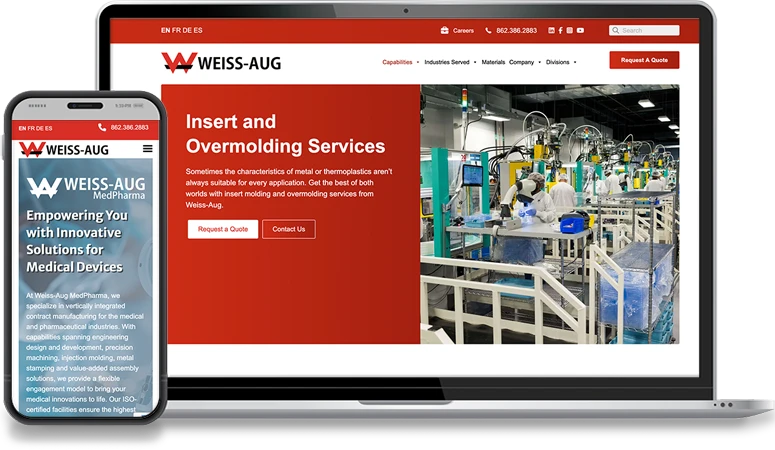
How a precision manufacturer grew organic demand and lead quality across multiple divisions.
Weiss-Aug Group is a precision manufacturing example that fits the parent Manufacturing hub because the challenge involved multiple divisions, technical product content, organic visibility, and lead quality. The company wanted to grow its medical division while improving lead quality across the business. OuterBox used the B-SMART method and lead data from LOOP Analytics to align search visibility with real buyer intent.
The case also shows why product-line content, division-specific search demand, and lead-quality feedback belong inside the same manufacturing marketing program. Weiss-Aug shifted from 80% direct traffic in 2022 to 52% organic search by May 2025, while the surgical product pages and metal-stamping visibility gains showed how specific product areas can grow when content follows actual buyer intent.
These results should not be treated as a guarantee or as proof for every manufacturing subtype. They do support the connected-agency argument: manufacturing growth gets stronger when content, search, lead data, product priorities, and sales usefulness are planned together.

Why OuterBox Fits Manufacturing Marketing Work
Manufacturers need more than a vendor that can run one channel. The buyer path crosses search, paid media, product content, website architecture, quote forms, analytics, and sales follow-up. If those decisions are split apart, each team can optimize its own metric while the business still struggles to understand which demand is worth pursuing.
OuterBox brings those disciplines into one manufacturing marketing program. SEO and content can map product and capability demand. Paid media can test and filter near-term intent. Web design and CRO can improve the path from technical evaluation to quote request. Analytics can connect source, page, campaign, and sales feedback. One connected team helps the manufacturer judge the program by quote quality and product-line demand instead of disconnected channel activity.
20+ Years
Digital Marketing Agency
1000+
Successful Client Partnerships
2M+
Page #1 Google Rankings
300+
USA-Based, In-House Experts
Manufacturing Marketing Strategy Review
Get A Manufacturing Marketing Strategy Review
Your next step should focus on the quality of demand instead of a generic brand audit. A manufacturing marketing strategy review can look at how buyers find your products, where technical confidence drops, whether paid campaigns are filtering fit, and whether quote paths and reporting show which opportunities are worth pursuing.
Services
"*" indicates required fields
Where Generic Manufacturing Marketing Breaks
Generic marketing often looks acceptable until sales reviews the inquiries. Rankings can improve, campaigns can spend, and forms can submit while the business still misses product-fit demand, requalifies weak leads, or struggles to see which channels create pipeline.

- Product visibility: Product and capability pages are mapped to how buyers search before they know the brand.
- Paid structure: Paid campaigns are structured around product families, exclusions, and landing-page fit.
- Quote paths: Quote paths collect practical context that helps sales prioritize the next conversation.
- Connected plan: Content, catalog, website, CRO, and analytics priorities move through one plan.
- Honest proof: Proof is matched to the buyer problem and labeled clearly.
- Connected reporting: Reporting connects activity to quote quality, sales feedback, and product-line priorities.
Generic or Status-Quo Marketing
- Product visibility: Broad SEO work chases traffic while valuable product searches go to clearer competitors.
- Paid structure: Campaigns spend against broad manufacturing terms that produce low-fit forms and unclear ROI.
- Quote paths: Forms ask too little, so sales has to requalify every inquiry after the conversion is counted.
- Connected plan: Vendors make disconnected recommendations that compete during implementation.
- Honest proof: Case results are treated as universal manufacturing evidence even when the source fits a narrower or adjacent context.
- Connected reporting: Leadership sees traffic and form totals but cannot tell which work deserves more investment.
Related Articles For Manufacturing Marketing

SEO | 16 min read
Whether you handle your search engine marketing in-house or hire an SEO agency to develop and manage your campaign, it is extremely important to be…

Digital Marketing | 5 min read
Website traffic is a vital driver of overall business growth, so it’s important to learn multiple methods to increase your website traffic. It improves your…

CRO | 5 min read
Ready to change your website into a conversion powerhouse? Mastering CRO (conversion rate optimization) best practices is your ticket to transforming casual visitors into loyal…
OuterBox Manufacturing Marketing Process
Manufacturing programs need a practical sequence that starts with the sales reality and works backward into channels. The process should define what a good opportunity looks like, which product or capability paths matter, and how feedback from sales will improve the program over time.

-
Define qualified demand. Your team should agree on what makes a lead worth pursuing. Product family, capability, buyer role, application, material, quantity, timeline, territory, channel path, and sales value can all shape that definition.
-
Map product and capability visibility. Your SEO and content plan should show where product pages, application pages, capability pages, supporting articles, paid landing pages, and quote paths belong, routing deeper intent to the right pages.
-
Shape paid demand around fit. Your paid media should use product intent, campaign structure, landing-page match, exclusions, and lead-quality feedback to reduce weak inquiries and judge spend by whether it creates better qualified demand.
-
Improve the quote path. Your website and CRO work should make the next step clearer for serious buyers. Navigation, proof placement, form fields, CTA copy, comparison support, and product context help a qualified visitor submit a stronger inquiry.
-
Close the reporting loop. Your reporting should connect source, page, campaign, product interest, call or form detail, CRM feedback, and sales outcome so leadership can choose the next product-line priority.
What To Look For In A Manufacturing Marketing Agency
A strong agency partner should be able to explain how manufacturing buyers find, evaluate, and qualify a supplier before the first conversation. A service list is only the starting point. The real test is whether the agency can connect those services around product demand, technical confidence, quote quality, and reporting.

Manufacturing Buyer Fluency
OuterBox starts with product-line demand, capability searches, technical content, catalog constraints, RFQ fields, and sales qualification language. If the plan works just as well for a local consumer service, it is not specific enough for manufacturing.

Integrated Program Thinking
Your channels should reinforce each other instead of competing for attention. OuterBox connects SEO, PPC, content, web, CRO, and analytics around the same product priorities, fit signals, quote path, reporting loop, and lead-quality definition.

Honest Result Discipline
Manufacturing marketers need proof that matches the situation being sold. OuterBox can use Weiss-Aug for manufacturing product-content and lead-quality claims, while adjacent industrial or paid examples belong only where the connection is clear.

Sales-Usable Reporting
OuterBox reporting should help marketing, sales, and leadership make decisions together. A useful dashboard shows which sources, pages, campaigns, product interests, and form paths create qualified opportunities, and which created activity without sales value.

Sibling-Aware Architecture
The Manufacturing hub should sell the connected program while deeper pages carry narrower work. Manufacturing SEO, Manufacturing Web Design, Industrial, OEM, Contract Manufacturers, Machine Shops, and Distributors each need clear boundaries so the site can grow without cannibalizing itself.
Related Services
Related Services For Manufacturing Growth





Ready To Review Your Manufacturing Quote Path?
If your marketing is creating activity but not enough qualified opportunity, the next conversation should inspect the connected path. OuterBox can review search visibility, paid demand, website experience, quote context, and reporting so a digital marketing agency for manufacturing companies is judged by pipeline quality, not activity alone.
"*" indicates required fields
"*" indicates required fields
Manufacturing Marketing FAQs
These FAQs answer the main fit, service, proof, cost, and measurement questions that manufacturers usually need to resolve before choosing a digital marketing agency partner.
What does a manufacturing marketing agency do?
A manufacturing marketing agency helps manufacturers create and qualify demand through SEO, paid media, content, web design, CRO, analytics, and lead-quality feedback. The work should be tied to product visibility, technical buyer confidence, quote paths, and pipeline quality rather than generic traffic or form volume.
How is manufacturing marketing different from manufacturing SEO?
Manufacturing SEO is a deeper channel page for organic search visibility. This parent Manufacturing hub covers the connected agency program across SEO, paid media, web, CRO, content, analytics, and sales feedback, then routes readers to Manufacturing SEO when they need organic-search depth.
How is manufacturing marketing different from industrial marketing?
Industrial marketing is the broader parent category. Manufacturing marketing focuses on manufacturers, product-line demand, capability pages, quote paths, technical content, and buyer evaluation before RFQ. The Industrial page can cover wider industrial businesses, while this page keeps manufacturing as the sales context.
Should manufacturers start with SEO or PPC?
The right starting point depends on the demand problem. SEO and content are often strongest when product and capability searches need better visibility. PPC can test high-intent demand faster, but it needs fit controls, landing pages, and lead-quality feedback so spend does not scale weak inquiries.
Can OuterBox support complex catalogs and RFQs?
OuterBox can support manufacturing programs where product content, catalog paths, quote forms, CRO, analytics, and reporting need to work together. The exact scope depends on the site, platform, product data, sales process, and public technical content boundaries.
How do you measure manufacturing lead quality?
Manufacturing lead quality should be measured by source, page, campaign, product interest, buyer context, quote status, sales feedback, and eventual opportunity quality. Traffic and form count still matter, but they should not be the only definition of success.
Does OuterBox have manufacturing case-study evidence?
Yes. Weiss-Aug is the cleanest manufacturing and multi-division SEO and content example for this page. Rapid Rivets, Fanuc, and GPI Meters are adjacent industrial or paid-method examples and should be labeled that way when used.
How much do manufacturing digital marketing services cost?
Cost depends on the mix of SEO, paid media, web, CRO, content, analytics, and reporting work required. A practical review should start with the demand problem, current site and campaign structure, quote-path friction, and the level of execution needed to improve qualified opportunity quality.