By: Zach Kent
A campaign can’t solve unavailable inventory, an unclear care-level fit, or a follow-up process that lets qualified families drift away. Those are the things that quietly decide whether an inquiry ever becomes a tour, and none of them show up in a cost-per-lead report.
So before I look at channels, I want to know which communities actually need demand right now, and whether the sales side can turn that demand into a next step. That answer comes from a handful of operating facts most teams already have, and they are worth getting straight before the budget conversation.
What Counts as a Qualified Senior Living Lead?
A qualified senior living lead is a reachable person with a plausible care or lifestyle need, geographic fit, and enough timing or intent to deserve sales attention. The resident sometimes makes the inquiry directly. An adult child, spouse, caregiver, or advisor often initiates the search.
In my experience, qualified leads can be the resident themselves, but often-times it is the children. The same conversion path therefore needs to answer two sets of questions. A prospective resident often focuses on independence, daily life, amenities, and community feel. An adult child usually needs clarity about care, safety, availability, pricing, and the responsiveness of the team.
Useful qualification signals include:
- The acuity level or lifestyle option being considered
- The community or market the family prefers
- The person’s role in the decision
- The likely timing of a move
- A valid phone number or email address
- The requested next step, such as pricing, availability, a call, or a tour
A raw form fill is not automatically a qualified opportunity. Job seekers, vendors, out-of-market researchers, incomplete contacts, and inquiries for an unavailable care level inflate volume without improving occupancy. Operators need a shared definition that marketing and sales apply consistently.
Diagnose the Constraint Before Buying More Leads
Inspect five inputs before increasing media spend.
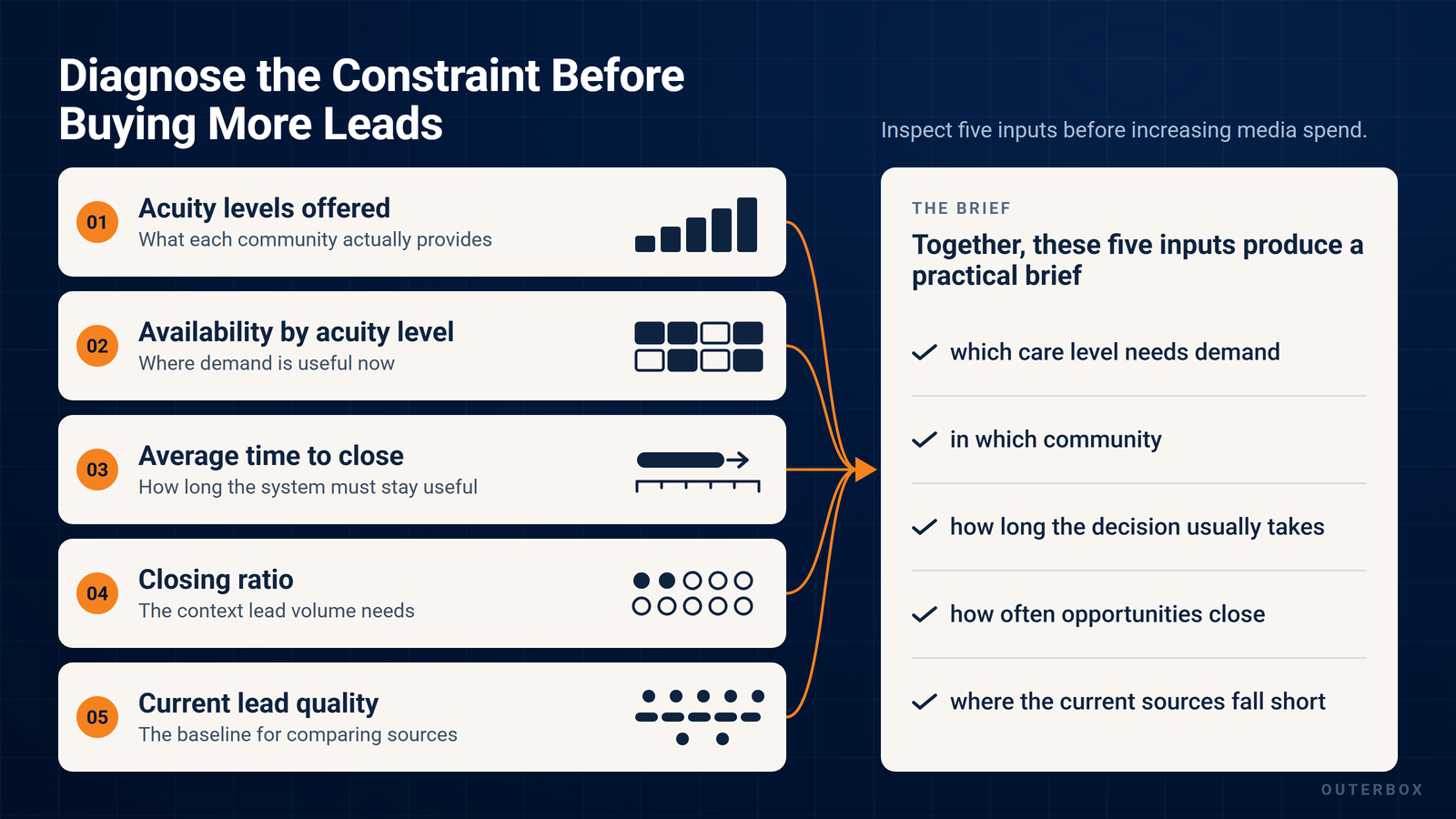
Acuity levels offered. The campaign must reflect what each community actually provides. Active adult, independent living, assisted living, memory care, and respite care attract people with different needs and decision paths. Broad “senior living” traffic often looks productive while failing to match the community’s services.
Availability by acuity level. Availability determines where demand is useful now. A portfolio may need more assisted living tours in one market while another community has memory care availability and a third has no practical room to scale inquiries. Direct budget to community-level need instead of dividing it evenly.
Average time to close. The buying window determines how long the marketing and sales system must stay useful. A family with an immediate care need follows a different path from a resident researching a move six months from now. Let close time set nurture length, remarketing windows, content, and forecasting.
Closing ratio. Closing ratio gives lead volume context. If a community already receives inquiries but very few become tours or move-ins, adding traffic magnifies the wrong problem. The gap may sit in targeting, the landing page, response quality, routing, tour experience, or sales follow-up.
Current lead quality. Current source quality provides a baseline. Compare sources by qualified conversations, tours, and move-ins instead of relying only on cost per form fill. A higher-cost source earns its place when it produces better-fit families. A low-cost source wastes staff time when the inquiries rarely advance.
Together, these five inputs produce a practical brief: which care level needs demand, in which community, how long the decision usually takes, how often opportunities close, and where the current sources fall short.
Build the Channel Mix Around the Buying Window
Senior living decisions rarely happen in one session. Search introduces the community. Reviews and care content build trust. Paid social and remarketing keep the community familiar. Calls, email, and sales follow-up answer the questions that move a family toward a tour.
All channels matter in senior due to the longer sales cycles. That does not mean every channel receives the same budget. It means each funded channel needs a defined job.
| Channel | Primary job | Useful outcome |
|---|---|---|
| Paid search | Capture in-market demand by care level and location | Qualified calls, forms, and tour requests |
| SEO | Build durable visibility for local and care-level questions | Organic inquiries and assisted conversions |
| Paid social and remarketing | Maintain awareness during comparison and family discussion | Return visits, content engagement, and reactivated inquiries |
| Reviews and local profiles | Establish local trust before the website visit or call | Direction requests, calls, and higher-confidence visits |
| Email, phone, and CRM nurture | Continue the conversation after the first inquiry | Responses, appointments, tours, and reopened opportunities |
I strongly recommend SEO for long-term success. Organic visibility answers questions before a family knows which community to contact, supports individual markets and care levels, and reduces dependence on campaign-only traffic over time.
Paid search has a different job. Paid search is always relevant to ensure you are in front of in-market audiences. Separate care levels, locations, and high-intent queries, then carry those distinctions into ads, landing pages, call tracking, and forms.
Paid social and remarketing support continuity. They bring a useful guide, community event, resident story, care-level reminder, or tour invitation back to someone who is still comparing. Their job is to keep qualified prospects engaged long enough for the next conversation.
“There can be long closing windows in Senior, thus consistent brand awareness is a MUST”
– Zach Kent
Match Landing Pages to Acuity and Community
Landing-page relevance is the bridge between targeting and lead quality. Send an assisted living ad to assisted living information for the correct community. A memory care campaign needs to answer memory care questions, establish trust, and offer an appropriate next step.
There’s not much nuance here, aside from ensuring the landing pages speak directly to the acuity levels you are advertising. The page does not need a complicated quiz. It needs clear alignment. The broader Senior Living and Assisted Living Marketing Agency hub explains how these care-level paths fit inside a full operator program.
A useful landing path should identify:
- The care level and community being offered
- Who the option is designed for
- Availability or the next step for checking it
- The questions a family can get answered
- A direct call, form, or tour action
- Enough source and campaign data for accurate routing
Forms should collect only the context the team will use. Care level, preferred community, timing, decision role, and contact preference help sales prepare. Excessive fields add friction without improving qualification.
Follow-Up Turns Inquiries Into Tours
Many senior living lead-generation problems appear after the form or call. In my experience, the common failure point is lack of follow-up. Since there’s a longer closing window (typically), having a full sales funnel running is crucial.
Fast response matters when a family is actively comparing options. Consistent response matters when the decision takes longer. Match the first follow-up to what the person asked about, and make ownership clear enough that no inquiry sits between marketing, a community, and a centralized sales team.
A practical follow-up system includes:
- Immediate confirmation that the inquiry arrived
- A prompt call or personal email tied to the care level and community
- A defined next step, such as an availability conversation or tour
- A scheduled series of useful follow-ups when the person is not ready
- A reason and date for re-engaging a dormant inquiry
- A recorded outcome that can improve the source and campaign
Useful parts of that system include email marketing, follow-up phone calls, and drip campaigns for brand awareness. Content can address pricing questions, care options, what to expect on a tour, family concerns, and community events. The tone should stay calm and useful. The goal is to make the next conversation easier without pressuring a family into a decision.
Match follow-up timing to the prospect’s stage. An immediate-need inquiry requires direct contact and a fast availability answer. A family planning months ahead needs a scheduled sequence that answers the next likely question without pretending the move is imminent. Record the timing signal when the inquiry arrives, then use it to set the next action and follow-up date.
Sales ownership must be visible. Every inquiry needs one accountable owner, a current status, and a dated next step. Automation confirms receipt and delivers useful material, but it should not disguise an unworked lead. CRM stages such as new, contacted, nurture, tour scheduled, tour completed, and closed give the team a common language and reveal where opportunities stop moving.
Dormant inquiries need a defined re-entry rule. Re-engage when availability changes, a relevant event approaches, a new care resource answers the person’s question, or the prospect’s stated timing window arrives. This creates useful contact based on context instead of repetitive “just checking in” messages.
Measure the Path From Source to Move-In
Online lead attribution connects the first useful source to the outcomes operators manage. Clicks and form fills diagnose campaign behavior, but they do not show whether the community received qualified demand.
The core measurement ladder is:
- Inquiry
- Qualified lead
- Tour or sales appointment
- Move-in
- Cost per qualified lead, tour, and move-in
Close time and closing ratio belong beside those stages. A channel looks weak in a short reporting window when its qualified prospects need more time. Another looks strong on lead volume while producing few tours. Cohort and community-level reporting make those differences visible.
Portfolio totals should not hide local constraints. Leadership needs to see which communities and acuity levels have availability, where follow-up is working, which sources produce tour-ready conversations, and where cost per move-in is changing. That view supports better budget decisions than a blended lead count.
At minimum, preserve the original source, campaign, landing page, requested care level, preferred community, first-response time, lead status, tour status, and move-in outcome. That record lets marketing trace a strong result back to the message and audience that created it. It also lets sales flag a quality problem with enough detail for the campaign team to act.
Review these fields monthly with marketing and sales in the same room. Resolve status gaps first, then use the resulting data to change targeting, budget, routing, or follow-up.
What Senior Living Results Look Like
Dial Senior Living shows how a connected program improved both marketing efficiency and an operator outcome. OuterBox combined paid search improvements, keyword retargeting, paid social, and SEO support across the portfolio. According to the Dial Senior Living case study, cost per conversion fell 54.55% and retargeting CTR rose 8x. Most important for this discussion, walk-in tours increased 20% year over year across many properties.
The channel metrics explain where the program improved. The tour result shows why the work mattered.
Read these figures as one connected sequence. Lower conversion cost created room to acquire demand more efficiently. Stronger retargeting engagement gave researching families another useful touch. The walk-in-tour lift showed movement closer to occupancy. None of the channel numbers replaces the tour outcome; together they help explain how the program produced it.
An anonymous senior living provider case study offers a second example. Over one year, the operator generated 54% more qualified online leads, 39% more move-ins directly from digital ads, and an 18% lower cost per online move-in. The operator also built more control over digital acquisition and reduced its use of third-party referral-service contracts.
The move-in and cost figures belong together. More qualified leads matter only when the sales path converts them, and more move-ins matter more when acquisition cost moves in the right direction. Review all three outcomes before increasing budget. A lead source that raises volume while weakening move-in economics has not solved the operator’s problem.
A 90-Day Senior Living Lead-Generation Plan
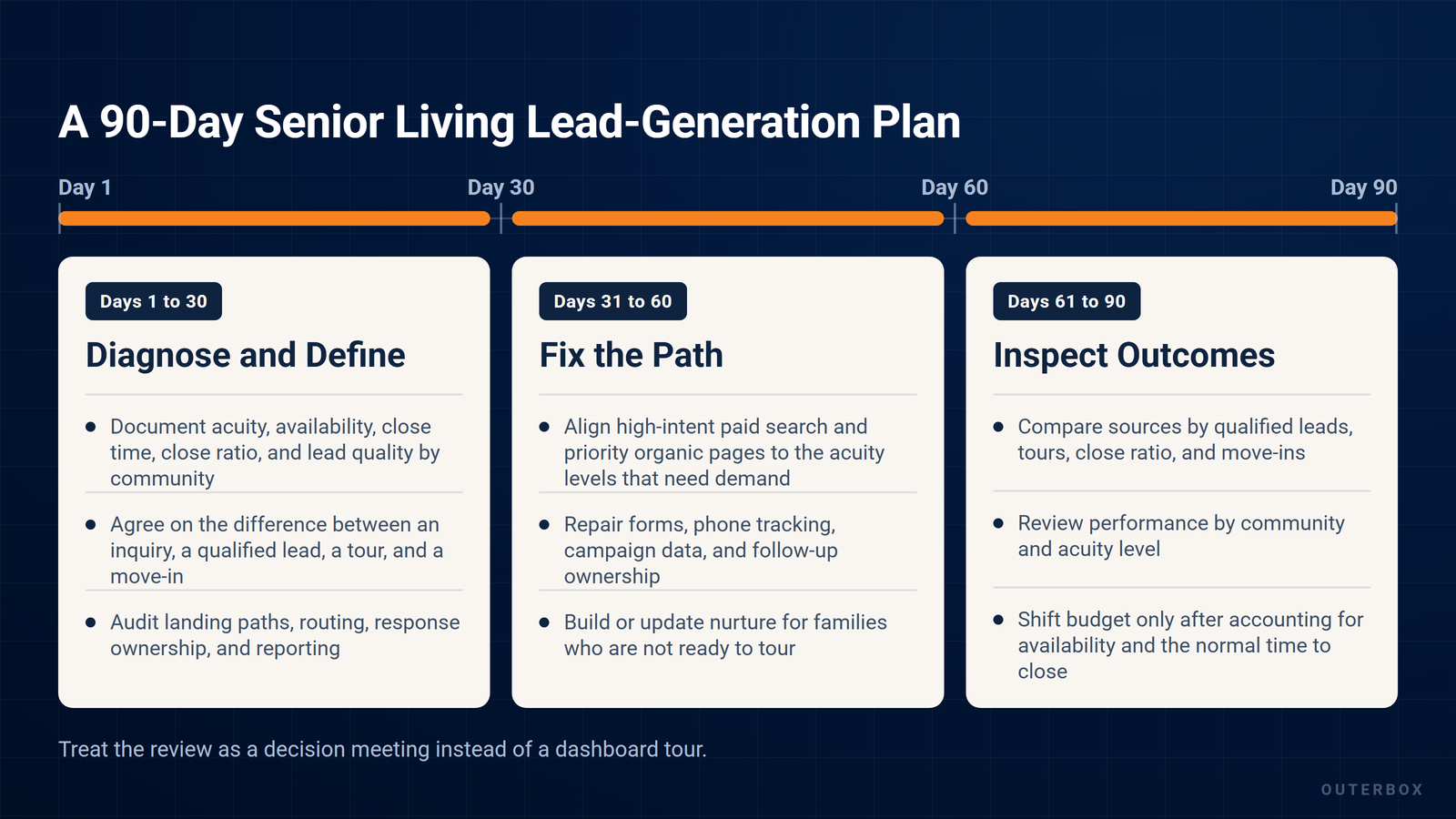
Days 1 to 30: Diagnose and Define
Document acuity, availability, close time, close ratio, and lead quality by community. Agree on the difference between an inquiry, a qualified lead, a tour, and a move-in opportunity. Audit landing paths, routing, response ownership, and reporting.
Days 31 to 60: Fix the Path
Align high-intent paid search and priority organic pages to the communities and acuity levels that need demand. Repair forms, phone tracking, campaign data, and follow-up ownership. Build or update nurture for families who are not ready to tour.
Days 61 to 90: Inspect Outcomes
Compare sources by qualified leads, tours, close ratio, and move-ins. Review performance by community and acuity level. Shift budget only after accounting for availability and the normal time to close. Keep the channels that produce useful conversations, and fix or reduce the ones that do not.
Treat the review as a decision meeting instead of a dashboard tour. Identify one source to expand, one friction point to repair, and one assumption to test in the next 30 days. Assign an owner and due date to each change. Then preserve the cohort baseline so the next review measures the effect instead of starting over with a new set of anecdotes.
Senior Living Lead Generation FAQs
These answers cover the operating questions that surface most often during planning.
What is senior living lead generation?
Senior living lead generation is the process of creating qualified calls, forms, tour requests, and move-in opportunities for senior living communities. It connects acquisition channels, landing pages, follow-up, and reporting around the care levels and locations an operator offers.
How do you generate leads for assisted living communities?
Assisted living lead generation starts with care-level and location fit. Operators can combine high-intent paid search, local and organic visibility, reviews, paid social, remarketing, and structured follow-up, then judge those sources by qualified conversations, tours, and move-ins.
What makes a senior living lead qualified?
A qualified lead has a plausible care or lifestyle need, location fit, a reachable contact path, and enough timing or intent to justify sales follow-up. The resident, adult child, spouse, caregiver, or advisor may initiate the inquiry.
Which channels work best for senior living leads?
The best mix depends on community availability, acuity, market demand, close time, and sales capacity. Paid search captures in-market demand, SEO builds long-term discovery, paid social and remarketing maintain awareness, and phone, email, and CRM follow-up advance the conversation.
What should senior living lead-generation reporting include?
Reporting should include inquiries, qualified leads, tours, move-ins, close ratio, time to close, and cost per qualified lead, tour, and move-in. Community-level and acuity-level views help operators distinguish a demand problem from an availability or follow-up problem.
Find the Constraint in Your Senior Living Lead Path
At OuterBox, my team and I evaluate your senior living lead path across acuity, availability, search, paid media, landing pages, follow-up, and attribution. Bring us the communities, current sources, and outcomes you are trying to improve. We will identify the constraint and show you where the next investment can do more useful work.
Senior Living Lead Generation
Talk Through Your Senior Living Lead Path
Tell us which communities need demand and where inquiries stall today, and we will show you what to fix first.
Services
"*" indicates required fields