By: Craig Smith
Your company has two choices: market harder or market smarter. If you choose to market harder, you need to increase your budget and grow your audience each year. The other option is to market smarter by refining your targeting and strategy to better reach potential buyers and improve your customer service to boost retention.
Marketing smarter allows you to market harder. You can improve your ROI and then reinvest the money you save into additional channels. One tool that strategic marketers can utilize is a single customer view (SCV), which pulls data from multiple sources to create a unified experience across channels and devices.
Editor’s Note: Some professionals refer to a single customer view (SCV) as a single view of the customer (SVC). These acronyms are interchangeable for the most part, and we chose the use the SCV option for clarity.
What Is a Single Customer View?
The single customer view (SCV) was developed in response to our multichannel digital world. For years, marketers struggled to reconcile how customer conversations and engagements that started on one channel turned into conversions on another one.
Marketers would lose customers on mobile devices who switched to a desktop.
They would lose customers who started on social media and then reached out to the call center.
This disconnect results in incomplete analytical data, duplicate results, and bad customer experiences. An SCV utilizes existing data from multiple sources to marry various customer engagements and create a single view.
An SCV mergers:
- Identifiers (email, cookies, device IDs, customer accounts)
- Engagements & interactions (site visits, app sessions, social messages, support tickets)
- Transaction history
- Preferences & profile data
With this information, an unresolved customer complaint via email is solved when a customer calls into the center or visits a store. Brands can also learn the different paths customers take in the customer journey to learn how they can improve the process and invest in better solutions.
Data maturity plays a critical role in building an effective Single Customer View. Organizations with higher data maturity have stronger governance, cleaner integrations, and more consistent identifiers across systems—making it possible to connect every touchpoint with accuracy. Without this foundation, even the best analytics tools struggle to reconcile fragmented records or deliver reliable insights. Advancing data maturity ensures that your SCV isn’t just a database of interactions, but a living, trusted source of truth that supports personalization, retention, and smarter business decisions.
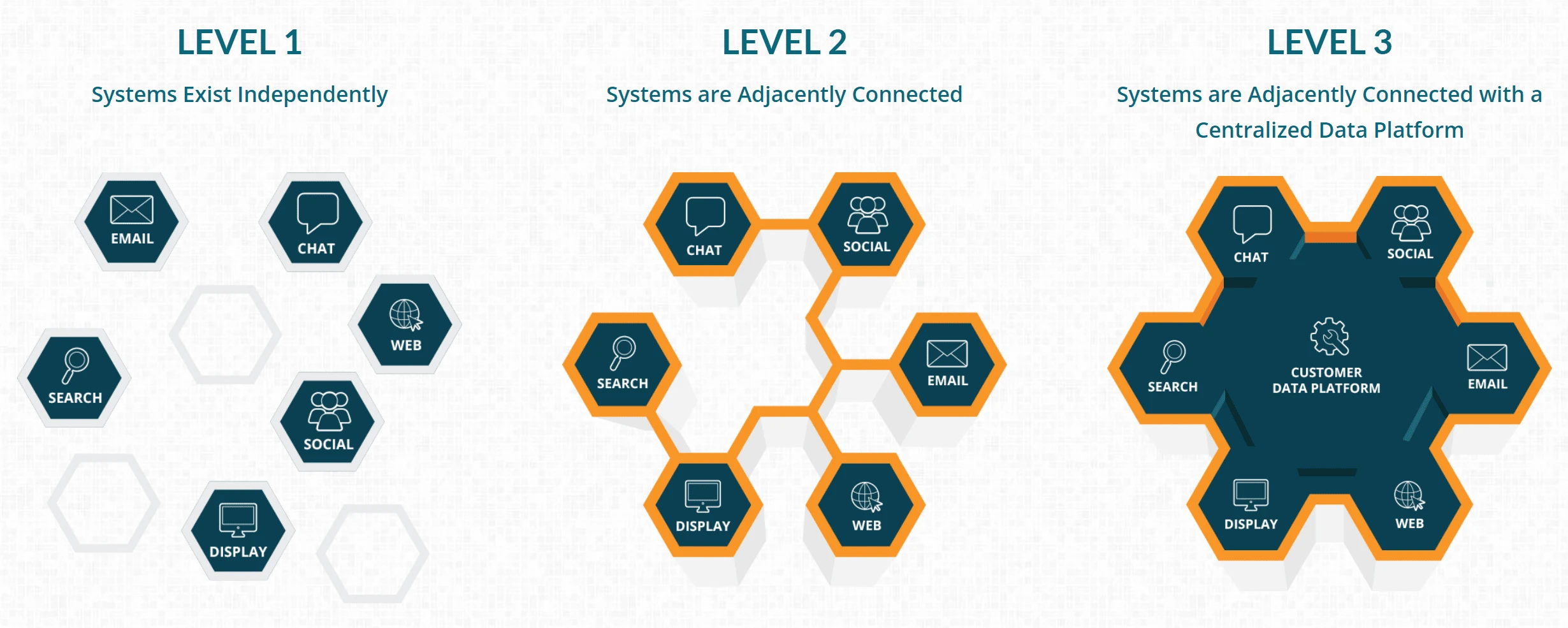
“The brands winning in 2025 are those that see their customer data as an ecosystem, not a collection of silos. Unified, first-party views are what make personalization scalable and measurable.”
— Marketing AI Institute, 2025 Report on Data Maturity
Essentially, customers expect your brand to have a high level of data maturity because other companies are already providing them with the experience that you can’t.
A Single Customer View Improves Customer Service
Customer expectations have outpaced most companies’ infrastructure. Whether they’re chatting with an AI assistant, messaging on social media, or calling your sales line, customers expect your brand to recognize them instantly and to continue the conversation seamlessly. That level of service is only possible with a Single Customer View (SCV).
An SCV connects interactions across every touchpoint so support teams and automation tools draw from the same unified record. When a customer starts a chat about a delayed order and later calls in, the agent already sees the context and resolution history. No repetition, no friction, no frustration.
Brands with disconnected systems still treat each channel as a silo, forcing customers to re-explain issues and fragmenting data between departments or vendors. Meanwhile, organizations operating from a unified customer view can anticipate needs, personalize responses, and resolve issues faster often reducing support costs and churn simultaneously.
Data insight: More than half of consumers now prefer messaging or chat over phone or email for customer service. With a unified data layer, brands can deliver that immediacy and consistency no matter where the interaction begins.
A Single Customer View Increases ROI Through Better Targeting
While brands might focus on customer service opportunities when they start developing their SCV models, there are additional benefits both to the customer and the brand. Knowing your customers means knowing how they want to interact with your brand and what they need.
An SCV brings together behavioral, transactional, and engagement data into one unified profile. That visibility reveals which audiences respond to specific messages, which channels drive the most qualified traffic, and which moments in the customer journey most influence conversion. Instead of relying on broad targeting or outdated lookalike models, your campaigns become data-informed — reaching likely buyers with the right message at the right time.
This unified perspective also elevates marketing attribution.
Google Analytics 4 includes Conversion Path reports, but it’s limited to tracked sessions and known identifiers. It won’t fully reconcile disconnected identities or integrate offline and cross-platform interactions. A Single Customer View fills that gap by connecting those touchpoints directly—giving marketers a complete picture of what’s truly driving revenue and retention.
With improved marketing attribution, you can better allocate your budget for better targeting. With better targeting, you get the right message in front of the right customers at the right time — increasing your conversions and sales.
What Does an SCV Contain?
Brands can develop their own single customer view in a variety of ways. Your team needs to determine which information is the most valuable to audiences and what can help your team track shoppers from one platform to the next. An SCV typically pulls three kinds of data:
- Transaction Data: Essential customer service information related to past and pending transactions, customer communication history, and interaction history with the brand.
- Demographics: Physical demographics like gender, age, and geo, interests, lifestyle, income, and buyer persona.
- Behavioral Patterns: Data relating to how and when they buy, what types of items they need and how they use them, which social channels they use, and how they communicate with the brand.
Brands looking to develop an SCV need to focus on collecting good data instead of excess data. Just because you have hundreds of data points on a customer doesn’t mean you have valuable information — especially if you are so overwhelmed by the volume that you can’t make strategic decisions.
Brands should prioritize first-party and zero-party data—information shared directly by customers through forms, calls, and conversations—over third-party data that’s often incomplete or restricted.
Without careful planning, you could have an incomplete or inaccurate SCV.
Building a Single Customer View with LOOP Analytics
Creating a Single Customer View doesn’t have to mean an enterprise-level data overhaul. LOOP Analytics unifies customer data right inside their existing marketing ecosystem.
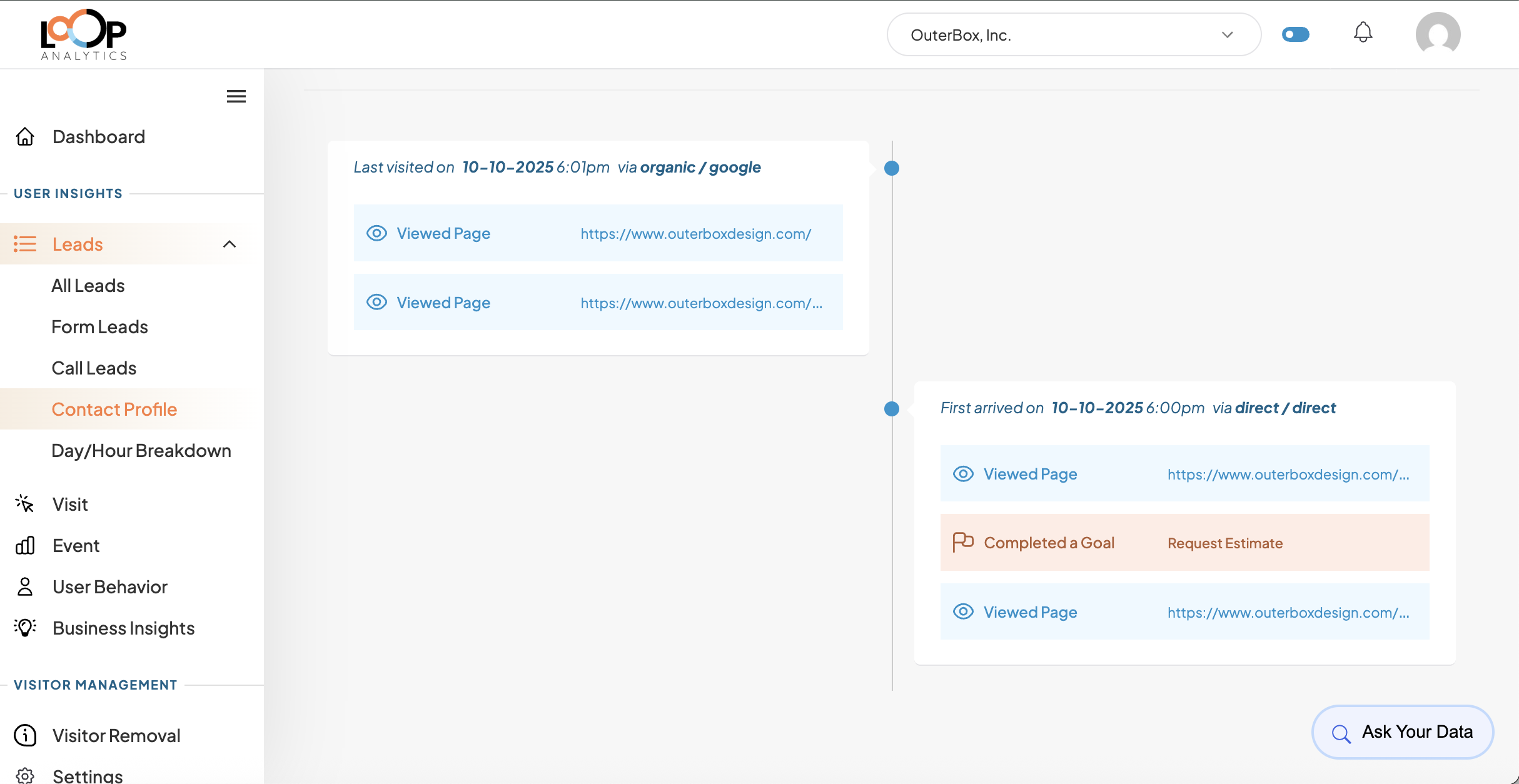
LOOP pulls in data from multiple sources, including form submissions, phone calls, company identification, and users’ activities and actions across your site to create a unified record of every customer interaction.
LOOP’s integrated dashboards merge behavioral, engagement, and attribution data, giving teams a single, actionable view of each lead or customer journey.
Example: A prospect who downloads a white paper, speaks with sales, and later fills out a quote request form is tracked as one entity—not three separate leads. Teams can make annotations to keep track of progress, ownership, and other key notes.
Because LOOP operates as a first-party data platform, it supports privacy-first frameworks—an essential foundation for modern SCVs. With third-party cookies phasing out, LOOP keeps data connected by integrating verified, consent-based first-party insights from your own marketing assets.
Evaluate Your Data Maturity to Build an SCV
At OuterBox, we constantly strive to market smarter through improved data services. We believe that winning marketers need to be data-obsessed and know how to navigate our increasingly analytical world.
Start by reaching out to our team and discover how we help you take your business to the next level with our data services.