By: Sal Commisso
SEO agency pricing has a wide range because an SEO engagement is not a single, standardized product. In Ahrefs’ global poll of 439 providers, the average agency retainer was about $3,209 per month. The most common hourly band was $100 to $150, and the most common one-off project band was $2,501 to $5,000.
Those figures are useful reference points. The cost of SEO changes with your market, website, goals, current visibility, technical condition, internal resources, and the amount of work needed to compete. A range gives you a starting point. Proper scoping gives you the price.
This guide explains the common pricing models, the factors behind different quotes, what budgets buy at different levels, and how to compare providers. If you already have a proposal in hand, use the tables and questions below to test whether the price and scope make sense together.
SEO Pricing at a Glance for 2026
The cleanest current benchmark comes from Ahrefs’ SEO pricing survey. The survey polled 439 SEO providers around the world, was published in December 2023, and was updated in April 2026. It found an average monthly agency retainer of $3,209 and an average hourly price of $111.
| Pricing model | Survey benchmark | Best used for | What to check |
|---|---|---|---|
| Monthly retainer | Agencies averaged about $3,209 per month | Ongoing technical, content, authority, and measurement work | Whether priorities can change as data changes |
| Hourly consulting | $100 to $150 was the most common band | Advice, troubleshooting, training, and tightly defined support | Who performs the work and how time is documented |
| One-off project | $2,501 to $5,000 was the most common band | Audits, migrations, research, and defined optimization projects | Deliverables, implementation responsibility, and exclusions |
| Performance-based | No dependable universal benchmark | Carefully defined outcomes with clear attribution | Incentives, measurement rules, contract risk, and guarantees |
| Package | Varies by scope and provider | Buyers who need a clear starting scope | Whether fixed quantities displace higher-impact work |
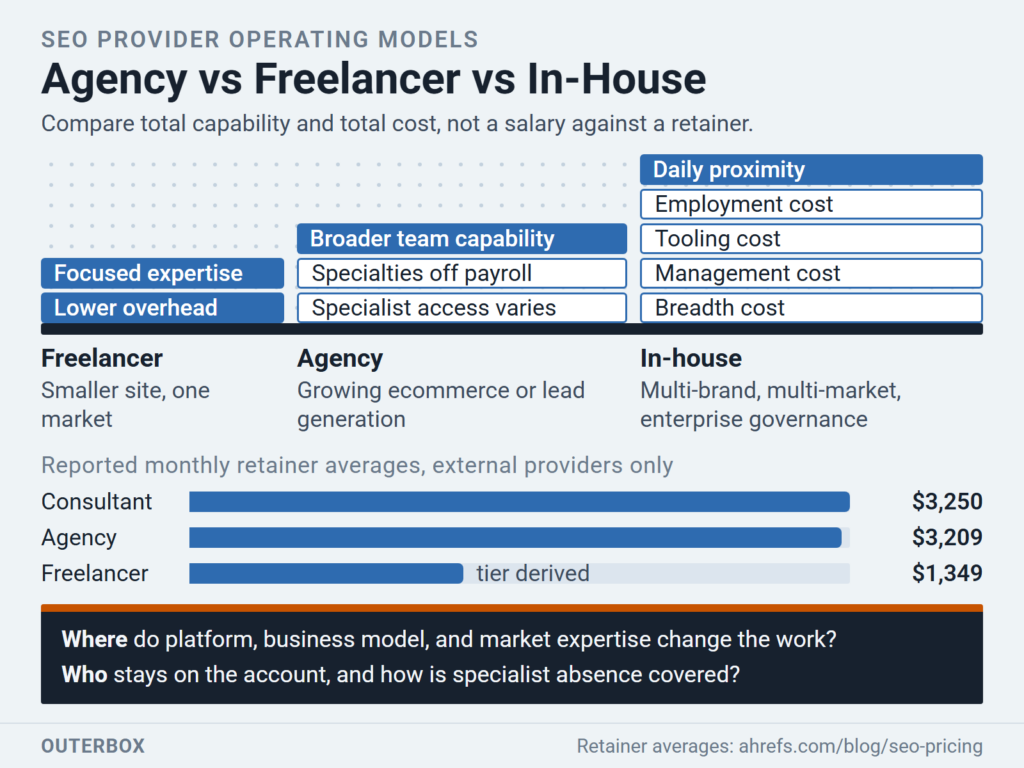
Provider type matters too. In the same survey, the tier-derived freelancer monthly-retainer average was $1,348.63, while agencies averaged $3,209 and consultants averaged $3,250. These figures describe the surveyed market. Value still depends on fit, scope, and execution, and $3,209 will not be the right budget for every company.
| Business situation | A practical pricing interpretation |
|---|---|
| A smaller site in one market | A focused scope may fit a freelancer, consultant, or narrower agency engagement if technical needs and competition are limited. |
| A growing eCommerce or lead-generation site | The quote usually expands as category, product, service, content, technical, and authority work begin running together. |
| A multi-brand, multi-market, or enterprise site | Governance, platform complexity, analytics, internal approvals, and parallel workstreams often matter as much as the number of pages. |
| A defined problem or migration | Project pricing can be easier to compare, provided each proposal describes the same depth and implementation boundary. |
The published survey is provider-reported and global, so treat it as a market reference. A US agency proposal can land below or well above these figures depending on the work. Judge whether the scope, expertise, risk, and expected business value support the number instead of expecting a quote to match an average to the dollar.
The shape of the benchmark also matters. An average can be pulled upward by a smaller group of large engagements, while a most-common band shows where the largest cluster of responses landed. That is why this guide uses the agency monthly average alongside the most-common hourly and project bands. They answer different questions, and none should be presented as a guaranteed market rate.
When comparing a real quote with the table, normalize the scope first. Confirm whether content production, development, digital PR, analytics configuration, migration support, and conversion work are included. A $3,000 proposal that excludes implementation can cost more in practice than a $5,000 proposal that covers it. Contract length, onboarding fees, access to senior specialists, and work performed by partners can change the total as well.
SEO Pricing Models Explained
Most SEO proposals use one of five structures: a monthly retainer, hourly consulting, project pricing, performance-based pricing, or a fixed package. The right model depends on whether the work is ongoing, how clearly the scope can be defined, and how much uncertainty the engagement has to absorb.
Monthly Retainer SEO Pricing
A monthly retainer is the dominant model for ongoing SEO. Ahrefs found that 78.2% of surveyed providers offered monthly retainers. Providers could offer more than one model, so that figure does not mean retainers accounted for 78.2% of all revenue or engagements.
Retainers work well when the priorities will change. A technical issue may deserve attention first, followed by category-page work, new content, internal linking, digital PR, or conversion improvements. The agreement gives the team room to follow the evidence instead of repeating a fixed checklist.
That flexibility does not mean the buyer should accept a vague promise to “do SEO.” A sound retainer has an initial point of view, a way to rank competing priorities, and a reporting structure that connects decisions to outcomes. It should also state which tasks require the client’s developers, writers, analysts, or legal reviewers. Those dependencies can determine pace as much as the agency’s capacity.
At OuterBox, we plan ahead and review the work, results, and priorities with the client. A two-way conversation between agency and client is how the best outcomes get earned. That matters because a package promising a fixed number of articles, backlinks, or optimizations can reward visible work volume even when a different problem deserves the budget.
The proposal should still be specific. When evidence exposes a higher-impact problem, the scope should be able to turn toward it. That freedom, paired with clear ownership and useful reporting, is what a retainer buys.
SEO Hourly Rates
Hourly SEO rates make sense when you need advice, training, troubleshooting, or specialist help with a contained problem. The Ahrefs survey reported a $111 average hourly rate, with $100 to $150 as the most common band. One in ten respondents charged more than $150 per hour.
The range can get much wider outside the center of the market. Your neighbor’s daughter who is “good with computers” may offer help for a few hundred dollars, while a nationally known consultant can charge far more for limited access. Either could be useful in the right situation. Prior experience with your problem and a clear use of the time matter more than fame (the famous name still has to fit the problem).
Hourly pricing is easy to understand but hard to forecast when the work is open-ended. An estimated range, a stop point, and a defined output keep the engagement bounded. Without them, a low hourly rate can produce an expensive project simply because it takes longer.
Teams that can execute internally often use SEO consulting to buy senior diagnosis, a prioritized roadmap, and implementation guidance without bundling full-service production.
Project-Based SEO Pricing
Project pricing suits work with a defined beginning and end, such as an SEO audit, migration plan, keyword map, technical diagnosis, or content program design. Ahrefs found $2,501 to $5,000 was the most common project band among respondents. Its tier-derived average for agency projects was much higher at $9,507.84, which is a good reminder that project depth varies substantially.
Think of an SEO audit as a doctor’s checkup for your site. A quick screening and a full diagnostic are both “audits,” but they do not answer the same questions. The proposal should state how many templates or systems are reviewed, whether crawling and analytics are included, how findings are prioritized, and whether implementation is part of the price.
Defined deliverables make project quotes easier to compare. But line-item similarity can be misleading. Two providers may both promise a technical audit while only one covers JavaScript rendering, indexation patterns, internal link structure, structured data, and implementation sequencing.
Delivery can mean a presentation, a detailed implementation backlog, developer-ready tickets, or hands-on fixes. If your team can’t act on a diagnostic, the cheapest audit may create a list that sits untouched. Implementation ownership belongs in the pricing comparison from the start.
Performance-Based SEO Pricing
Performance-based pricing ties some or all compensation to an outcome such as rankings, traffic, leads, or revenue. The appeal is obvious: the buyer wants incentives aligned with results. The difficulty is defining a result the provider can influence, measure, and attribute fairly.
Google advises businesses to avoid anyone who guarantees a first-place ranking. No provider controls Google’s results, competitor actions, site approvals, or every factor affecting revenue. That does not make every performance component dishonest. It does mean the contract needs precise measurement rules, a sensible baseline, safeguards against low-value keyword chasing, and clarity about what happens when implementation is delayed.
SEO Package Pricing
SEO pricing packages bundle a standard set of work into tiers. They can make purchasing easier, especially for a buyer who needs a clear starting scope. They can also hide the difference between activity and progress.
Compare packages by the problems they can solve and put less weight on counts. Ten articles aren’t automatically better than four if the site first needs a crawl/indexation fix. A promise of monthly backlinks says nothing about relevance or quality. A package earns its keep when the included work can change with the evidence and the custom-work boundary is clear before signing.
Our SEO packages provide more context on how scope can change across programs, but any final recommendation should still begin with your site, goals, and competitive position.
What Makes One SEO Quote Cost More Than Another
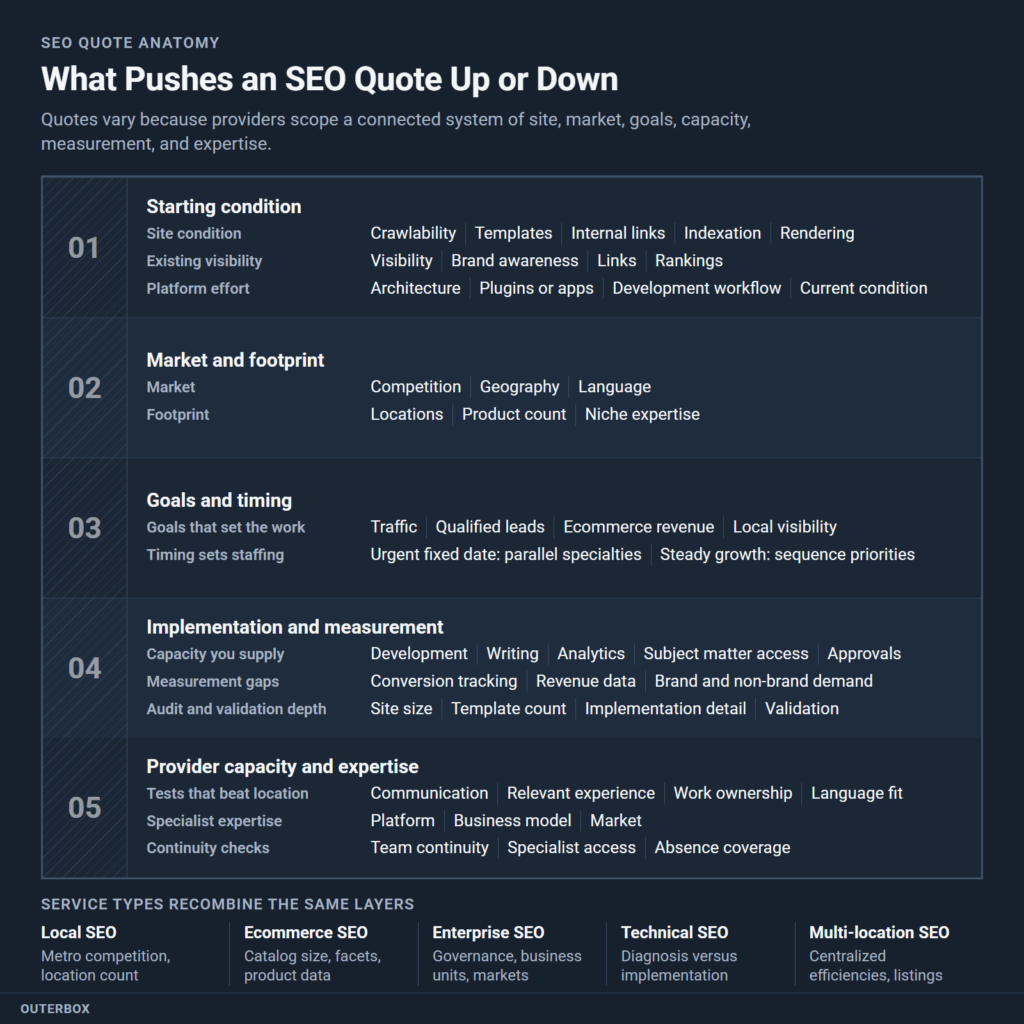
SEO quotes vary because providers are pricing a combination of starting condition, market difficulty, ambition, speed, and expertise. No credible source gives each factor a universal percentage. A useful proposal explains how these inputs affected the scope rather than presenting a mysterious total.
Your Starting Point
The technical condition of the site and CMS changes how quickly productive work can begin. A crawlable, well-structured site with clean templates, sensible internal links, and reliable analytics gives the team a better foundation. A site with indexation problems, duplicate templates, rendering issues, or a risky migration ahead requires diagnosis and repair first.
Existing visibility and brand awareness matter too. A recognized site with strong links and page-one rankings starts from a different place than a new domain. Starting farther back can mean more foundational work or a longer runway, even when both companies want the same outcome.
Your Market and Footprint
Competition changes the amount and quality of work required. A local service business in one city faces a different competitive field than a national retailer, a regulated financial company, or an enterprise software brand. Geographic scope, language, number of locations, product count, and niche expertise all influence the quote.
Provider location can affect overhead and rate structure, but location alone does not determine quality. Communication, relevant experience, work ownership, and language fit are more useful tests than a broad assumption about any country or city.
Your Goals and Timing
Traffic growth, qualified leads, eCommerce revenue, local visibility, and migration protection require different work. Urgency also changes staffing. A fixed launch date may require several specialties to work in parallel, while a steady growth program can sequence priorities over time.
Your internal team affects scope as well. A company with developers, writers, analysts, and fast approvals may buy strategy and specialist guidance. Another may need the agency to supply more implementation capacity. Neither model is automatically better, but they should not carry the same price.
The condition of your measurement setup can add another layer. If conversions are not tracked consistently, revenue is split across systems, or reporting cannot separate brand from non-brand demand, the engagement may need analytics work before either side can judge progress. That effort is part of responsible scoping, even though it does not look like a ranking task.
The Provider’s Expertise
Experience with your platform, business model, and market can reduce wrong turns. OuterBox specializes in eCommerce and lead-generation SEO, so our perspective includes the relationship between site architecture, merchandising or service pages, conversion paths, content, and organic visibility. That expertise may cost more than general support, but the proposal should show where it changes the work.
Capacity and continuity matter too. The proposal should show whether the people presented during sales stay involved, how specialist access changes by tier, and how work is covered when a team member is unavailable. A lower quote can be perfectly sound when its operating model is clear.
SEO Prices by Service Type
SEO service pricing shifts across local, eCommerce, enterprise, technical, and multi-location work. Site condition and competition can move any real quote, while the sources available for each specialty vary in depth.
| Service type | Pricing signal |
|---|---|
| Local SEO | The survey supplies a monthly average, but metro competition, service count, and location count still change scope. |
| eCommerce SEO | Catalog size, faceted navigation, platform constraints, content depth, and development ownership tend to expand the engagement. |
| Enterprise SEO | Governance, template systems, business units, markets, and parallel implementation work usually push scope upward. |
| Technical SEO | A diagnostic-only audit costs differently from implementation, migration support, and post-launch validation. |
| Multi-location SEO | Centralized systems can control cost; unique local pages, listings, reviews, and inputs add work as the footprint grows. |
Local SEO Pricing
Local SEO often concentrates on a defined service area, Google Business Profile visibility, reviews, citations, local landing pages, and location-relevant authority. In the Ahrefs survey, local SEO averaged $1,557 per month across providers. Local agencies averaged $1,819, freelancers averaged $1,150, and $75 to $100 was the most common hourly band.
Those numbers are useful for orientation, but local is not always simple. A single-location business in a smaller market has a different challenge than a company competing across a metro area with many service lines. The need for review strategy, location content, citation cleanup, technical work, and site authority still changes the scope.
eCommerce SEO Pricing
eCommerce SEO pricing depends heavily on catalog size, platform, category competition, faceted navigation, product data, content needs, and development capacity. A large catalog can create thousands of crawl and indexation decisions. Merchandising changes, discontinued products, seasonality, and platform releases add work that a smaller brand site never encounters.
That is why a single market-wide eCommerce price band would be misleading. On a 50-product store, category and product priorities may be tightly contained. On a catalog with hundreds of thousands of URLs, the team may need to solve crawl paths, indexation, templates, data, content, and development sequencing together. That difference belongs in the quote.
Our eCommerce SEO services reflect that broader scope. For Wine Enthusiast and WineExpress.com, OuterBox supported a platform migration that included responsive redesign, HTTPS cutover, and information architecture work. The source case study reports a 59% organic traffic increase, a 60% organic revenue increase, and a 12% increase in total ranking keywords, with a seven-month migration schedule. Those results belong to that client and do not promise a price or performance level for another engagement.
Enterprise SEO Pricing
Enterprise programs add scale and governance. Large sites may involve multiple business units, markets, platforms, analytics stakeholders, development teams, and approval layers. The price reflects the coordination and specialized judgment required to move those systems together. A larger keyword list captures only a small part of that complexity.
Enterprise pricing usually rises with template count, technical complexity, market count, internal coordination, and implementation volume. Those inputs produce a more useful comparison than a universal band detached from scope.
OuterBox’s enterprise SEO services can include work across those systems. In the Weiss-Aug case, intent-driven content across capabilities, industries, and divisions contributed to a 270% year-over-year increase for surgical pages, while organic search accounted for 66% of leads. Keep the attribution tight. Those outcomes belong to Weiss-Aug’s engagement.
Technical SEO Pricing
Technical SEO can be a one-off diagnostic, an implementation project, or part of a retainer. The scope may cover crawling, indexation, canonicals, internal links, structured data, JavaScript rendering, Core Web Vitals, redirects, templates, or a migration. A small brochure site and a large JavaScript storefront should not receive interchangeable audit quotes.
A diagnostic-only price should be separated from implementation guidance, ticket writing, developer collaboration, validation, and post-launch checks. Our SEO audit services can stand alone or serve as the starting point for a broader program.
Franchise and Multi-Location SEO Pricing
Multi-location pricing often scales with the number and diversity of locations, but a simple per-location fee can obscure the work. A 10-location franchise with centralized content and consistent data has a different scope from a 50-location business with distinct services, local competition, review programs, and location-page needs.
Centralized systems can control costs across a location portfolio. Unique services, local competitors, review programs, and location-specific content pull effort in the other direction. A sound quote makes that tension visible and separates site work from Google Business Profile, review, and citation work.
Location maturity also changes the work. A new location may need accurate listings, a useful page, measurement, and a review process. An established location may already have those assets but face stronger local competitors or duplicate information across systems. A single blended fee can be convenient, yet the provider should still be able to explain how effort varies across the portfolio.
What an SEO Budget Actually Buys
A useful SEO budget buys diagnosis, prioritization, implementation, measurement, and the specialist time needed to improve organic performance. The mix changes with the site. Early work may lean toward technical fixes and measurement; a mature site may need deeper content, internal linking, authority, and conversion analysis.
The lower-complexity-versus-enterprise distinction is useful when it describes capability and coordination instead of arbitrary monthly quantities.
| Lower-complexity scope | Enterprise scope |
|---|---|
| One site or a narrower market | Multiple sites, markets, brands, or business units |
| Foundational technical and on-page priorities | Template systems, migrations, rendering, and platform governance |
| Focused keyword and page opportunity set | Large-scale research across categories, products, services, and audiences |
| Clear analytics setup and decision reporting | Multiple analytics stakeholders, data sources, and executive reporting needs |
| Content updates around the highest-value gaps | Parallel content workstreams with editorial and subject-matter approvals |
| Focused authority and internal-link work | Broader digital PR, authority, and internal-link systems |
| Direct owner or small approval group | Cross-functional coordination with development, legal, brand, and product teams |
These columns describe common scope patterns. A smaller company can have a technically difficult site, and an enterprise may need a narrowly defined project. The point is to understand what makes the work heavier.
Proposal language can reveal whether the provider understands that distinction. A lower-complexity plan should identify the few areas most likely to change the outcome. An enterprise plan should explain governance and implementation, rather than taking the smaller plan and multiplying every quantity. Scale creates coordination problems as well as production needs.
Be cautious when a package leads with article counts, backlink counts, or a fixed checklist without explaining priorities. Tangible deliverables feel reassuring, but they can lock the budget into activity after the data points somewhere else. A good scope tells you what capabilities are available and how the next priority is chosen.
How to Set an SEO Budget You Can Defend
Start with business economics, then test the proposed SEO cost per month against the opportunity and your ability to sustain the work. Five company-specific questions are more useful than a universal marketing-budget percentage.
- What is an additional sale or qualified lead worth? Use contribution margin, close rate, average order value, repeat value, or another business measure your finance team trusts.
- What would equivalent demand cost through paid search? Current paid-search cost can give you a replacement-cost reference, even though paid and organic visitors are not identical.
- How large is the organic opportunity or competitive gap? Look at the pages, categories, services, and queries that could matter, plus the strength of the sites already winning them.
- What can your internal team implement? Development, content, analytics, approvals, and subject-matter access affect how much external support you need.
- How much runway can you support? SEO gains and implementation effects do not arrive on a universal schedule. A budget that forces the company to stop before meaningful work can be evaluated is a poor fit.
Consider a company producing $250,000 in total monthly sales at a 20% contribution margin. That is $50,000 in monthly contribution before other costs. Subtract a $5,000 monthly SEO retainer and $45,000 remains before those other costs. This is an affordability check using total sales. It makes no claim that SEO produced the sales, forecasts no ROI, and does not establish the right budget.
A defensible budget connects the quote to opportunity, capacity, and risk. It also leaves room to say no when the economics do not support the scope.
Run the same worksheet for more than one scenario. A conservative case can use lower close rates or margins and a longer evaluation period. A stronger case can reflect the full opportunity if the company has evidence to support it. If the budget only works under the most optimistic assumptions, narrow the scope or choose a defined project first.
You should also separate agency fees from internal costs. Development time, subject-matter review, creative production, data access, and executive attention all consume resources. A plan that looks affordable on the invoice can still fail if the company cannot support those dependencies. Good budgeting reserves both money and organizational capacity.
Is SEO Worth the Cost? Use Revenue and Replacement Cost
SEO can be worth the cost when the business value of durable organic visibility exceeds the investment and the company can support implementation long enough to evaluate it. The paid-search replacement-cost test is a useful starting point: estimate what it would cost to buy comparable qualified visits or leads, then compare that value with the organic program.
The comparison is imperfect. Paid traffic can turn on quickly, organic visibility can persist, and the channels may reach different buyers. Still, replacement cost gives the conversation a real economic anchor. If paid search would cost far less than the SEO program for the same useful demand, challenge the scope. If the organic opportunity is strategically valuable and expensive to rent through ads, SEO may deserve a larger role.
OuterBox’s case studies show what successful programs have produced for specific clients. They demonstrate capability, while expected returns still depend on the next client’s situation.
| Client | Source-bound result |
|---|---|
| CORSA Performance | 366% organic revenue increase in the first two years, 122 first-page keywords, and a 75% year-over-year organic revenue increase in 2025 |
| High Point Scientific | 363% website traffic increase, 179% organic revenue increase, and 9,876 first-page keywords compared with 3,205 |
| Warehouse Lighting | 105% organic revenue increase, 119% organic transactions, and 110% organic traffic increase |
| Soccer Innovations | 17% year-over-year organic revenue increase, 859 page-one keyword rankings in 2025, and 491 new or improved page-one keywords supporting the soccer-ball product focus |
When you build the business case, keep each assumption separate. Use total revenue or lead volume only for affordability. Use attributable organic revenue, qualified leads, or another agreed measurement for performance. Use case studies to assess whether the provider has handled comparable complexity, never as a forecast for your account.
And remember that SEO value is not limited to a last-click report. Better site architecture, clearer pages, stronger measurement, and useful content can support paid media, sales, merchandising, and customer decisions too. Count those benefits carefully, without turning every improvement into invented revenue.
How to Compare SEO Agency Pricing and Packages
The right company should feel like an extension of your team. Price matters, but the buying decision gets clearer when you compare the reasoning behind each proposal.
| Green flag | Red flag |
|---|---|
| The provider explains your starting condition, opportunity, priorities, and implementation dependencies. | The proposal is a generic deliverable menu with no connection to your site or market. |
| You can speak with the people who would lead or perform the work. | Sales cannot explain who owns strategy, execution, or communication after the contract is signed. |
| Case studies keep metrics attached to named clients and context. | Results are presented as typical outcomes or guarantees. |
| Reporting connects work to business and search outcomes. | Reporting centers on activity counts that look busy but avoid impact. |
| The agreement explains what can change as evidence changes. | Fixed quantities continue whether or not they address the biggest problem. |
| The provider gives realistic estimates and acknowledges what it cannot control. | The provider guarantees a number-one Google ranking. |
Google’s guidance on hiring an SEO recommends asking for a technical and search audit, realistic estimates, and an explanation of the work. It also says to find someone else if a provider guarantees first place. Google’s spam policies give you a reference point when proposed tactics sound risky.
Talk with the actual team. Ask how they would diagnose your site, what they would prioritize first, what implementation needs from you, and how they handle a finding that changes the plan. Look for patterns across several relevant case studies rather than one dramatic number.
Then make the proposals comparable. Put each provider’s assumptions, included capabilities, exclusions, implementation ownership, senior access, reporting, contract terms, and exit conditions in one table. A price difference is much easier to judge once the hidden differences are visible. If a provider will not clarify an exclusion or dependency before signature, expect that ambiguity to become expensive later.
If you are comparing agencies for a large engagement, buying standalone audits from two or three providers can be revealing. You pay more upfront, but you see how each team investigates, prioritizes, explains tradeoffs, and turns findings into action. Our guide to choosing an SEO company covers the broader evaluation process.
If you want to compare your current proposal with an OuterBox scope, call (866) 647-9218 or request a conversation through our SEO services page.
SEO Pricing FAQs
On average how much does an SEO campaign cost?
Ahrefs’ 439-provider survey found an average agency monthly retainer of about $3,209. Across provider types, 63% reported monthly pricing between $500 and $5,000. Your campaign can land outside those figures because site condition, competition, goals, geography, and implementation needs change the scope.
Why do some companies charge only a few hundred dollars a month?
A low price can reflect a narrow scope, a freelancer’s overhead, limited experience, automation, or a standardized package. Do not judge the number alone. Ask who performs the work, what is included, how quality is checked, and whether the scope addresses your actual problem.
Is there a standard price for SEO?
No. SEO is not a standardized product, so there is no universal price. Market benchmarks help you orient, but a defensible quote connects the site, market, goals, timeline, internal capacity, provider expertise, and implementation responsibility to a specific scope.
The same monthly price can buy very different levels of strategy, production, implementation, and specialist access. Compare the scope and operating model before deciding that two proposals are equivalent.
How long does SEO take to start working?
There is no universal results window. Google’s SEO Starter Guide says some changes can appear within hours while others can take several months, and it recommends waiting a few weeks before assessing whether an effect was beneficial. Starting condition, competition, resources, and implementation speed all matter.
Does SEO cost more for different CMS platforms?
It can. Platform architecture, template control, rendering, plugin or app constraints, development workflow, and the condition of the current implementation affect effort. WordPress, Shopify, Magento, and custom systems can all support SEO, but the work required to diagnose and change them is not identical.
What's included in an SEO package?
Common capabilities include research, technical analysis, on-page improvements, content work, internal linking, authority development, analytics, and reporting. The mix should follow the site’s needs. Higher-complexity programs may also require migration support, template governance, multi-market coordination, and deeper analytics.
Ask which capabilities are included, which are optional, and which depend on your team. A package should make buying easier without hiding those boundaries.
Is it better to hire an agency, a freelancer, or an in-house SEO?
Each model fits a different need. A freelancer can provide focused expertise and lower overhead. An agency brings a broader team without adding every specialty to payroll. An in-house hire offers daily proximity but also carries salary, benefits, tools, recruiting, management, and potential breadth gaps. Compare total capability and total cost instead of isolating the salary or retainer.
How much should an SEO audit cost?
Ahrefs found $2,501 to $5,000 was the most common project band across surveyed SEO providers, but an audit can fall below or above it. Site size, template count, rendering, analytics, migration risk, implementation detail, and validation determine whether you are buying a screening or a full diagnostic.
Are You Ready to Rank?
Good SEO agency pricing starts with a business case and a scope you can understand. Bring your goals, economics, current paid-search costs, implementation constraints, and biggest questions to the conversation. We can help you determine what deserves attention first and whether an ongoing program, a project, or a narrower consultation fits. Call (866) 647-9218 or request a quote below.
How Much Does SEO Cost in 2026? SEO Prices by Model & Service
Are You Ready to Rank #1
We hope this guide cleared up the pricing confusion and gave you a framework for making a more informed decision about the SEO company that’s right for your business. If you have remaining questions or want to discuss your website with an SEO expert, call us at 866-647-9218 or request a quote below.
Services
"*" indicates required fields