By: Jeff Hirz
SEO page rank is not a public Google PageRank score you can check in a toolbar anymore, but the link-based idea behind it still matters. The modern question is whether your important pages earn, keep, and pass enough authority to improve page rankings.
If you’re trying to improve SEO page rank, PageRank is useful because it explains why links still matter. It is also easy to misunderstand. The old public PageRank number is gone, third-party authority scores are not Google scores, and link equity cannot rescue a page that misses search intent or gives users a weak answer.
This guide refreshes the original OuterBox PageRank explainer for modern SEO. It explains what PageRank means, whether Google still uses it, why checker tools are not the answer, and how to improve page rankings without chasing a fake score.
What Is SEO Page Rank?
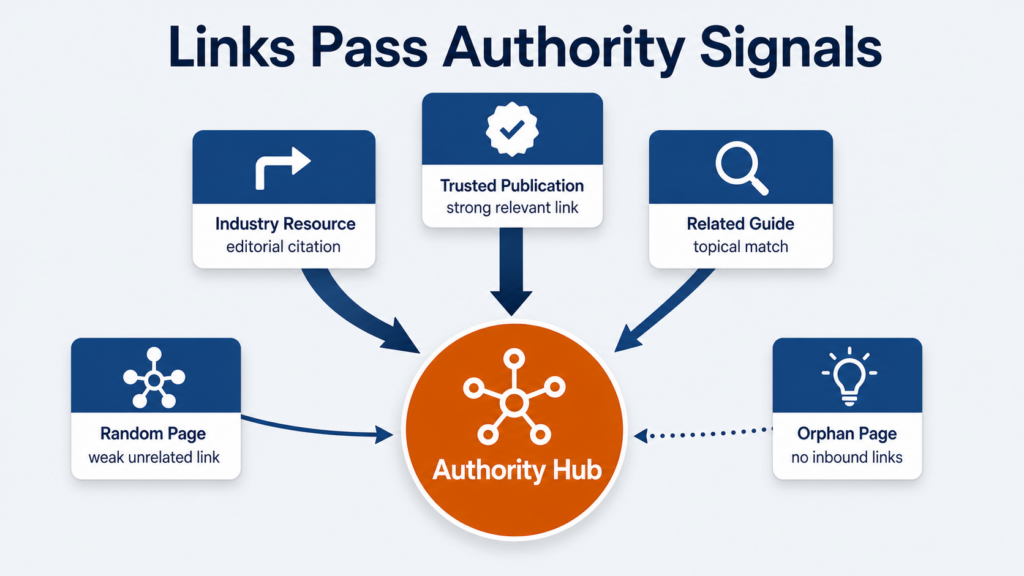
Google PageRank is a link-analysis system that evaluates pages partly by how pages link to one another. The basic idea is that links can pass authority signals. A link from a relevant, trusted, prominent page usually means more than a random link from a weak or unrelated page.
That explanation is intentionally simple. PageRank began as one of Google’s original breakthroughs because it treated links as signals in a larger web graph. A page did not become important only because it said the right words. It became more discoverable and more trusted when other pages pointed to it in meaningful ways.
For SEO, the lasting lesson is practical: links help search engines discover pages, understand relationships, and evaluate relative importance. A product category linked from the home page, a guide linked from related articles, or a service page cited by outside publications receives stronger signals than an orphaned page with no paths in or out.
PageRank is page-focused, not just domain-focused. A strong domain can have weak pages, and a smaller site can have individual pages that earn valuable links. That is why SEO work looks at both site-wide authority and page-level authority when deciding which URLs deserve support.
Does Google Still Use PageRank?
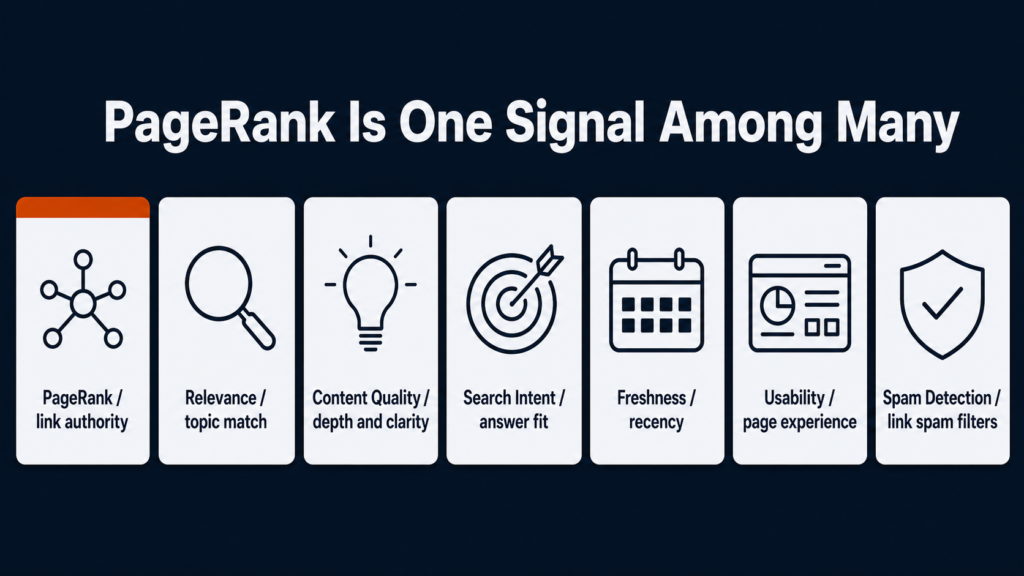
Google’s ranking systems guide says PageRank has evolved and continues to be part of its core ranking systems. That does not mean SEOs can see a PageRank score, treat it as a standalone ranking metric, or assume links are the only signal that matters.
The safer way to say it is this: PageRank remains part of how Google evaluates links, while modern rankings depend on many systems and signals. Relevance, content quality, search intent, location, freshness, usability, spam detection, and technical accessibility can all influence what a user sees in search.
That distinction matters for anyone buying or managing SEO services. If an SEO report talks about PageRank as though it is still a visible number, the report is using outdated language. If it ignores link authority entirely, it is missing one of the oldest ideas behind organic search.
Modern PageRank is not a dashboard metric. It is better understood as one part of the link graph that supports rankings when the page itself deserves to rank.
Can You Still Check Website Page Rank?
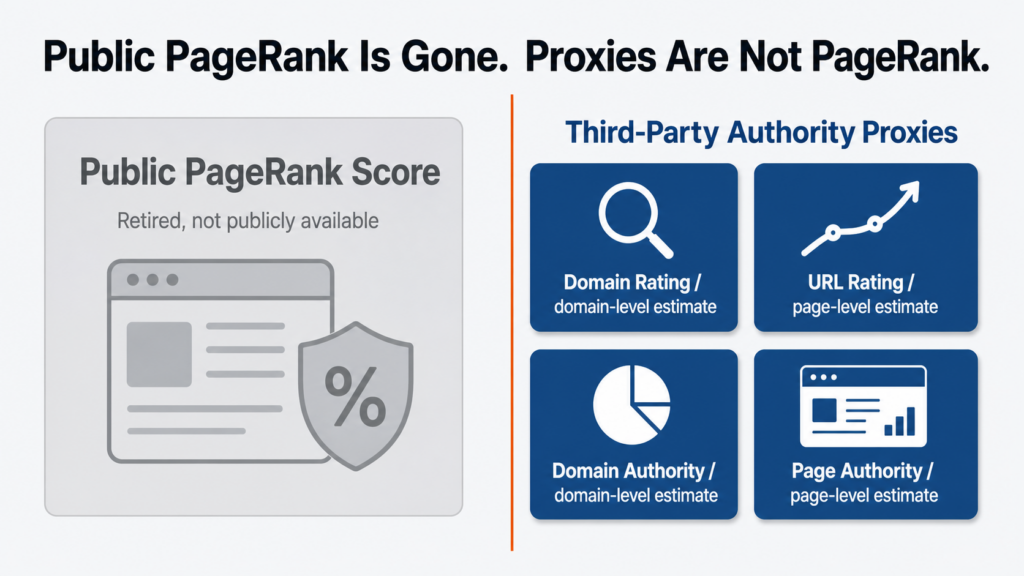
You cannot check a current official Google PageRank score or official website page rank for your page. Google stopped giving SEOs a public PageRank number years ago, so any tool promising to show your exact Google PageRank is not showing a current Google metric.
Third-party authority metrics can still be useful. Ahrefs has Domain Rating and URL Rating. Moz has Domain Authority and Page Authority. Those scores estimate link strength in different ways, but they are not PageRank and they are not interchangeable with Google’s internal systems.
Use third-party authority metrics directionally. They can help you compare competing pages, find link gaps, prioritize internal links, and decide where a page may need more authority support. They should not become the goal by themselves.
The better question is not “what is my PageRank number?” It is:
- Which important pages have few internal links?
- Which pages earn outside links naturally?
- Which linked pages fail to convert or answer the query well?
- Which weak pages split authority from stronger pages on the same topic?
- Which link opportunities would make sense even if search engines did not exist?
That last question is a useful filter. A link that helps the right user find a useful page is usually closer to real authority than a link placed only to manipulate a metric.
How PageRank Works With Links
PageRank turns links into signals, but not all links carry the same meaning. The source page, the destination page, the relationship between them, the link’s placement, and the reason the link exists all affect how useful the signal is.
Links From Strong, Relevant Pages Matter More
The original article made a useful point: a link from an important page can pass more value than a link from a weak page. That idea still holds, but modern SEO needs a few more qualifiers.
A useful link usually comes from a page that is relevant to the topic, trusted by its audience, indexable, and editorially connected to the page it cites. A random link from an unrelated page is not the same as a citation from an industry publication, a manufacturer resource, a customer story, or a guide that naturally expands the topic.
Quantity alone is not the answer. Hundreds of low-quality links can create risk instead of authority. A smaller number of relevant links can do more for page rankings when the linked page is worth citing and the link makes sense in context.
Internal Links Help Authority Reach The Right Pages
Internal links are often the PageRank lever a site controls most directly. Search engines use internal links to discover pages and understand which pages relate to one another. Users use those same links to move from a broad idea to the page that solves their problem.
Good internal link building sends authority toward the pages that matter. A category page linked from a buying guide, a technical article linked from a service page, or a high-traffic article linked to the next logical resource can help authority move through the site instead of stopping at one URL.
Internal links also reveal priorities. If a revenue-driving page is buried five clicks deep, missing from related articles, and absent from hub pages, the site is telling both users and search engines that the page is not central. PageRank flow improves when important pages are easy to reach from relevant pages.
Nofollow, Sponsored, And UGC Links Change The Signal
Some links include attributes that qualify the relationship between the source and destination. Google’s outbound link guidance explains sponsored, ugc, and nofollow attributes for paid, user-generated, or non-endorsed links.
Google has also said these attributes can be treated as hints in Search systems. That means link attributes should not be reduced to a simple “passes PageRank” or “does not pass PageRank” rule. The practical takeaway is clearer: use link attributes honestly, and do not rely on nofollowed or paid links as your authority strategy.
For readers trying to improve page rankings, the safest authority signals come from links that exist because the page is genuinely useful, relevant, and worth citing.
How To Improve Page Rankings Without Chasing A Score
The old version of this article asked how to raise PageRank. The modern version is a little different: how do you help the right pages earn and keep authority without chasing a number Google no longer shows?
Start with pages worth linking to. A thin page rarely becomes strong just because it has links pointed at it. Useful research, clear explanations, original data, tools, comparison resources, product guides, and well-structured service pages give other sites a reason to cite you.
Earn relevant links instead of collecting random ones. Link building services should focus on relevance, editorial fit, and real audience value. Google Search Central’s spam policies define link spam around links created primarily to manipulate rankings, including paid or exchanged links that pass ranking credit.
Strengthen internal links. Pages that already receive traffic, links, or engagement can support related pages when the links are useful. The goal is not to force an exact-match anchor into every paragraph. The goal is to help users and search engines understand which page answers the next question.
Clean up competing or duplicate pages. When several weak URLs cover the same idea, authority can scatter across them. The fix may be better canonical signals, clearer page roles, merged content, stronger hub structure, or a separate redirect decision in a real site migration. Do not treat every weak URL as an automatic 301 task.
Fix technical paths that waste authority. Broken internal links, long redirect chains, blocked pages, non-indexable important URLs, and confusing canonical tags can keep authority from reaching the pages that need it. Those are technical SEO services issues as much as link-building issues.
Measure outcomes, not just proxy scores. Rankings, organic traffic, leads, revenue, assisted conversions, crawl behavior, and link quality tell a fuller story than a single authority metric. PageRank explains one part of the system, but SEO decisions need more than one lens.
PageRank Is Not All That Counts
The original article ended with the right warning: PageRank is not all that counts. That point is even more important now.
Google’s public How Search Works explanation says links or references from prominent websites can be one quality signal. The same explanation also talks about meaning, relevance, quality, usability, context, and other ranking considerations.
In practice, a page needs more than authority. It needs to answer the query, match the searcher’s intent, load and render correctly, work on mobile, use clear HTML structure, avoid thin or duplicated content, and give users a reason to trust the answer.
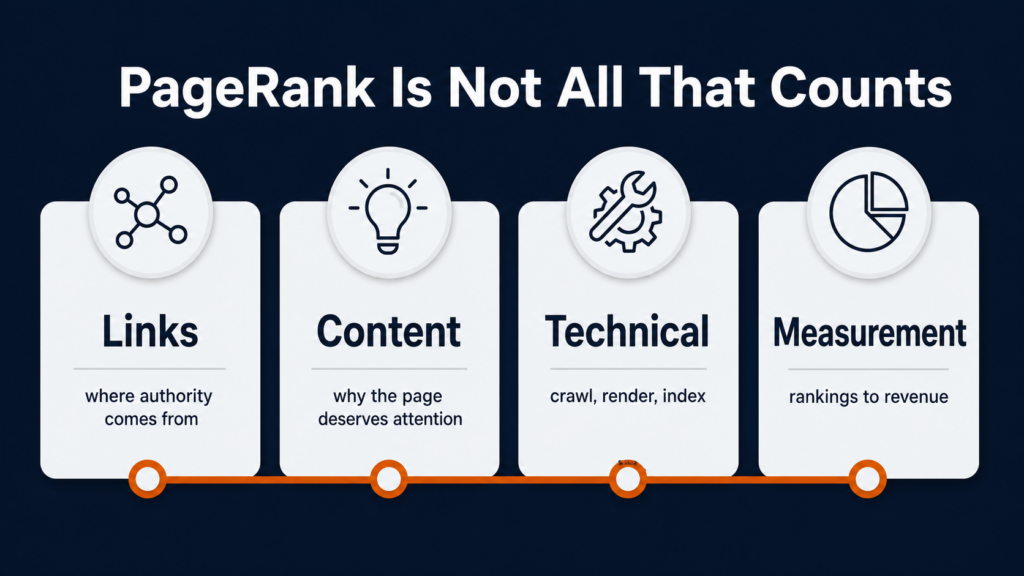
This is where PageRank thinking can help without taking over the whole SEO strategy. Links tell you how authority moves. Content tells you why the page deserves attention. Technical SEO makes sure search engines can reach, render, and understand the page. Measurement shows whether the page is turning visibility into business value.
If a page has strong links but weak content, improve the page. If a page has strong content but no internal paths, improve the link architecture. If a page has both but still struggles, look at intent, SERP format, technical barriers, and competing pages before assuming one metric explains the result.
Turn PageRank Into Better SEO Decisions
PageRank SEO decisions work best when link authority, content quality, and technical access are evaluated together.
PageRank is useful when it pushes the right question: where does authority come from, and which pages deserve more of it?
For many sites, the answer is not a PageRank checker. It is a clearer content strategy, stronger internal links, safer authority building, and technical cleanup that lets important pages receive the signals they have earned.
OuterBox can help connect those pieces into an SEO plan that improves rankings without chasing outdated scores. The goal is not a bigger proxy metric. The goal is stronger pages, cleaner paths, better links, and search traffic that turns into business.
Frequently Asked Questions About SEO PageRank
Does Google still use PageRank?
Google says PageRank has evolved and continues to be part of its core ranking systems. The link-based idea behind PageRank still matters, but PageRank is not public, separately reportable, or useful as the only ranking signal in an SEO plan.
Can I check my Google PageRank?
No official public Google PageRank checker exists for modern SEO. Tools that estimate authority can still help compare link strength, find gaps, and prioritize work. They should not be treated as Google’s PageRank score.
What is the difference between PageRank and Domain Rating?
PageRank is Google’s internal page-focused link-analysis system. Domain Rating is a third-party domain-level backlink metric, so it estimates the strength of a whole domain’s backlink profile. Domain-level authority metrics can help with comparison, but they are not Google PageRank and they do not predict rankings by themselves.
Do nofollow links pass PageRank?
Nofollow, sponsored, and UGC attributes tell Google more about the relationship behind a link. Google has said these attributes can be treated as hints in Search systems. For SEO planning, do not build an authority strategy around nofollow links. Earn relevant editorial links and use attributes honestly.
How can I improve page rankings safely?
Improve page rankings by building pages worth citing, earning relevant links, strengthening internal links, fixing technical barriers, and avoiding link schemes. Authority helps most when the destination page is useful, crawlable, indexable, and aligned with the query the user searched.