By: Sal Commisso
Choosing an SEO company can feel harder than it should. Every agency has a polished site, confident claims, and a version of the same promise: better rankings, more traffic, more leads, more revenue.
That does not mean every agency is the right fit for your business.
SEO has no magic button, and a serious agency should tell you that early. The right SEO partner can diagnose what is holding the site back, prioritize the work, explain the tradeoffs, and stay accountable as search changes. The wrong partner can burn months of budget on vague reporting, risky links, thin content, or ranking promises that were never theirs to make.
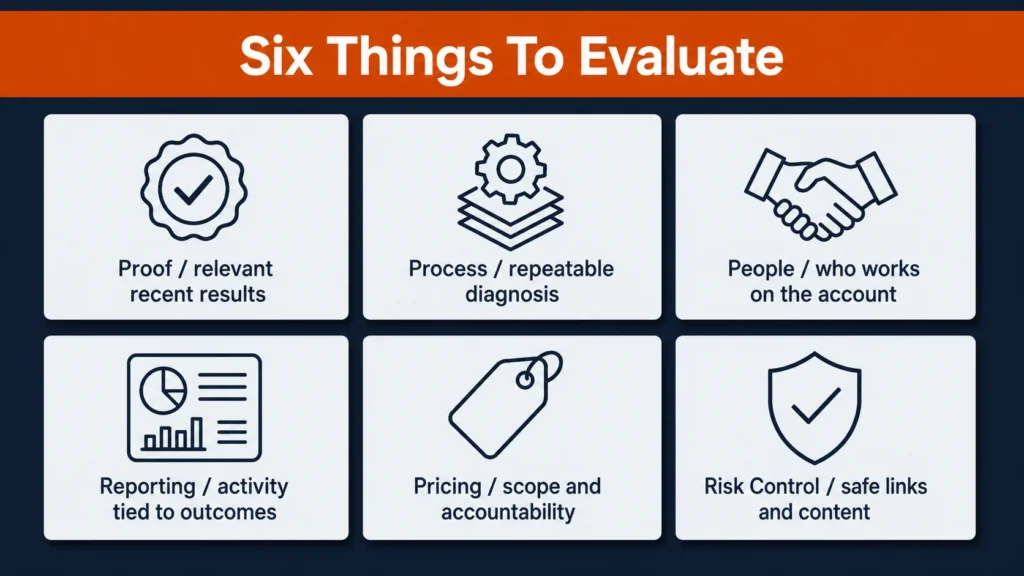
This guide keeps the decision practical. When you are choosing an SEO company, look for proof, process, people, reporting, pricing clarity, and risk control. If an agency can explain those six areas in plain language, you are much closer to a good decision. The goal is not just to learn how to choose an SEO company, but to understand which partner can explain the work, prove the process, and tie SEO to business outcomes.
Start With Proof That Matches Your Business Model
A strong SEO agency should be able to show current, relevant proof. Ask for websites the agency has optimized, the problems they were hired to solve, the work they did, and the results that followed.
Recent proof matters because SEO changes quickly. A case study from years ago may still show experience, but it does not prove the agency is keeping up with current search behavior, content quality standards, AI-assisted search experiences, technical requirements, or measurement expectations.
The better question is not simply, “Have you worked in my industry?” Industry experience helps, but the conversion model often matters more.
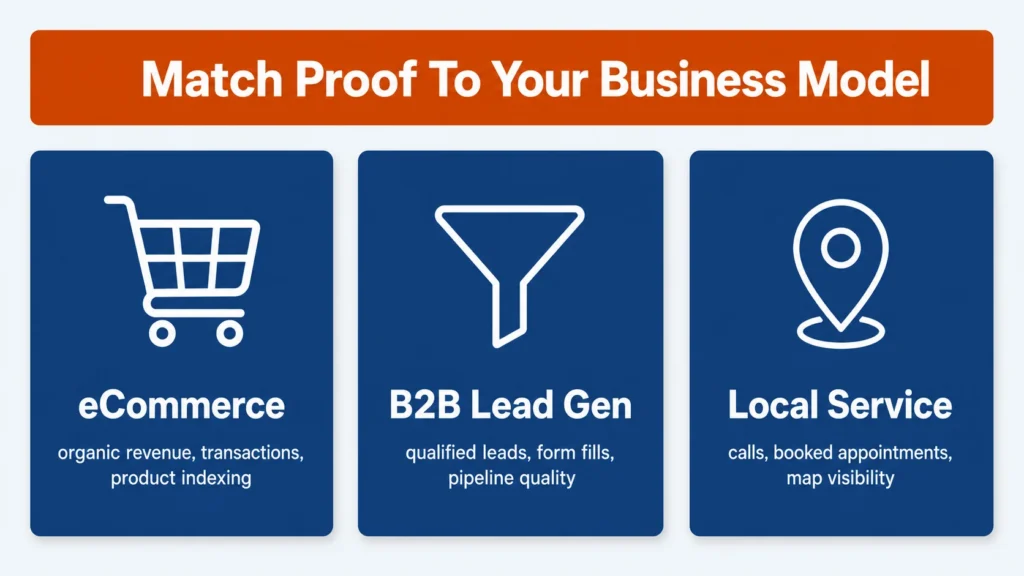
- eCommerce companies should look for eCommerce SEO results tied to organic revenue, transactions, category visibility, product-page indexing, and site performance.
- B2B and lead-generation companies should look for B2B SEO proof tied to qualified leads, form fills, pipeline quality, and sales handoff.
- Local or service businesses should look for examples that connect visibility to calls, booked appointments, map visibility, and location-specific pages.
OuterBox proof works this way. 1 EDI Source came to OuterBox after another agency and wanted clearer communication plus reliable execution across SEO and PPC. The campaign produced a 66% month-over-month increase in organic leads and a 42% year-over-year decrease in cost per conversion. Warehouse Lighting needed to recover declining keyword visibility; after technical, on-page, and content work, organic revenue rose 105% and organic transactions rose 119%. Cardinal Peak saw traffic, rankings, and leads dip after a site launch; after homepage optimization, landing-page refinement, content work, and internal linking, organic traffic rose 167% year over year and organic goal conversions rose 169%.
Those examples are useful because they connect the work to business outcomes. Rankings matter, but a trustworthy SEO partner should talk about conversions, revenue, lead quality, user behavior, and what the client needed from the program.
B2B buyers can apply that same standard to a working shortlist in our B2B SEO agency comparison.
Ask How the Results Were Produced
Case-study numbers are only useful if the agency can explain the path behind them. Ask what changed on the site, why those changes were chosen, how the work was measured, and what the agency would do differently if the same problem appeared today.
A good answer will include specifics: technical SEO fixes, page templates, content strategy, internal linking, title and H1 updates, structured data, site speed, analytics setup, conversion paths, or link acquisition. A weak answer will stay at the slogan level.
You are not asking for a secret formula. You are asking whether the agency has a repeatable way to diagnose problems and prioritize work.
Look for Strategy Beyond Rankings
The best SEO companies do not treat rankings as the finish line. Rankings are a signal. The business goal is usually revenue, qualified leads, sales opportunities, appointments, or lower acquisition cost.
That is why SEO and conversion rate optimization belong in the same conversation. A page can rank and still underperform if visitors do not trust it, if the form is buried, if the call to action is unclear, if the mobile experience is weak, or if the page does not answer the buyer’s real question.
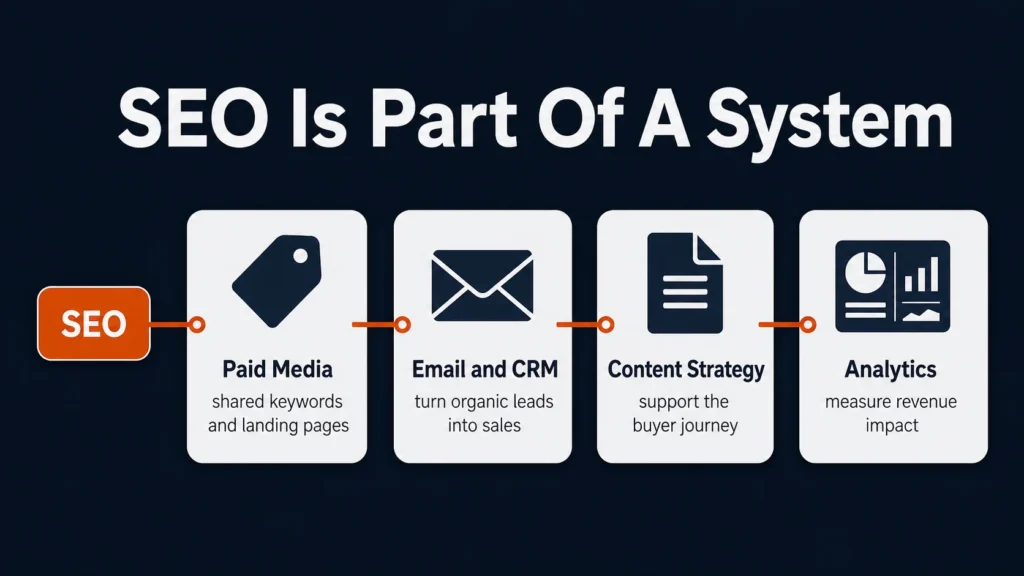
A strong SEO agency should be able to explain how search connects with the rest of your marketing system:
- Paid media and SEO should share keyword, landing-page, and conversion learning.
- Email and CRM workflows should help turn organic leads into sales conversations.
- Content strategy should support the buyer journey, not just publish articles for keywords.
- Analytics and attribution should show what organic visibility is doing for the business.
AI search makes this broader view more important, not less. Do not accept a vague promise that an agency will “get you into AI results.” Ask how the team is improving the underlying signals: helpful content, clear authorship, trustworthy sourcing, structured answers, technical accessibility, brand mentions, and pages that deserve to be cited.
Google’s guidance on helpful, reliable content is a useful filter here. If an SEO plan is built around manipulating search engines instead of helping people make better decisions, it is not a durable plan.
On our side, search, conversion optimization, paid media, and analytics share the same view of performance, so organic gains are measured against revenue and qualified leads, not just rankings.
Meet the People Who Will Work on Your SEO
When you choose an SEO company, you are choosing an extension of your team. The relationship matters because SEO touches content, development, design, analytics, leadership, sales, and sometimes customer service.
If you can visit the agency or meet the team in person, do it. If the buying process is remote, ask for a real working call with the people who will own the strategy. You want to know who is actually touching the account after the sale.
Ask direct questions:
- Who leads the SEO strategy?
- Who handles technical SEO?
- Who writes or edits content?
- Who reviews analytics and conversion data?
- Who manages link building or digital PR?
- How often will we meet?
- What happens when priorities change?
A serious SEO program usually needs more than one generalist. At OuterBox, SEO work can involve content strategists, technical SEO specialists, link-building specialists, designers, developers, analytics specialists, and account leadership. That team depth matters because most SEO problems are not isolated.
A ranking drop may involve a template change. A conversion drop may involve a UX issue. A content gap may involve sales-team feedback. A reporting gap may involve GA4, call tracking, CRM fields, or attribution. The right SEO agency will be comfortable showing how the team works together.
Ask for the Audit, Reporting, and First-90-Day Plan
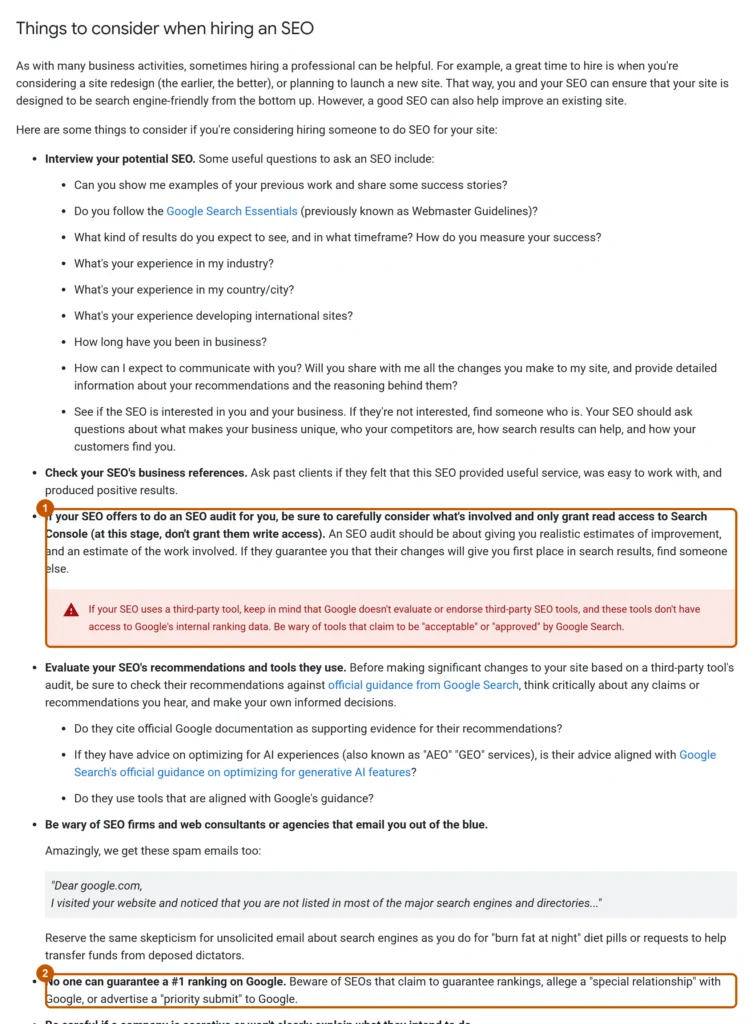
Before hiring an SEO company, ask what they would audit first. Google’s own SEO hiring guidance recommends asking a prospective SEO for a technical and search audit that explains what should be done, why it matters, and what outcome is expected. A formal SEO audit should make the first set of priorities easier to understand, not harder.
That does not mean an agency should give away a complete strategy before a contract exists. It does mean the agency should be able to show how it thinks.
A useful audit conversation should cover:
- Technical crawlability and indexation issues.
- Priority page opportunities.
- Title tags, H1s, and metadata.
- Content gaps and thin pages.
- Internal linking.
- Backlink and authority risks.
- Competitor visibility.
- Core Web Vitals and page speed.
- Conversion paths and tracking.
- Reporting quality.
Ask how recommendations are supported. Google also tells site owners to ask SEOs to corroborate recommendations with trusted sources, such as Search Central documentation, Search Console help, or other Google-backed responses. A good agency should be able to explain when a recommendation comes from official guidance, when it comes from tested experience, and when it is a strategic judgment call.
Reporting deserves the same scrutiny. Ask for a sample report before you sign. The report should connect activity to outcomes. You should see rankings, organic traffic, conversions, revenue or lead quality where available, completed work, upcoming priorities, and what changed since the last reporting period.
The first 90 days should also be clear. SEO is long-term work, but the first months should not feel mysterious. You should know what will be audited, what will be fixed first, what content or technical work is planned, what access is needed, and what early indicators will be watched.
For example, our own first-90-day plans open with a technical and priority-page audit, so clients can see the reasoning behind the work before it begins.
Be Careful With Low-Cost SEO Packages
Low-cost SEO can be tempting, especially when the proposal promises the same outcomes as a more expensive agency. The risk is that cheap SEO often has to cut corners somewhere: strategy time, technical review, content quality, reporting, link quality, or senior oversight.
Some cheap programs simply underdeliver. Others create damage that lasts long after you cancel.
The most serious risk is link manipulation. Google’s spam policies describe link spam as links created primarily to manipulate search rankings. If an SEO agency will not explain its link-building approach, cannot describe the sites it earns links from, or promises a fixed number of links without context, slow down.
The same caution applies to content. Large volumes of thin, generic pages may look productive on a monthly report, but they rarely build trust. A good SEO company should be able to explain why a page should exist, what question it answers, how it supports the buyer journey, and how it will be maintained after publishing.
Warning signs include:
- Very cheap monthly pricing with broad promises.
- Guaranteed link counts with no quality explanation.
- Refusal to explain tactics.
- Reports that show tasks but no business outcomes.
- New pages created without expert input.
- Heavy reliance on exact-match anchor text.
- No discussion of technical SEO, analytics, or conversion quality.
A lower price is not automatically bad. A focused scope for a smaller site can be perfectly reasonable. The issue is whether the price matches the work required. If the agency cannot explain what is included, what is not included, and what tradeoffs the budget creates, the number is not very useful.
Treat Guaranteed Rankings as a Major Red Flag
Guaranteed rankings are one of the clearest warning signs in SEO. No legitimate SEO company can guarantee a specific number-one position on Google because the agency does not control Google’s ranking systems, competitors, algorithm changes, searcher behavior, or every signal on your site. If you want the deeper version of this warning, read our guide to guaranteed rankings.
Google’s SEO hiring guidance says this plainly: no one can guarantee a number-one ranking. That does not mean agencies should avoid accountability. It means the accountability should be tied to work quality, strategy, reporting, issue resolution, visibility trends, qualified traffic, and conversion outcomes.
Be cautious with promises like:
- “Guaranteed first-page rankings.”
- “Instant SEO results.”
- “Number-one rankings in 30 days.”
- “Secret Google method.”
- “We know someone at Google.”
- “Hundreds of backlinks every month.”
These claims often hide risky tactics or unrealistic expectations. Ethical SEO companies talk about probability, prioritization, and compounding gains. They explain what they can control and what they cannot.
The better question is: what will the agency do when rankings do not move as expected? A strong partner will have a diagnostic path. They will review the page, the query, the SERP, competitors, links, internal linking, content quality, technical signals, user behavior, and whether the original keyword target still makes sense.
For our part, we will not guarantee a number-one position, and we will explain every link we build and why it is there.
Compare SEO Pricing Against Scope and Accountability
When comparing SEO pricing, do not judge proposals by monthly cost alone. Judge them by scope, seniority, transparency, and expected business impact.
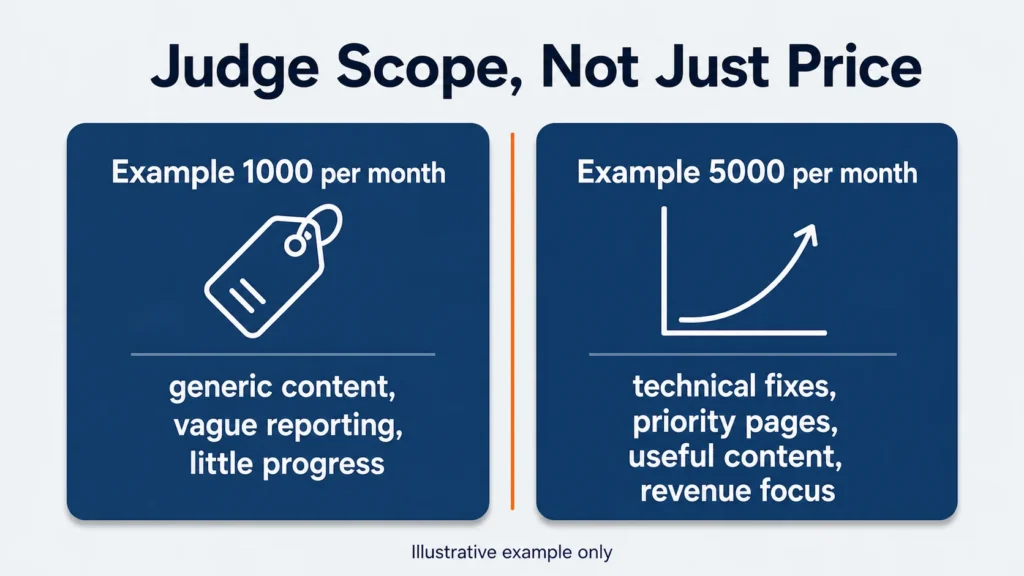
A $1,000 monthly package can be expensive if it produces generic content, vague reporting, and no meaningful progress. A $5,000 monthly program can be efficient if it fixes technical issues, improves priority pages, builds useful content, strengthens internal links, and connects search visibility to revenue or qualified leads.
Ask each agency to explain the scope in plain language:
- How many priority pages will be worked on first?
- What technical SEO support is included?
- Who writes and edits content?
- Is development support included or separate?
- How is link building handled?
- What reporting is included?
- How often are strategy priorities revisited?
- What happens if the site needs more work than the package includes?
Preset packages are not always a problem, but the agency should still adapt the plan to your business model, site size, competitive environment, and growth goals. A local lead-generation site, a national eCommerce catalog, and a B2B SaaS company should not receive the same SEO plan with different logos on the report.
The right SEO agency will help you understand the investment, not pressure you into the biggest package. They should be able to say where the budget is enough, where it is tight, and which work should wait.
Questions to Ask Before Choosing an SEO Company
Use these questions to compare agencies in a way that goes deeper than sales claims.
- What would you audit first on our site, and why?
- What issues would you expect to find in the first 30 days?
- Which results from similar clients can you show us?
- Were those results tied to rankings, traffic, leads, revenue, or another metric?
- Who will work on our account after the sale?
- How do you prioritize technical SEO, content, links, and CRO?
- How do you approach AI search and AI Overview visibility without overpromising?
- What reporting will we receive each month?
- How do you measure lead quality or revenue impact?
- What link-building tactics do you use and avoid?
- What work is included in the monthly fee?
- Which SEO company should we use if we need strategy, technical fixes, and content support in the same program?
- What would require extra budget or our internal team?
- How do you handle a ranking drop?
- How do you handle recommendations that require development support?
- What would make you tell us we are not a good fit?
The last question is important. A good agency should know who it serves well. If every prospect is a perfect fit, the agency may be selling capacity rather than judgment.
Choose the SEO Company That Can Explain the Work
Choosing the best SEO company is not about finding the loudest promise. It is about finding the team that can show its work, explain its decisions, protect your site from shortcuts, and connect SEO activity to the business outcomes you actually care about.
Choosing the best SEO company usually means choosing the team that can explain priorities, show relevant proof, and report on revenue impact.
OuterBox’s SEO work has changed many times as search has changed. The constant is stewardship. Your SEO partner should treat the site like an asset, your budget like it matters, and your questions like part of the work.
If you are comparing agencies, start with the questions in this guide. If you want a second opinion on your site, our SEO services team can walk through the opportunity, the risks, and the next practical step.
Frequently Asked Questions About Choosing an SEO Company
How do I choose the right SEO company?
Choose the right SEO company by comparing proof, process, team access, reporting, pricing, and risk control. Ask for relevant case studies, a sample audit process, a sample report, and a clear explanation of what the first 90 days would include. Avoid agencies that promise guaranteed rankings or refuse to explain tactics.
What should I look for when hiring an SEO company?
Look for business-outcome proof, technical SEO depth, strong content standards, transparent reporting, and a team that can explain tradeoffs in plain language. The agency should understand your conversion model, not just your keywords. It should also show how SEO connects to CRO, analytics, paid media, and sales quality.
Do I need an SEO company or can I handle SEO in-house?
You may be able to handle SEO in-house if you have technical, content, analytics, and strategy resources already available. An SEO company is useful when the site needs deeper diagnosis, faster execution, broader specialist support, or an outside team that has seen similar problems across many websites.
How much should I pay for an SEO company?
SEO pricing should match site size, competition, technical complexity, content needs, and growth goals. A smaller site may need a focused scope, while a larger eCommerce or B2B site may need technical SEO, content, analytics, CRO, and development coordination. The right question is what the fee includes and how progress will be measured.
Can an SEO company guarantee results?
An SEO company can be accountable for the quality of its work, strategy, communication, and reporting. It cannot guarantee a specific number-one ranking on Google. Be careful with agencies that promise instant or guaranteed rankings, especially if they cannot explain the methods behind those promises.