By: Jeff Hirz
Marketing consultant cost is not one fixed number because the buying situation changes the work. A tactical freelancer helping with a short campaign is not the same investment as a senior digital marketing consultant guiding strategy, analytics, channel mix, and team priorities.
For most businesses, the useful question is not “What is the cheapest marketing consultant rate?” It is “What level of marketing judgment, execution support, and accountability do we need?”
This guide keeps the practical cost framework from the original article: hourly rates, project pricing, retainers, scope drivers, and budget checks. The update adds current 2026 planning ranges, source-backed context, and a clearer way to compare a consultant with an agency or an internal hire.
How Much Does a Marketing Consultant Cost in 2026?
The cost to hire a marketing consultant commonly ranges from $75 to $250 per hour as a planning synthesis for many independent advisory engagements, with senior specialists and fractional leaders often charging $150 to $500 per hour when the work is strategic, technical, or tied to revenue responsibility. Smaller marketplace projects can price lower, while full digital marketing programs can move into monthly retainers of $5,000 to $50,000 or more.
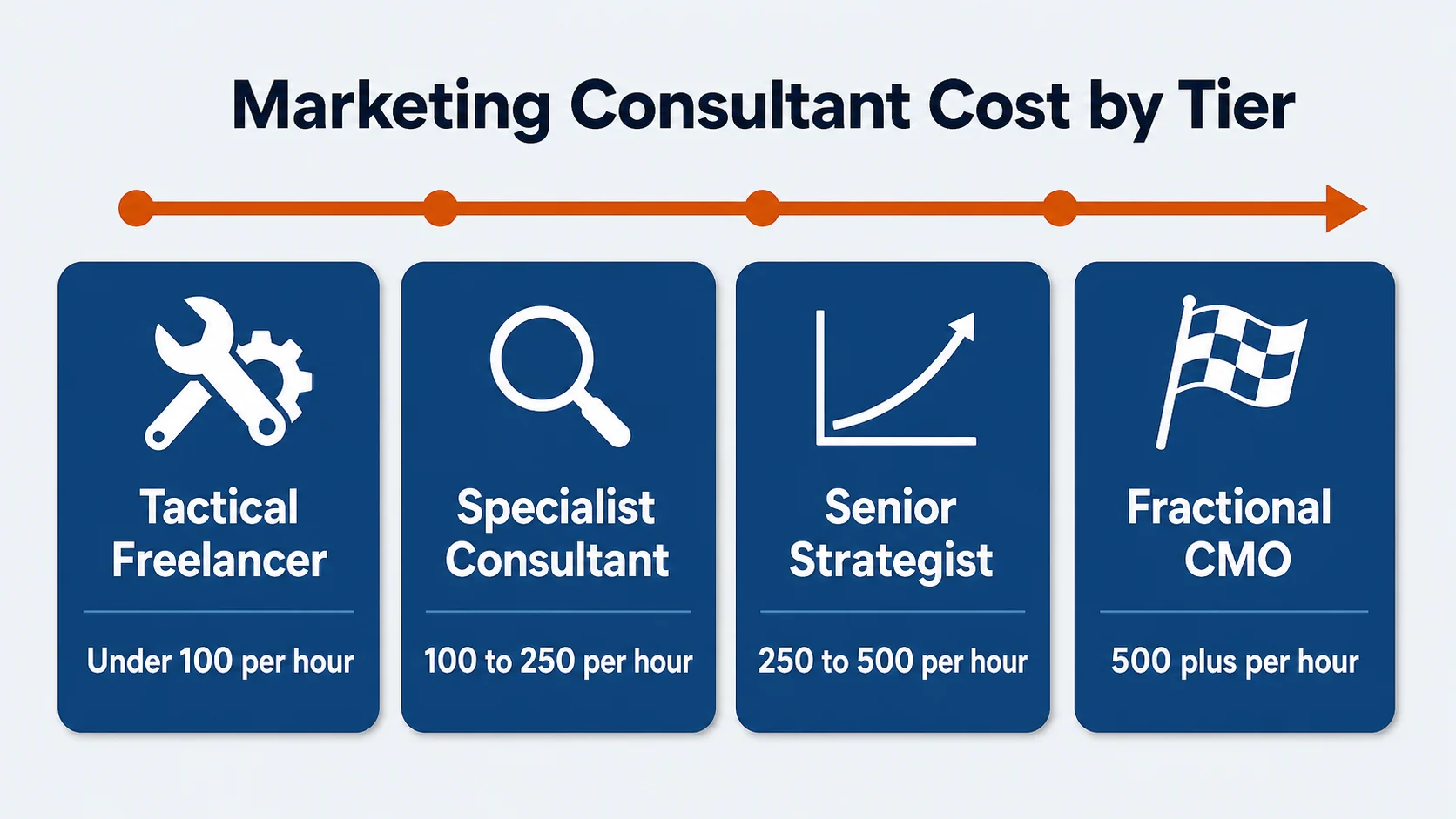
Use those numbers as planning ranges, not rules. A low hourly rate can still become expensive if the scope is unclear, and a higher rate can be efficient when the consultant diagnoses the right problem quickly.
| Marketing consulting engagement | Typical planning range | Best fit |
|---|---|---|
| Marketplace or freelance tactical help | $20 to $60 per hour | Global marketplace contract data, defined tasks, simple campaign support, limited strategic responsibility |
| Independent marketing consultant | $75 to $250 per hour | Planning synthesis for strategy, audits, messaging, channel planning, or advisory work |
| Senior specialist or fractional marketing leader | $150 to $500 per hour | Growth strategy, complex channel mix, executive guidance, high-stakes decisions |
| Defined marketing project | $5,000 to $50,000+ | Audits, launch plans, repositioning, channel roadmap, analytics cleanup |
| Monthly consulting retainer | $1,500 to $10,000+ for narrow support; $5,000 to $50,000+ for broader programs | Ongoing advisory, reporting, prioritization, and implementation guidance |
Upwork’s marketing consultant cost data shows a global marketplace range of $20 to $60 per hour. That is useful for understanding freelance supply, but it should not be treated as the same category as senior US advisory work.
Clutch’s digital marketing agency pricing guide gives a broader agency context. It lists digital marketing projects commonly in the $10,000 to $49,999 range, a platform-wide agency hourly band of $25 to $49 per hour, and separate service-specific rates for SEO, PPC, content marketing, social media, and email marketing around $100 to $149 per hour. Those are distinct pricing views, not one blended range. That matters because many buyers use “consultant” and “agency” interchangeably even though the delivery model is different.
What Are You Paying a Marketing Consultant to Do?
A marketing consultant gives you outside judgment, planning, and channel experience without forcing a full-time hire before the need is clear. The right consultant helps your team see what is working, what is missing, and what should happen next.
That work can include a market review, messaging audit, SEO strategy, paid media assessment, analytics review, content plan, conversion review, email roadmap, automation review, or executive planning session. The consultant may also help your internal team or vendors turn recommendations into work that can actually ship.
The value is not just a list of ideas. The value is priority. A good consultant can tell you which marketing issues are worth fixing now, which are distractions, and which require a deeper digital marketing consulting engagement.
The Scope of Marketing Consulting Services
Marketing consulting fees rise as the scope expands. One channel review costs less than a full marketing plan because the consultant has fewer inputs, fewer stakeholders, and fewer decisions to connect.
Common marketing consulting services include:
- Digital marketing strategy: channel mix, goals, budget allocation, measurement, and campaign priorities.
- SEO and content consulting: search demand, content gaps, technical risk, internal linking, topic strategy, and SEO consulting priorities.
- Paid media consulting: spend efficiency, account structure, landing pages, query waste, tracking, and Google Ads consulting opportunities.
- Email and lifecycle consulting: list health, segmentation, automation, messaging, and email marketing planning.
- CRO and analytics consulting: form friction, checkout issues, landing-page behavior, reporting gaps, and CRO priorities.
- Brand and positioning: audience definition, offer clarity, messaging, and differentiation.
- Marketing automation and CRM: marketing automation consultant guidance on lead stages, data quality, nurture logic, and sales handoff.
- Training and team enablement: workshops, roadmap reviews, vendor guidance, and executive education.
A consultant who only reviews one campaign should cost less than a consultant who connects SEO, paid media, content, analytics, email, and conversion data into one operating plan. The second engagement has more moving parts and more business risk.
Marketing Consultant Pricing Models: Hourly, Project, and Retainer Costs
Digital marketing consultant cost usually falls into one of three pricing models: hourly, project-based, or monthly retainer. Each model can be reasonable when it matches the work.

Hourly Marketing Consultant Rates
Hourly pricing works best when the work is contained. Examples include a strategy call, campaign review, analytics walkthrough, content audit, or short advisory block.
The advantage is flexibility. You can buy a defined amount of senior time without a long commitment. The downside is uncertainty. If the problem is broader than expected, the final cost can rise because every new meeting, review, and revision adds time.
Hourly is strongest when the question is narrow: “Review this media plan,” “Pressure-test this SEO roadmap,” or “Help our team choose between these three priorities.”
Project-Based Marketing Consulting Fees
Project pricing works best when the deliverable is clear. Examples include a go-to-market plan, marketing audit, campaign launch plan, messaging review, SEO roadmap, or analytics cleanup plan.
The advantage is budget control. You know the price before work begins. The risk is scope drift. If the project starts as “review our marketing” and turns into stakeholder interviews, dashboard cleanup, channel planning, and vendor management, the fixed fee will either rise or the deliverable will shrink.
Project pricing needs a written scope. The proposal should define inputs, deliverables, meeting cadence, timeline, revision limits, and what happens if new work is added.
Monthly Marketing Consultant Retainers
Retainers work best when your team needs ongoing guidance. A consultant may join monthly planning calls, review results, prioritize campaigns, advise internal staff, and help keep vendors aligned.
The advantage is continuity. The consultant learns your business and can make better decisions over time. The risk is vague activity. A retainer should not become a monthly meeting with no work queue, no decisions, and no measurable next steps.
Retainers need a clear operating rhythm: what gets reviewed, what gets delivered, who owns implementation, and how the scope resets each month or quarter.
What Changes the Cost of a Marketing Consultant?
Marketing consultant fees change because the work changes. A clean price comparison starts with the factors below.
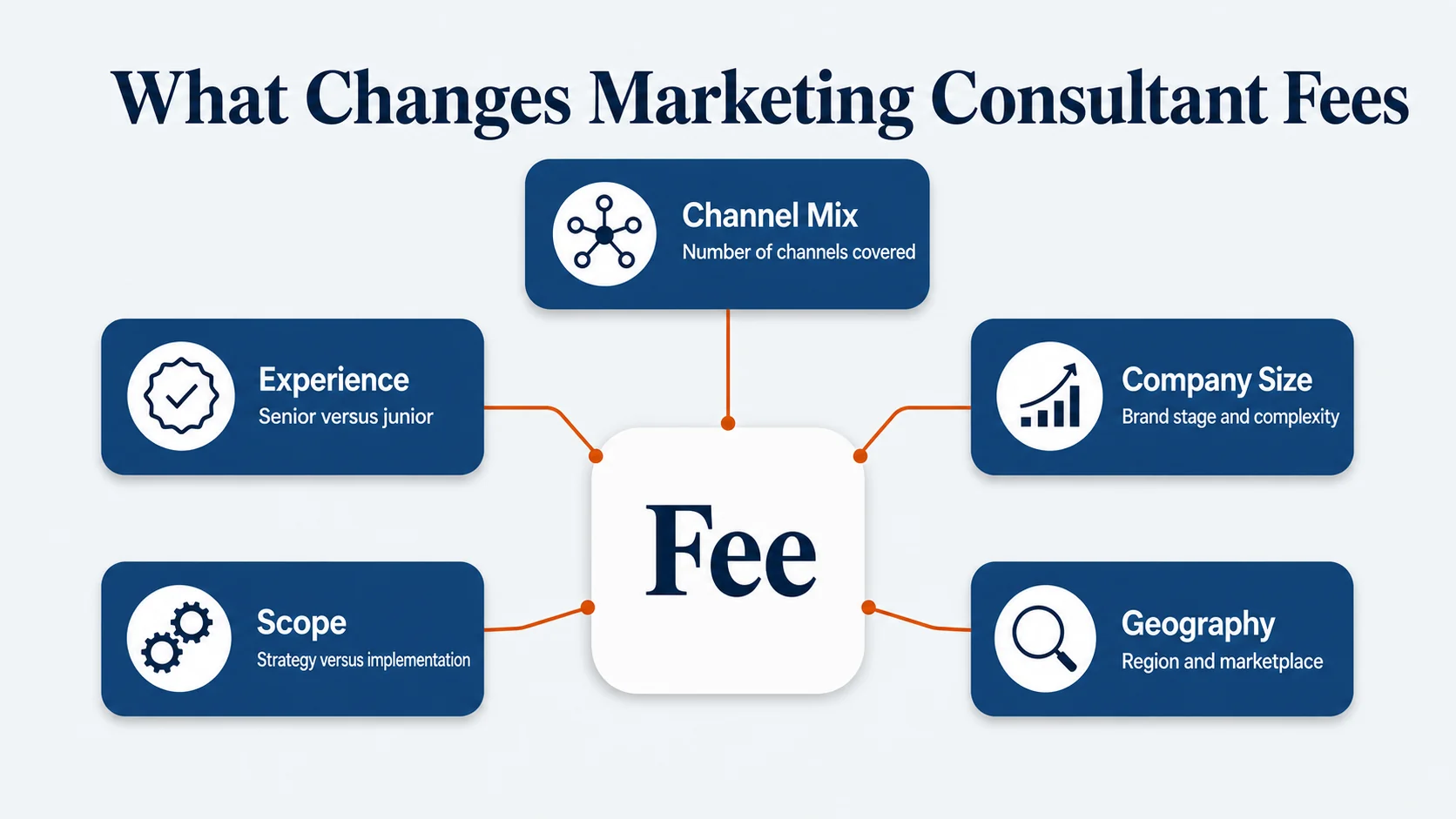
Experience and Specialization
Experience and specialization cost more, but they can shorten diagnosis and reduce wrong turns. A consultant who has worked through dozens of SEO migrations, B2B lead-generation programs, ecommerce tracking issues, or paid media restructures may reach the right decision faster than a generalist.
Specialization matters most when the downside risk is high. If a bad decision can waste ad spend, damage organic traffic, break reporting, or confuse a sales team, senior judgment is part of the price.
Scope and Channel Mix
Scope is the biggest cost driver because a strategy review, analytics audit, paid media review, email roadmap, and team training are different levels of work. The more channels that need to work together, the more discovery and coordination the consultant has to manage.
A single-channel audit may need one data source and one decision-maker. A full-funnel growth plan may involve SEO, paid media, email, CRO, analytics, creative, sales, finance, and leadership.
Strategy Only vs Implementation Support
Some consultants only advise. Others help translate the plan into briefs, tickets, vendor direction, reporting templates, or campaign reviews.
Strategy-only work should be easier to price. Implementation support costs more because the consultant stays involved after the recommendation. That can be worth it when your team needs help turning decisions into action.
Company Size and Complexity
Larger companies usually have more complex marketing systems. More products, locations, stakeholders, approval steps, data sources, and vendors increase the work.
Small businesses may need a simpler roadmap and a few priority fixes. Mid-market and enterprise teams may need governance, stakeholder alignment, analytics cleanup, and executive reporting.
Geography and Marketplace
Location still affects fees, but remote work has made the comparison messier. A global freelance marketplace rate, a local consultant rate, and a senior US strategy consultant rate may all appear in the same search result.
Do not compare those numbers without comparing the role. A $40-per-hour tactical freelancer and a $250-per-hour consultant may both be useful, but they are not solving the same problem.
Marketing Consultant vs Agency vs In-House Hire
Marketing consultant cost becomes clearer when you compare it with the alternatives.
An internal marketing leader is a permanent capacity decision. The Bureau of Labor Statistics reported a May 2024 median annual wage of $161,030 for marketing managers. That salary does not include benefits, payroll taxes, recruiting, management time, software, tools, or the cost of building a team around the role.
A consultant is usually a better fit when you need senior guidance, a plan, an audit, or a transition period, but not a full-time leader. A consultant can help you decide what to fix before you commit to a hire.
An agency is usually a better fit when you need strategy and execution capacity. Digital marketing services can include SEO, paid media, content, CRO, analytics, email, creative, and development support under one operating model. That broader team costs more than one consultant, which is why marketing agency pricing should be compared against deliverables and team coverage instead of a single advisor’s hourly rate.
Use this simple decision frame:
| Option | Best fit | Watch-out |
|---|---|---|
| Consultant | You need senior direction, an audit, planning, or an outside perspective. | Advice still needs an owner to implement it. |
| Agency | You need strategy plus execution across multiple channels. | Scope and deliverables must be clear before retainers are compared. |
| In-house hire | Marketing work is daily, permanent, and central to operations. | Salary is only part of the real cost. Tools, recruiting, and support staff still matter. |
How to Budget for Digital Marketing Consultant Cost
A realistic budget starts with the business problem, not the rate card.
First, define the decision you need to make. Are you trying to improve lead quality, fix reporting, reduce wasted spend, grow organic traffic, launch a new offer, choose a channel mix, or manage a vendor?
Second, separate strategy from execution. A consultant can tell you what needs to happen, but someone still has to write the content, build the landing page, configure the campaign, update the CRM, or fix the tracking.
Third, choose the pricing model that fits the risk. Hourly is fine for contained advice. Project pricing is better for a defined deliverable. Retainers make sense when you need recurring guidance.
Fourth, compare proposals by assumptions. Two proposals can both say “marketing strategy” and mean very different things. One may include interviews, analytics review, competitive research, channel planning, and implementation support. Another may include only a presentation.
Finally, start smaller when the fit is uncertain. A paid audit, strategy sprint, or campaign review can show how the consultant thinks before you commit to a larger engagement.
What Should Be Included in a Marketing Consultant Proposal?
A good proposal makes the price easier to judge. It should explain what the consultant will do, what they need from your team, and what you will have at the end.
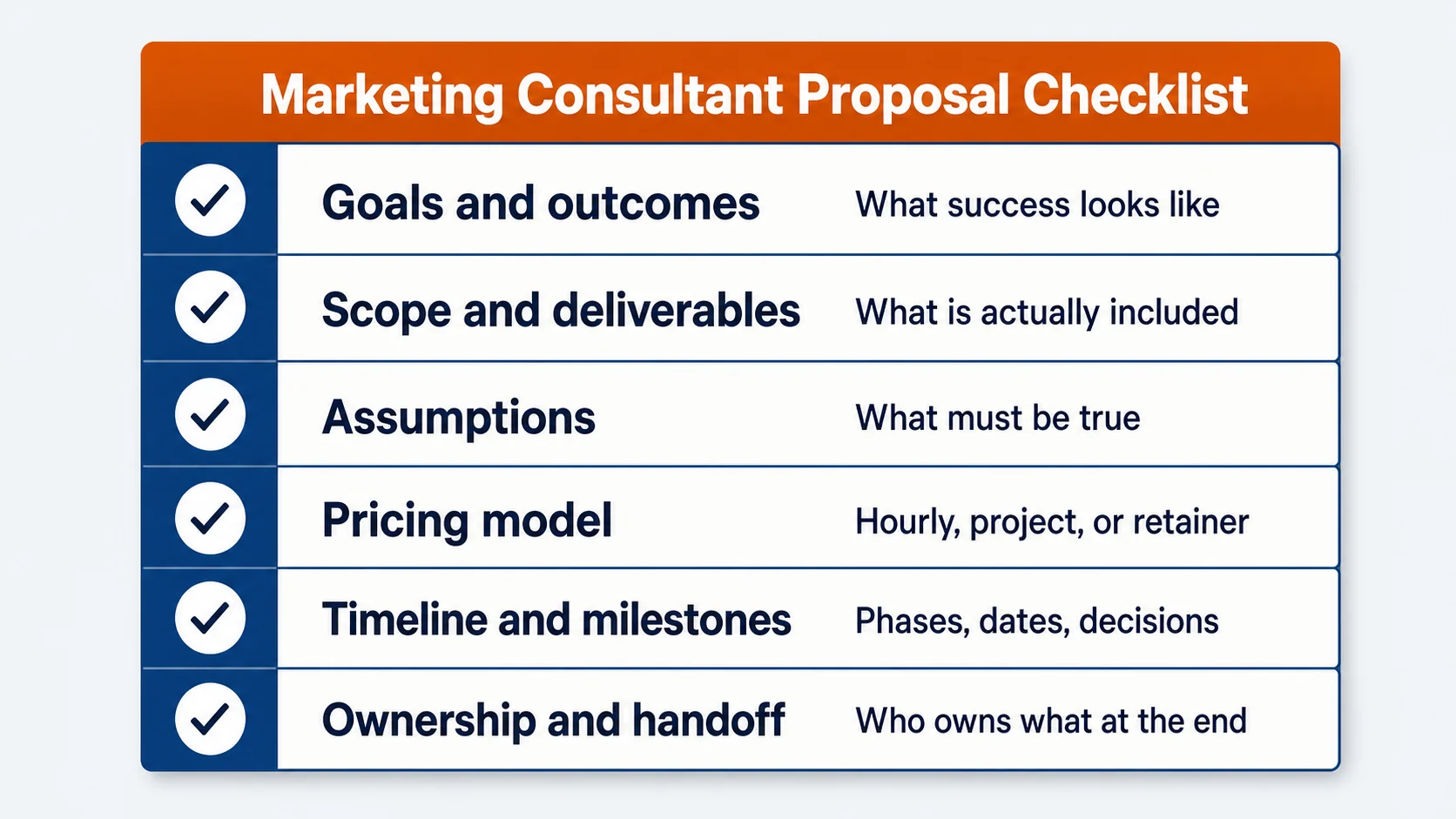
Look for these items before you compare costs:
- The business goal or decision the engagement supports.
- The channels, campaigns, or teams included in scope.
- The deliverables you will receive.
- The data, access, and stakeholder input required.
- The meeting cadence and review process.
- The timeline and major milestones.
- The person responsible for decisions on your side.
- The line between consulting and implementation.
- The reporting or measurement plan.
- The pricing model, payment schedule, and change-order rules.
If those items are vague, the quote is not ready to compare. A cheap proposal with undefined deliverables can become expensive once the real work starts.
When Paying More Makes Sense
Paying more can make sense when the consultant is solving a more expensive problem.
A senior consultant may be worth the higher fee when your team is about to relaunch a website, change agencies, restructure paid media, enter a new market, clean up analytics, or make a budget decision that affects the next quarter. In those situations, the cost of a wrong turn can be higher than the consulting fee.
Paying more does not make sense when the work is simple, repeatable, or low risk. If you need a short list of campaign edits or a few hours of tactical support, a narrower hourly engagement may be enough.
The best price is the one that matches the decision at hand.
Get a Marketing Consulting Plan That Matches the Work
Marketing consulting services should make the next decision clearer. If your team needs outside perspective on strategy, channels, analytics, or execution priorities, OuterBox can help you define the work before you commit budget in the wrong place.
Start with the problem you are trying to solve. The right engagement may be a focused audit, a strategy sprint, an advisory retainer, or a broader agency partnership. The scope should follow the work, not the other way around.
How much does a marketing consultant typically cost?
A marketing consultant can cost $75 to $250 per hour for many independent advisory engagements, while senior specialists can reach $150 to $500 per hour. Project work often starts in the low thousands and can exceed $50,000 when the scope includes research, strategy, analytics, and implementation guidance.
What is a normal monthly retainer for a marketing consultant?
A narrow consulting retainer may run $1,500 to $5,000 per month, while broader advisory retainers often land between $5,000 and $10,000 or more. Multi-channel agency-style retainers can be much higher because they include more people, production work, reporting, and execution support.
Is it cheaper to hire a consultant, an agency, or an employee?
A consultant is usually cheaper than a full-time senior hire when you need temporary guidance or a defined project. An agency usually costs more than one consultant but can carry execution. An employee can be the right choice when the marketing work is permanent, daily, and central to the business.
What factors determine marketing consultant fees?
Marketing consultant fees depend on experience, specialization, scope, company complexity, geography, urgency, data access, and whether the consultant is only advising or also helping with implementation. The same hourly rate can produce very different total costs if the scope is not defined.
What pricing model is best for marketing consulting?
Hourly pricing fits narrow advisory work, project pricing fits a defined deliverable, and retainer pricing fits ongoing guidance. The best model depends on how clear the problem is and how much support your team needs after the first recommendation.
How do I avoid overpaying for a marketing consultant?
Define the business problem before asking for a price. Ask each consultant to explain scope, deliverables, assumptions, exclusions, timeline, and implementation ownership. Compare the work behind the quote, not just the rate. If the decision is high risk, start with a smaller paid project before a long retainer.